Showing posts with label North Korea. Show all posts

May 10, 2021

Shamanism Endures In Both Koreas - But In The North, Shamans Risk Arrest Or Worse

Shamanism Endures In Both Koreas - But In The North, Shamans Risk Arrest Or Worse
ANTHONY KUHN
NPR
May 8, 2021


SEOUL — The cold light of winter shines down on a hillside temple in Seoul. It gleams on the billowing red, yellow and blue robes of shaman Jeong Soon-deok, as she twirls in circles. It glints off the ceremonial knives, bells and fans she waves through the air.

The man standing before her in simple white robes is her newest initiate. Jeong's aim is to throw open the doors of the spirit world so the gods of sun, moon and mountains and the spirits of ancestors and children may enter him.

An estimated 50,000 shamanic ceremonies are held each year in greater Seoul, according to Kim Dong-kyu, a scholar of religion at Sogang University. Some South Koreans see shamanism — which predates Buddhism and Christianity — as a vibrant cultural treasure, while others consider it a primitive embarrassment to their modern, cosmopolitan society. But its appeal endures — in North Korea, too, where it is illegal.

Shamanic rituals are intended to bring good harvests, help villages or communities prosper and assist the souls of the dead in their journey into the afterlife. Shamans tell fortunes based on the Chinese calendar system and communication with the spirit world. They help clients choose names for children, serve as matchmakers and pick auspicious dates for weddings, moving house or opening businesses.

During a break in the ceremony, Jeong reports that this initiation is going smoothly.

"When we were welcoming the heavenly spirits of the sun and moon, they descended to him in the form of light," she explains.

Parts of the ritual, known in Korean as naerim-gut, are accompanied by singing or the playing of drums, gongs and wind instruments — sometimes fast and raucous, at other times slow and hypnotic. Jeong says the bells she uses have a special significance.

"The sound of the bells awakens the universe," she explains. "It also symbolizes the opening of the gate of words for the shaman."

That's the climax of the ceremony, when one spirit finally possesses and speaks through the shaman. This can take some time, and the initiation ceremonies are often all-day affairs with plenty of eating and socializing. Some temples have several ceremonies in progress at the same time.

Kim says shamanism, combining elements of animism, ancestor worship and folk religion, seeks to explain both natural and supernatural influences on human life.

"When someone suffers, there can be two explanations," he says. "One is that it's the ancestors or spirits that are intervening and inflicting pain. The other is that it's the person's destiny to suffer."

North Koreans rely on shamans for similar reasons, Kim says. But they must do so in secret.

"In South Korea, shamanistic rituals are visually flashy and involve a lot of sound," he says, "whereas in the North, from what I've heard, they are very small-scale and quieter."

In fact, shamanism in the North is completely underground and without formal organization, defectors and rights groups report. Practitioners can be jailed, sent to reeducation and labor camps or executed for taking part in what's considered an illegal superstition.

A survey of religious persecution in North Korea released last October by the U.K.-based Korea Future Initiative found that 56 of 273 documented victims of persecution were believers in shamanism.

The State Department reported "an apparent continued increase in shamanistic practices, including in Pyongyang" in its 2018 report on religious freedom in North Korea, noting that "authorities continued to react by taking measures against the practice of shamanism... Defector reports cited an increase in party members consulting fortunetellers in order to gauge the best time to defect."

Because North Korean shamans who hold rituals risk being discovered and arrested, some "shamans there simply do fortune-telling," Kim says, "which can still be effective in explaining the reasons for clients' problems."

Lee Ye-joo told fortunes in North Korea before defecting to the South in 2006 at age 33. She now lives in Chungnam province, south of Seoul.

When she was 12, Lee began studying a book of divination called the Four Pillars of Destiny, based on the Chinese calendar system. She began telling fortunes eight years later.

"All people who came to me were officials," she recalls.

Because ordinary North Koreans "don't even have enough to eat, the only people who seek out fortune-tellers are those with money, like big-name officials," she explains. "They usually ask when they might lose their job or who their children should marry."

Lee built up her clientele surreptitiously, by word of mouth. She had to be careful not to get caught, she says — but then again, so did her clients.

"They were all linked to other officials who introduced me to them," she says. "So if one of them got me into trouble, I could tell on all the others."

Telling fortunes didn't pay well, so she turned to trading. She says she bought and smuggled goods out of a special trade zone to sell, often making a perilous trek through the mountains to evade authorities.

"What a relief it is not having to carry a knife," she exclaims. "In North Korea, when you carry a bundle of money, you always have to carry a knife, so you don't get robbed."

Her journey out of North Korea was harrowing. Human traffickers sold her into a marriage in China, which she later escaped. But she says her ordeal was worth it.

"It's so good to live in this country," she says. "You can make money at 3 or 5 in the morning, if you just try. I'm in this great world now."

But since arriving in the South, she's had some health problems that have been hard to pinpoint.

"I'd been feeling unwell for about five years, and the hospitals couldn't diagnose the problem," she says. "So I visited a shaman and was told that the spirit has entered my body, the spirit of my grandmother."

The only cure for this shinbyeong, or spiritual ailment, was for her to formally become a shaman herself.

So now Lee is preparing for her own initiation. She believes this will help her tell fortunes more accurately. Her spiritual strength as a shaman will depend on her link with her grandmother, so workers are building a temple outside her house dedicated to her grandmother's spirit.

Just as North Korean defectors begin new lives in the South, becoming a shaman is also seen as a kind of spiritual rebirth. As both a defector and a shaman in training, that puts Lee in the unusual position of being born again — and again.

Se Eun Gong contributed to this report in Seoul.

https://www.npr.org/2021/05/08/973254913/shamanism-endures-in-both-koreas-but-in-the-north-shamans-risk-arrest-or-worse


Sep 19, 2017

Ex-AUM doctor helps with Malaysia's probe into Kim Jong Nam assassination

The Mainichi
September 14, 2017

A former doctor of the AUM Shinrikyo doomsday cult has provided articles he wrote to the Malaysian government in cooperation with its investigation into the deadly VX nerve agent attack on the half-brother of North Korean leader Kim Jong Un, it has been learned.

Tomomasa Nakagawa, 54, a former AUM Shinrikyo executive who was sentenced to death for murder using VX nerve agent and other charges, received an inquiry about VX poisoning from the counterterrorism unit of the Malaysian government and sent his articles he had contributed to the Japanese monthly journal "Chemistry Today," according to Colorado State University professor emeritus Anthony Tu.

According to Tu, an 87-year-old leading toxicologist originally from Taiwan, Nakagawa received written inquiries from the Malaysian government via a United Nations organization sometime after April. The Malaysian government has been investigating the broad-daylight murder of Kim Jong Nam, half-brother of the North Korean leader, at Kuala Lumpur International Airport in February.

During a meeting with Tu on Sept. 11 at Tokyo Detention Center, Nakagawa confessed his aspirations to write a report in English focusing on AUM Shinrikyo crimes using VX nerve agent, which the former cultist was involved in. Tu has interviewed Nakagawa since 2011 for counterterrorism purposes, and the latest meeting was the 12th of its kind. Tu has also cooperated with Japanese police in its investigation into the 1995 sarin gas attack on the Tokyo subway system and other crimes perpetrated by AUM Shinrikyo.

In February, Nakagawa sent a letter to Tu suggesting that VX agent may have been used in the slaying of Kim Jong Nam -- even before Malaysian law enforcers disclosed that the agent was detected in his body.

Tu says Nakagawa, being a former doctor, is versed in chemistry and the professor would like to consider the way to handle the report on VX agent Nakagawa is going to put together after reading the content.

The AUM Shinrikyo cult was behind three murder and attempted murder cases using VX agent in Japan between 1994 and 1995. According to Japanese public security officials, the three cases and the Kim Jong Nam assassination are the world's only known cases of VX use in attacks on humans. Nakagawa was involved in all three cases in Japan, treating cult members who were poisoned by the agent after attacking victims. Nakagawa himself also survived VX poisoning after he mistakenly got agent on his hand and received an antidote injection.

Feb 24, 2017

Japanese cult also used VX; survivor recounts how it felt

MARI YAMAGUCHI
The Associated Press
February 24, 2017

A Japanese religious cult that carried out a deadly nerve gas attack on Tokyo's subways in 1995 also experimented with the VX nerve agent suspected in the killing of North Korean leader Kim Jong Un's half brother in Malaysia.

Months before killing about a dozen commuters and severely injuring dozens more in Tokyo with sarin, another kind of nerve gas, in March 1995, the Aum Shinrikyo cult tried VX on at least three victims, killing one whom cult members believed was a police informant.

In their trial, cult members said they practiced using syringes to spray the deadly chemical on people's necks as they pretended to be out jogging. The suspected police informant spent 10 days in a coma before dying.

One of the people attacked with VX by the cult, Hiroyuki Nagaoka, told Japanese public broadcaster NHK on Friday that news of Kim Jong Nam's murder reminded him of his own experience.

He was walking on the sidewalk in his neighborhood in Tokyo in January 1995 when a member of the cult sprayed the nerve agent on the back of his neck. Most of it was blocked by his jacket collar.

"I had no idea what happened at that time," he said. He was attacked because he was a vocal opponent of the cult.

He finished walking home but about half an hour later realized everything seemed to be oddly dark — an effect of the toxin causing his pupils to shrink. He started feeling hot inside and, sweating profusely, took off his clothes.

His wife later told him that he got down on all fours like an animal, twisting and scratching his neck and chest, before rolling onto his back in pain and losing consciousness.

He was rushed to a hospital for emergency treatment, and was unconscious for several days.

"I was saved by the collar of the jacket I was wearing," he told NHK after officials in Malaysia said they suspected VX in the Kuala Lumpur killing.

According to court documents, two trained chemists who had joined the cult developed VX in a customized lab in the summer of 1994. They initially wanted to produce 1 kilogram (2.2 pounds) but succeeded in making only about 70 grams (2.5 ounces).

They had an antidote but it's not clear from the court documents if any of the cultists got sick from VX exposure.

More than 20 years after the attack, Nagaoka still has numbness on the right side of his body and uses an oxygen tube inserted in his nostrils to assist his breathing.

Nagaoka said when he saw Kim Jong Nam in an airport surveillance video walking unassisted for a while but gradually seeming to slow down, he thought it must be VX.

He also said Kim might have been sweating heavily like he did, citing wet spots on Kim's shirt when he was shown slumped in a chair.

———

Associated Press writer Eric Talmadge contributed to this report.

Feb 15, 2017

How poisons have been used in assassinations across the globe

Matthew Dunn
news.com.au
February 15, 2017
INFAMOUS mafia hitman Richard “Iceman” Kuklinski admits he killed hundreds of people.

He developed a reputation for brutal deaths, including using guns, ice picks, crossbows and even allowing men to be eaten alive by rats in a cave.

But he would later confess his favourite method was poisoning his victims with cyanide — a fast-acting poison that prevent cells from using oxygen, causing respiratory failure or heart failure.

Quick, silent and deadly. The perfect murder weapon.

While there is no confirmation yet of exactly what was used in the apparent assassination of Kim Jong-nam, the estranged half-brother of North Korean leader Kim Jong-un is said to have died as the result of being sprayed with a liquid at Kuala Lumpur’s airport.

The 46-year-old was taken to the airport clinic and told staff his face had been feeling extremely painful after he was sprayed with the unidentified liquid.

He was rushed to the hospital, but died on the way — two women believed to be North Korean operatives are the main suspects.

Toxicology expert Graham Nicholson said it is too early to determine what agent was used in the attack, with results not likely until Wednesday’s post-mortem into Kim’s death.

“The issue here is what material was used and how it would be detected, if something highly toxic very small amounts could have been used and it could require very sensitive analytic equipment to detect them,” he told news.com.au.

So with answers expected to take a few days, news.com.au has examined fatal cases of poisonings in recent times.

THE ICEMAN AND CYANIDE

Richard ‘The Iceman’ Kuklinski claims cyanide was one of his favourite ways to murder his victims was with cyanide.

Kuklinski first discovered the ease and subtle nature of killing with cyanide from a fellow hitman dubbed “Mister Softee” because he drove an ice cream truck as his cover.
Kuklinski has detailed his crimes in his book The Ice Man: Confessions of a Mafia Contract Killer and in a HBO documentary The Iceman and the Psychiatrist.

He claims to have murdered many of his victims by spraying them in the face with the poison because all traces of the element disappear within days, making it almost impossible to locate post-mortem.

Kuklinski first committed murder at the age of 14 and was recruited by New York’s Genoese crime family after unquestioningly killing a random man on the sidewalk to prove his loyalty.

Kuklinski first used the poison to kill a Bonanno family lieutenant inside a popular New York disco.

The contract killer claimed to have jabbed his mark with a cyanide filled syringe when passing him on the dancefloor, which had left him dead before Kuklinski had even left the club.

Richard Kuklinski is believed to have killed between 100-200 men.

In order to test his new-found knowledge, the hitman admitted to walking down the street with a handkerchief over his nose and spraying a man in the face.

The victim then collapsed on the street and died, with a heart attack thought to be the cause.

He also used the method to kill a blackmailer in Zurich and several victims in restaurants with a quick spray of cyanide.

Kuklinski also fed cyanide-laced sandwiches to four cohorts he had been involved with for a robbery, leaving them all dead.
The following day he also poisoned the man who had arranged the job.

Kuklinski additionally takes credit for poisoning more than one victim with cyanide by simply spilling a laced drink on their clothes, which would gradually soak into their skin and kill them.

Of all the methods used, the serial killer said the best effect came from spraying the victim in the nose because they inhale it.

Kuklinski was convicted of five murders and sentenced to consecutive life sentences.

In October 2005, he died in prison at the age of 70 after being diagnosed with a rare and incurable inflammation of the blood vessels

THE DEATH OF ALEXANDER LITVINENKO

Former Russian spy and KGB defector Alexander Litvinenko was poisoned by a rare, highly radioactive element.

In November 2006, MI6 agent and Russian spy-turned-dissident Alexander Litvinenko was assassinated by ex-KGB agents Andrei Lugovoi and Dmitri Kovtun.

The agents lured Mr Litvineko to the Millennium Hotel in London’s Grosvenor Square, where he consumed green tea poisoned with polonium-210, which is a rare, highly radioactive element a trillion times more toxic than hydrogen cyanide.

With a half-life of just 138 days — the amount of time it takes radioactivity to fall to half its value — the polonium used to assassinate Mr Litvinenko was likely produced not long before his death

Once ingested, the element is rapidly distributed around the body and steals electrons from any molecule it encounters — essentially breaking apart the chemical bonds in living cells, causing them to die.

After Mr Litvinenko ingested the radioactive element, the former spy became ill and was taken to hospital where doctors were able to diagnose him with radiation poisoning.

The 44-year-old first suffered diarrhoea and vomiting, before rapidly losing his hair and having his immune system break down.

He died in hospital three weeks later, after the polonium spread to his bone marrow and caused multiple organ failure.
Forensic pathologist Nathaniel Cary said the post-mortem was “one of the most dangerous” ever undertaken in the Western world.

Former KGB agent Russian spy Alexander Litvinenko died in his hospital bed three weeks after drinking green tea poisoned with polonium-210.

It was so hazardous specialists were required to wear two white suits, protective gloves and specialised hoods with their own air supply throughout the examination.

A frantic police investigation also led to a number of locations being quarantined and tested for traces of the radioactive material by forensic scientists.

The Millennium Hotel, Abracadabra lap-dancing club and Emirates football stadium were all locations that tested positive for traces of polonium-210.

Two planes at Heathrow Airport, the British embassy in Moscow and one of the assassins’ flats in Hamburg, Germany also tested positive.

In total, close to 700 people were tested for radioactive poisoning, with none of them found to be seriously ill.

After a two-month investigation, Scotland Yard detectives recommended Mr Lugovoi and Mr Kovtun be charged with murder, but both denied any responsibility for the death.

At a news conference in Moscow, Mr Lugovoi repeatedly stressed his innocence and claimed British security services were responsible for the death.

Russian authorities refused to comply with extradition requests because it was against the constitution.


TOKYO SUBWAY SARIN ATTACK

Authorities clean up after the sarin gas attack.

Almost 22 years ago, a terrorist attack in Japan saw members of a shadowy cult killing 13 people and leaving more than 6000 others suffering long term side effects after deadly sarin nerve gas was released in Tokyo’s subway system.

On March 20, 1995, perpetrators dropped plastic bags of liquid sarin on subway trains in five co-ordinated attacks during rush-hour.

Each of the assailants from Japan’s Aum Shinrikyo religious cult released the deadly nerve gas by piercing the plastic bags with metal-tipped umbrellas.

Developed in Nazi Germany in the 1930s, sarin is a clear, colourless, and tasteless liquid that has no odour in its pure form and evaporates into a vapour.

Once inhaled or absorbed through the skin, the gas paralyses the muscles around the lungs and cripples the respiratory centre of the central nervous system, ultimately causing death by suffocation.


While the deadly nerve gas is fast-acting and can kill people within minutes of contact, non fatal doses can still cause permanent harm to a victim’s lungs, eyes and central nervous system — a fate suffered by many commuters involved in the Tokyo’s subway sarin attack.

According to a New York Times report, passengers staggered out of trains and collapsed on the platforms following the attack.

“Subway entrances soon looked like battlefields, as injured commuters lay gasping on the ground, some of them with blood gushing from the nose or mouth,” the report read.

“Army troops from a chemical warfare unit rushed to the scene with special vehicles to clear the air, and men in gas masks and clothes resembling space suits probed for clues.”

Days after the attack, police raided Japan’s Aum Shinrikyo religious cult, discovering and extensive preparations for chemical and biological attacks

Almost 200 members of the cult were convicted in connection with the attack, with cult leader Shoko Asahara and 12 others now on death row.

THE MYSTERY OF ROMAN TSEPOV
The former bodyguard of Putin was killed under mysterious circumstances.

While the aforementioned deaths can be attributed to certain compounds, not every case has an answer.

Former bodyguard to President Vladimir Putin, Roman Tsepov, was murdered by a mystery substance he had ingested with food or drink.

After a business trip to Moscow, Tsepov was admitted to hospital after falling ill and died three weeks later.

Dr Pyotr Pirumov said his patient’s case was unlike anything he had ever seen before.

“It was poisoning without a poison ... It was as if his immune system was switched off,” he said, reports the BBC.

A post mortem analysis suggested radioactive material had been used in the murder, with other sources claiming the poison was a medicine used to treat leukaemia.

Despite these findings, an exact cause for the bodyguard’s death was never recorded.

Oct 19, 2015

How North Korea's brainwashing plans are being foiled by Queen Elsa: Children are taught to hate the U.S. from kindergarten - but secretly they love pop music and Frozen

JENNY AWFORD
DAILY MAIL AUSTRALIA
October 18, 2015

  • North Korean children are brainwashed through culture, thesis has claimed
  • PhD candidate Christopher Richardson has studied 70 North Korean books
  • He argued that the state monopolises education and children's culture
  • But he said some children listen to pop music and watch Frozen in secret 
Young children in North Korea are being brainwashed to ensure they will support ruler Kim Jong-un, according to an Australian man who has done extensive research in the secretive country.

University of Sydney doctoral student Christopher Richardson said children are taught to hate the USA, Japan and South Korea and worship the leader as soon as they reach kindergarten.

The PhD candidate's thesis explores how the state monopolises education and children's culture, even controlling the songs, films and games that they can listen to and enjoy.

But he also argued that the North Korea's Workers' Party's influence may be waning as he said that many young children have started illegally watching Disney films - including Frozen.

'From the moment children are born, the first words they are taught are words in worship of the Kim family,' Mr Richardson said.

'From the time they are in kindergarten they are taught to hate the United States, Japan, and South Korea, and they are taught to love the leaders.

'Childhood is perceived as a time to create revolutionary consciousness, national cohesion, ideological purity and reverence for Kim Il Sung, Kim Jong Il, and Kim Jong Un.

'The state knows that its future depends on the young, so they are trying to win over the hearts and minds of children.'

He has examined more than 70 North Korean children's book and said it was 'extraordinary' that some of the leaders were credited as having written some of the fairy stories and fables.

Kim Jong-il, the current supreme leader's father, is credited with writing 'Boys Wipe Out Bandits,' a story about the 'redemptive power of ultra-violence'.

And Kim Il-sung, founder of the dynasty, is listed as the author of an anti-American fable called 'The Butterfly and the Cock'.

'In between trying to develop the world's largest army and create a nuclear program, I think it's extraordinary that the leaders have taken time out to oversee the writing of children's books.

'Of course a ghost writer is likely to have actually penned the books. But just image if David Cameron or Malcolm Turnbull were credited with writing children's books.'

He said that in stark contrast to the West which has a cultural free market, the state controls book publishing in North Korea.

'There is a very small number of state owners publishers and all authors are state appointed. The idea of a celebrity author writing a book is unheard of.'

The young are encouraged to join the North Korean Children's Union - which is the country's version of the Hitler Youth, according to Mr Richardson.

They are brainwashed with state ideology and taught that they should be prepared to risk their own life to save the supreme leader.

But despite the nation's oppression of free speech and thought, Mr Richardson argued that aspects of the western world were becoming more prevalent in North Korea.

'More and more children have started listening to pop music and watching Disney movies like Frozen. They are also tuning into South Korean soap operas.

'It is all happening behind closed doors. The problem is that is it just so seductive and the state is not sure how to deal with it.

'People are commenting on how in North Korean girl's skirts are getting shorter and children are walking around with Mickey Mouse backpacks in the capital.'

http://www.dailymail.co.uk/news/article-3278695/How-North-Korea-s-brainwashing-plans-foiled-Queen-Elsa-Children-taught-hate-U-S-kindergarten-secretly-love-pop-music-Frozen.html

Oct 8, 2015

Tourism or propaganda: how ethical is your North Korean holiday?

Will Coldwell
The Guardian
October 8, 2015


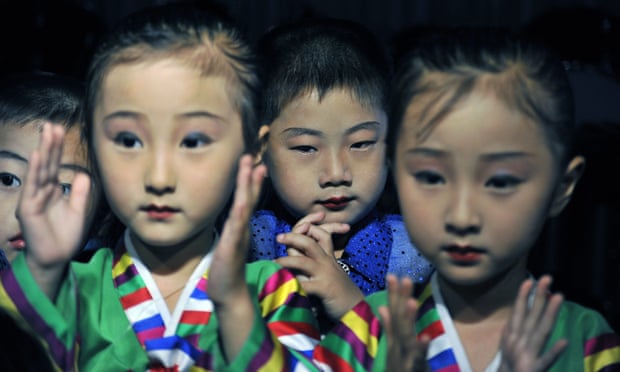
North Korean children finish a performance for foreign tourists to celebrate the 60th anniversary of Korean War. Photograph: Wu Hong/EPA
North Korean children finish a performance for foreign tourists
 to celebrate the 60th anniversary of Korean War.
Photograph: Wu Hong/EPA
Asking a person who risked their life to escape from North Korea why foreigners would pay to go on holiday there has a touch of the surreal.


Ji Min-kang, who fled the country after his grandfather, a government minister, was imprisoned and his family placed under surveillance, struggles to understand it.

“Outsiders can’t communicate with the citizens and the guides control all that they see,” says Ji. “You cannot see the real North Korea as a tourist.”

Yet despite tight restrictions and widespread human rights abuses, the number of people visiting North Korea is booming.

In 2005 – around the time Ji defected with his sister and mother – the number of western tourists was in the hundreds. Now 5,000 visit every year, say Koryo Tours, the biggest operator taking tourists to the isolated communist dictatorship. That number is still dwarfed by Chinese tourists, estimated to be 100,000 annually.

And the North Korean government wants more. In recent years it has opened new attractions such as the five-star Masikryong ski resort, the “tourist city” of Wonsan, and is training future tour guides at Pyongyang tourism college.

In June, they said by 2020 they want two million foreigners to be visiting annually.

A force for good?


The tour companies taking visitors in encourage the view that tourism is a positive thing, but the extent to which it helps remains difficult to unpick, with many remaining sceptical.

“If tourism were opening North Korea [up], over the 15-year span of this industry we ought to have seen some evolution in the restrictions and permissible exposure of foreigners to North Korean society,” says Joshua Stanton, founder of the OneFreeKorea blog. “[But] we haven’t.”

“Kim Jong-un has redoubled his efforts to isolate the majority of his people ... cracking down on cross-border cell phones, smuggling, and refugee flows,” he adds.

This is also the attitude held by the European Alliance for Human Rights in North Korea – who have supported defectors such as Ji. They argue that the tourism industry serves only “to fund and legitimise the regime”.

As destinations go, North Korea is unique. State guides will accompany you throughout and there is no deviation from the government-approved itinerary.

Trips aren’t cheap either – four nights can cost around £1,000 excluding flights – and it is a profitable enterprise for all involved.

But those working in the industry argue that the money trickling through to the government is small – and if they were to cease operations tomorrow the impact on the regime would be negligible.

‘Tourism helped the citizens of the USSR’


Andrei Lankov, a specialist in Korean studies who attended Pyongyang’s Kim Il-sung University in the 1980s but has since been blacklisted, supports the view that tourism can subtly undermine the authoritarian government.

He draws from his own experience growing up in a working class family in the Soviet Union and recalls seeing tourists from Finland, who would visit the USSR for the cheap alcohol. “We didn’t talk to them, but everybody saw how they dressed and how they behaved and nobody could view them as poor victims of capitalist exploitation,” he says.

A view of the Pyongyang skyline, taken by Danish photographer Ulrik Pedersen, who spent two weeks last year documenting a more colourful side to life in North Korea. Facebook Twitter Pinterest
A view of the Pyongyang skyline, taken by Danish photographer Ulrik Pedersen, who spent two weeks last year documenting a more colourful side to life in North Korea. Photograph: UkrikPedersenTransterra/Barcroft
“They showed a very high level of living and individual freedom. Not a single person had any doubt that people in western countries lived [a] better [life] than us.”

Lankov believes that a revolution in North Korea cannot be forced. He’s a proponent of slow evolution, in which tourism can play a “minor and marginal” role.

But Ji places less emphasis on the tourist connection. It’s easier than ever, he says, for North Koreans to get information from the outside from other means – radio transmissions from China and South Korea are the prime example.

Hyeonseo Lee, a North Korean activist and author of The Girl With Seven Names, the story of her escape in 1997, is equally cynical.

North Koreans can get in serious trouble for trying to talk to a foreigner about any substantive issues, so this is “hardly constructive engagement”, she says. Besides, most North Koreans who tourists meet in Pyongyang are part of the elite, with little incentive to resist.

“Tourists are used as propaganda,” says Hyeonseo. “They are required to bow to the large statue of our first dictator, Kim Il-sung”,and these images are used by “propagandists to show North Koreans that foreigners come from all over the world to pay homage to the Dear Leader.”

She adds: “This is an effective brainwashing technique for the North Korean people, who think that if foreigners are making a pilgrimage to respect the leader ... North Korea’s supremacy must be true.”

Hyeonseo is also critical of the tour companies. They have full access to information about the injustices of the regime yet still take people there, she says, “and profit in the process.”

Tour companies have full access to information about the injustices of the regime yet still take people there
Hyeonseo Lee
One of the first travel companies to specialise in trips to North Korea is Koryo Tours, founded in 1993, who take around 40% of the western visitors to the country.

Vicky Mohieddeen, creative projects manager for Koryo Tours, says that many more North Koreans are now employed as guides, coach drivers, restaurant workers and other jobs catering to the influx of tourists.

“They enjoy certain benefits because they work in the tourism industry,” she says. “They are healthy and enjoy the wages and benefits of working as a tour guide; they get to meet foreign people, practice foreign languages and they get a glimpse of the outside world.”

Gareth Johnson, founder of Young Pioneer Tours, believes the gentle requests from travel companies to take visitors to new locations has played a “huge role” in encouraging the North Korean government to relax.

“If you go back eight years ago to when I started, Americans weren’t allowed in the country at all,” he says. “If something opened – like the swimming pools, or the aquarium – you wouldn’t be allowed to go or you’d have to seek permission. Now, generally speaking if something opens you can.”

Visitors are also left with conflicted feelings. Ludovica Picone travelled to North Korea with Young Pioneer Tours in 2012. She describes the trip as a “propaganda tour de force”, but believes tourism can be educational. It’s not just about the North Koreans, but western tourists also “getting a better understanding the country and its ideology,” she says.

“It becomes very evident that the magnitude of the North Korean threat has been amplified by the media.”

Guardian journalist Peter Walker visited the country in 2003, travelling with Koryo Tours. “My feelings are mixed,” he says. “On the one hand you’re giving money to a regime which the UN has said bears moral equivalence to the Nazis. Against that, you’re arguably helping keep some North Koreans a bit in touch with the outside world.”

Tourists should ask themselves if they actually want to go, he says, adding “it’s the most depressing place I’ve ever been.”

“We’d had a performance by kids from a sort of state theatre school. I assumed the ones we met were about six or seven. It turned out they were 10 or older. Even as kids of the elite they’d been stunted by the famine” – which ravaged the country in the 1990s.

In terms of helping the outside world understand North Korea better, the people working for the tour companies have played a significant role as a news source, providing insights and tip-offs from within a country that has tight restrictions on journalists.

Though it ultimately serves to promote the tour operators, some of their work has been particularly impressive. Koryo Tours helped produce award-winning documentary the Game of Their Lives, about surviving members of North Korean 1966 World Cup team, who were adopted by football fans from Middlesbrough. “Such links are arguably vital in a discourse dominated by talk of war,” says Walker.

http://www.theguardian.com/travel/2015/oct/08/north-korean-tourism-ethics

Sep 1, 2015

N.Korean leader sends condolence letter to Moon’s family


Kim Jong Un maintains cordial relationship with family of Unification Church founder

August 31st, 2015
Ha-young Choi

North Korean leader Kim Jong Un has sent a condolence letter to the family of Unification Church founder Sun Myung Moon.

Moon, who founded Pyeonghwa (peace) Motors factory in North Korea, dedicated his life to inter-Korean exchanges. He died in early September 2012, leaving his widow Han Hak-ja the leader of the Unification Church.

On Sunday the North’s Korea Central News Agency (KCNA) revealed that the North Korean leader had contacted Han as the three-year anniversary of Moon’s death approaches.

“I sincerely express condolences to president Han Hak-ja and the bereaved family members on the anniversary of former president Moon Sun Myung’s passing,” the letter reads. “Moon has devoted himself to reconciliation of the nation and integration, unification and world peace. I hope president Han and the bereaved family members respect and follow Moon’s intention.”

The Family Federation for World Peace and Unification said the letter was sent via Kim Yang Gon, secretary of Workers’ Party of Korea and the director of the United Front Department, with condolence flowers.

Kim Jong Un has sent correspondence and flowers to Moon’s family before, including at his funeral on September 2012.

North Korea and the Unification Church have maintained strong ties, particularly in industry. In 2013, the Unification Church donated its control and stake in Pyeonghwa Motors to North Korea without receiving compensation.

Moon met Kim Il Sung in 1991, suggesting the Mount Kumgang development project, and established a tourism company.

Park Sang-kwon, current honorary president of Pyeonghwa Motors visited Pyongyang from August 24-28, meeting Kim Yang Gon on the 27th.

The Segye Ilbo, a South Korean newspaper which has ties to the Unification Church, has reported messages from Kim Yang Gon to South Korean government, delivered by Park Sang-kwon.

Kim Yang Gon reportedly said, “we are cautiously considering the divided families’ issue and have cancelled a quasi-war statement.” He added that “we will never break our promise, so please tell the South Korean government to build trust,” while criticizing a South Korean Ministry of National Defense official, who on Thursday, about the “plan of beheading North Korean main leaders, should North Korea indicate the use of nuclear weapons.”

Kim also called for the suspension of anti-North Korea leaflets, saying that “leaflets and loudspeaker broadcasts are not that different.”

Park Sang-kwon is Korean-American, having visited Pyongyang 220 times over 21 years, the Segye Ilbo reported.

In a May interview Han said she is considering when to visit North Korea.

http://www.nknews.org/2015/08/n-korean-leader-sends-condolence-letter-to-moons-family/

Mar 19, 2015

What I Learned From Teaching English In North Korea

March 18, 2015
Suki Kim
Ted

Born and raised in Seoul, Suki Kim posed as an English teacher at an all-male university in Pyongyang run by evangelical Christians; she spent six months teaching the 19-year-old sons of North Korea’s ruling class. In this excerpt from her book, she describes the experience.

“Essay” was a much-dreaded word among my students. It was the fall of 2011, and I was teaching English at Pyongyang University of Science and Technology in North Korea. Two hundred and seventy young men, and about 30 teachers, all Christian evangelicals besides me, were isolated together in a guarded compound, where our classes and movements were watched round the clock. Each lesson had to be approved by a group of North Korean staff known to us as the “counterparts.” Hoping to slip in information about the outside world, which we were not allowed to discuss, I had devised a lesson on essay writing, and it had been approved.

I had told my students that the essay would be as important as the final exam in calculating their grade for the semester, and they were very stressed. They were supposed to come up with their own topic and hand in a thesis and outline. When I asked them how it was going, they would sigh and say, “Disaster.”

Pyongyang University of Science and Technology, 2011.
Suki Kim teaching a class at  Pyongyang
 University of Science and Technology, 2011.
I emphasized the importance of essays since, as scientists, they would one day have to write papers to prove their theories. But in reality, nothing was ever proven in their world, since everything was at the whim of the Great Leader. Their writing skills were as stunted as their research skills. Writing inevitably consisted of an endless repetition of his achievements, none of which was ever verified, since they lacked the concept of backing up a claim with evidence. A quick look at the articles in the daily paper revealed the exact same tone from start to finish, with neither progression nor pacing. There was no beginning and no end.

So the basic three- or five-paragraph essay — with a thesis, an introduction, a body paragraph with supporting details, and a conclusion — was entirely foreign to them. The idea they had the most difficulty comprehending was the introduction. I would tell them that it was like waving hello. How do you say hello in an interesting way, so that the reader is “hooked”? I offered many different examples, but still they would show up during office hours, shaking their heads and asking, “So this hook … what is it?”

Instead of a lesson on sources, which was not possible there, I asked that they read a simple essay from 1997 that quoted President Bill Clinton on how important it was to make all schools wired. The counterparts had approved it because it related to our current textbook theme of college education. I hoped that they would grasp the significance of the Internet and how behind they were. I also gave them four recent articles — from the Princeton Review, the New York Times, the Financial Times, and Harvard Magazine — that mentioned Mark Zuckerberg, Facebook and Twitter. None of the pieces evoked a response. Not even the sentence about Zuckerberg earning $100 billion from something he dreamed up in his college dorm seemed to interest them. It was possible that they viewed the reading as lies. Or perhaps the capitalist angle repelled them.

The next day, several students stopped by during office hours. They all wanted to change their essay topics. Curiously, the new topics they proposed all had to do with the ills of American society. One said he wanted to write about corporal punishment in American and Japanese middle schools. Another handed me a revised thesis: “Despite the harmful effect of nuclear weapons, some countries such as the United States keep developing nuclear weapons.” A third student wanted to write about the evils of allowing people to own guns so freely, in America. A fourth student asked me which country produced the most computer hackers; he had been taught that it was America. A fifth wanted to change his topic to divorce. There was no divorce in the DPRK, but in America the rate was more than 50 percent, and divorce led to crime and mental illness, according to him. “So what happens when people are unhappy here after being married for a while?” I asked. The student looked at me blankly. Still another student wanted to write about how McDonald’s was horrible. The same student then asked me, “So what kind of food does McDonald’s make?”


One thing was clear. Their collective decision to switch their essay topics to condemn America seemed to have been compelled by the articles about Zuckerberg. What I had intended as inspirational, they must have viewed as boasting and felt slighted. The nationalism that had been instilled in them for so many generations had produced a citizenry whose ego was so fragile that they refused to acknowledge the rest of the world.

My efforts to expand their awareness kept backfiring. When I had them write a paragraph about kimjang (the annual kimchi-making tradition), I was handed a pile of preachy, self-righteous tirades. Almost half the students claimed that kimchi was the most famous food in the world, and that all other nations were envious of it. One student wrote that the American government had named it the official food of the 1996 Atlanta Olympics. When I questioned him, he said everyone knew this fact, and that he could even prove it since his Korean textbook said so. A quick Internet search revealed that a Japanese manufacturer had claimed that kimchi was a Japanese dish and proposed it as an official Olympic food, but had been denied. Somehow this news item had been relayed to them in twisted form and was now treated as general knowledge.

To correct my students on each bit of misinformation was taxing and sometimes meant straying into dangerous territory. Another teacher said, “No way. Don’t touch that. If their book said it was true, you can’t tell them that it’s a lie.”

This photograph was taken with a North Korean student at Kim Il-sung University campus. Note the statue of Kim Il-sung, who ruled North Korea from 1948 until his death in 1994.

Sometimes they would ask why I never ate much white rice. They piled their trays with huge heaps of it at every meal, whereas I always put just a little on my tray. I explained that I liked white rice but did not care for it all the time. They asked what kinds of food I ate other than rice and naengmyun, their national dish. I couldn’t exactly go on about fresh fruit smoothies and eggs Benedict, so I named two Western dishes I knew they had heard of: spaghetti and hot dogs. I knew that North Koreans enjoyed their own version of sausage because I had seen them lining up for it at the International Trade Fair. One of the students then wrote in his kimjang homework, “Those Koreans who prefer hot dogs and spaghetti over kimchi bring shame on their motherland by forgetting the superiority of kimchi.” Nothing, it seemed, could break through their belligerent isolation; moreover, this attitude left no room for any argument, since all roads led to just one conclusion. I returned the paper to him with a comment: “Why is it not possible to like both spaghetti and kimchi?”

After several lessons on the essay, a student said to me at dinner, “A strange thing happened during our social science class this afternoon.”

They never volunteered information about their Juche class, so I listened intently.

The student continued, “We had to write an essay!” He explained that they normally wrote short compositions in Korean and he had never thought of them as essays before, but now he did, and it made him feel strange.

“What was so strange?” I asked.

“I don’t know,” he said, pausing thoughtfully. “I looked at it as an essay, and I realized that it was different now. Writing in English and writing in Korean are so different, but then it is also the same, and I kept thinking of the essay structure as I was writing it, and it made me feel strange.”

PUST students on a snowy day after an exam; Kim Jong-il’s death would be announced just a few days later. 
PUST students on a snowy day after an exam; Kim Jong-il’s death would be announced just a few days later.

I did not question him further, but I thought I understood. It must have been deeply confusing to approach his writing on Juche like an essay. In his country there was no proof, no checks and balances — unless, of course, they wanted to prove that the Great Leader had single-handedly written hundreds of operas and thousands of books and saved the nation and done a miraculous number of things. Their entire system was designed not to be questioned, and to squash critical thinking. So the form of an essay, in which a thesis had to be proven, was antithetical to their entire system. The writer of an essay acknowledges the arguments opposing his thesis and refutes them. Here, opposition was not an option.

I stared across at him and felt a familiar sick feeling. Perhaps this was only the beginning. The questions they would have. The questions they should be asking. The questions they would realize they had not been asking because they did not imagine they could, or because asking meant that they could no longer exist in their system.

This is an excerpt from Without You, There Is No Us, Suki Kim’s memoir of teaching English in North Korea during the last six months of Kim Jong-il’s reign.

http://ideas.ted.com/what-i-learned-from-teaching-english-in-north-korea/

Jan 17, 2015

North Korea begins brainwashing children in cult of the Kims as early as kindergarten

Washington Post
Anna Fifield
January 16, 2015
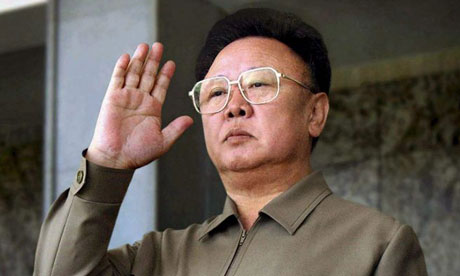
Kim Jong Il picture
 When Jeon Geum-ju was a girl in Hoeryong, a depressing mining town at the very northern reaches of North Korea, she used to sing at school about the country's supreme leader.
"Kim Jong Il, how hard he works, he works so hard that he sleeps in the car and just eats rice balls," sang Jeon, now 29, sitting in a restaurant here trying to recall the words that were once ingrained into her. "On his desk there are piles and piles of reports that he has to read and approve. He works so hard for us, the people."
And when Lee Hyun-ji, 19 and also from the country's north, was in elementary school, learning to throw wasn't a simple matter of pitching a ball.
In gym class, there was a wooden target of a human figure with pale skin and a huge nose, with "cunning American wolf" written on it. Lee and her young schoolmates would practice their throwing with a wooden "grenade."
For North Korea's dynastic Kim regime, citizens are never too young to be indoctrinated. Indeed, an all-encompassing personality cult has kept the country intact even as the Soviet Union collapsed and as China and Cubahave opened up.

Inside North Korea

With its pudgy leaders and their comical haircuts, its goose-stepping soldiers and its inventive turns of phrase, this bastion of totalitarianism has provided endless opportunity for mockery, most recently with the controversial U.S. film "The Interview."
Although critics have questioned its artistic merits and defectors have lamented the way it makes fun of North Koreans, the movie targets a central tenet of Kimist mythology: the idea that the North's leaders are divine beings. The crucial moment in the film is not the death of Kim Jong Un but earlier, when a talk show host interviews Kim and taps into his daddy issues, leading the young dictator to start blubbering, "I am strong," revealing him to be not only human but also insecure.
The personality cult that permeates every aspect of North Korean life has become an ideology in itself. It revolves around Kim Il Sung, portrayed as
an anti-Japanese revolutionary hero and founding father who remains North Korea's "eternal president" more than two decades after his death.
His son, Kim Jong Il, was, according to North Korean myth, born on a sacred mountain, under a bright star at night. (In reality, he was born in Siberia.) Since Kim Jong Il's death in 2011, Kim Jong Un has taken over the family business.
"I believed in this system for more than 20 years, but I was so thirsty to find out about the outside world," said Jeon, who now lives in South Korea and works in an office. Her curiosity led her to decide to sneak across the border to China. "Then, when I realized it was all lies, it was like I was just born at 23 years old. Twenty-three years had been stolen from my life."
365 days' worth of Kims
In North Korea, there is no escaping the Kims. Every home, office, classroom and even train car features portraits of the first two leaders, and the pictures must be cleaned with a special cloth every day.
North Koreans wear pins, usually of Kim Il Sung but sometimes of both Kim One and Kim Two, on their chests, on the left to be close to their hearts.
Television sets and radios are fixed to state-run channels — being caught with an unfixed device, or worse, foreign DVDs, is a severe offense that often leads to time at a labor camp — and for all but a handful of the elite, there is no Internet. Although an increasing amount of information seeps across the border from China, the state continues to have almost total control over the flow information.
After years of futile efforts to stop North Korea from developing nuclear weapons, the international community is now focused on human rights violations there. Unprecedented attention is being given to political imprisonment and executions.
More pervasive, but less obviously gruesome, is the way the regime brainwashes children from an early age to believe in the Kims as godlike leaders.
This indoctrination program has two basic goals, according to a groundbreaking 372-page report published last year by a U.N. commission of inquiry: to instill utmost loyalty and commitment toward the supreme leader, and to instill hostility and deep hatred toward the United States, Japan and South Korea.
The brainwashing starts in kindergarten.
"The milk would arrive and we would go up one by one to fill our cups," recalled Lee, who came to South Korea only in March and asked to use a pseudonym to protect her family in the North.
"The teachers would say: 'Do you know where the milk came from? It came from the Dear Leader. Because of his love and consideration, we are drinking milk today,' " said Lee, looking every bit a South Korean with her dyed hair and trendy sweater.
"I didn't really ask questions," she shrugged. "Somehow I just knew not to."
Children's books convey the ideology, too. "The Butterfly and the Cockerel," for example, tells the story of an irascible, bullying rooster (the United States) outwitted by a small, virtuous butterfly (North Korea).
Teachers don't just teach history, they teach "revolutionary history." And all music, storybooks, novels and artwork relate to the Kims.
"When I taught math problems, they would go like this," said Chae Kyung-hee, who used to teach middle school in North Korea and now runs a school for defectors in Seoul. "If you have this many of Kim Il Sung's anti-Japanese fighters and this many Japanese soldiers, and X-many Japanese soldiers are killed . . ."
There are 365 days' worth of education materials, so every day teachers could say to their students, "On this day, Kim Il Sung went there, did that." At age 7, all children must join the Children's Union. The next year, they start Saturday "self-criticism" sessions in which they must confess how they fell short of the "Ten Principles" that are the foundation of North Korea's ideology. The principles include requirements such as studying the "revolutionary ideas of Great Leader Comrade Kim Il Sung" daily.
At 14, they move up to the Kim Il Sung Socialist Youth League, which focuses on worshiping the Kim family.
High school students in North Korea must complete a three-year, 81-hour course on the history of Kim Jong Un, according to a recent report from South Korea's KBS World Radio, which cited a copy of the North Korean Education Committee's "compulsory education outline." The course is in addition to a 160-hour course on Kim Il Sung and 148 hours of study about Kim Jong Il.
Social molding
Tatiana Gabroussenko, an expert on North Korean literature who teaches at Korea University in Seoul, said that by not allowing people to form their own opinions, North Korea infantilizes its citizens.
"North Korea molds children socially," Gabroussenko said. Books for different generations have different styles but the same message and characters, sometimes involving South Korean "stooges" or American "beasts."
"In the children's version, a child will be fighting Americans by throwing pepper in their eyes and making them sneeze and cough," Gabroussenko said. In the adult version, weapons, rather than condiments, are used.
"The message 'We are one nation' implies that you can't rebel against your father, you can't rebel about your government, that it's important to stick together," she said.
Indeed, the system of surveillance and informing on people is so pervasive that husbands dare not voice doubts about the regime to their wives, and parents, if they are skeptical, dare not try to protect their children's minds.
"My parents were very loyal," said Ji Sung-ho, a 31-year-old who lost a foot and an arm as a teenager when he fell from a moving train while trying to steal coal for his family. "I think my parents really believed it, even when people were dying of hunger."
The U.N. report concluded that the system of indoctrination and surveillance constitutes numerous human rights abuses, including violations of the freedoms of thought, expression and religion. To some, those violations are just as inexcusable as the executions, torture, infanticide and other abuses documented in the report.
"Of course, you can talk about torture and labor camps," said Jeon, the defector, "but I think a more serious infringement of human rights is not giving people any choice to think for themselves or giving them access to outside information."


Anna Fifield is The Post's bureau chief in Tokyo, focusing on Japan and the Koreas. She previously reported for the Financial Times from Washington DC, Seoul, Sydney, London and from across the Middle East.