Showing posts with label Shen Yun Performing Arts. Show all posts

Mar 12, 2024

'Shen Yun' slides anti-Beijing message into colourful dance

France 24
March 13, 2024

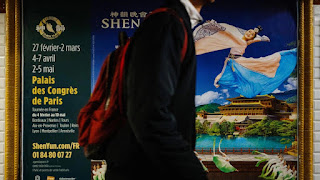
The Shen Yun Performing Arts company has slipped the beliefs of a spiritual movement called Falun Gong in between its technicoloured visuals and leaping dancers since 2006, with advertising for the show so ubiquitous that it has become an internet meme in recent years.

Founded in 1992, Falun Gong claims nearly 100 million followers and has been subject to "persistent persecution" in China, according to a January 2024 European Parliament resolution.

Shen Yun aims to "revive 5,000 years of traditional Chinese culture", which the group says Beijing has nearly succeeded in destroying.

Atheism, evolution, and the Chinese Communist Party (CCP) are just some of the topics targeted during the show's roughly two-hour run time.

China banned Falun Gong, which it calls an "evil cult", in 1999 after 10,000 members peacefully demonstrated outside a government building in Beijing.

But the movement has found a global audience, performing Shen Yun in cities across the world every year and generating revenues of $46 million in 2022 alone, according to the ProPublica investigative news site.

– 'Greater forces at work' –

In front of some 2,000 spectators in the French city of Tours, a soprano sings to a divine power, castigating "modern thoughts" that are "corrupting" humanity.

The audience then watches as Chinese police chase peaceful demonstrators before one of the officers has a change of heart, becoming "aware that greater forces may be at work", according to the programme.

The demonstrators portrayed in the scene are members of Falun Gong -- but adverts for the performance do not spell this out.

"Shen Yun is obviously a facade to promote Li Hongzhi's ideas and recruit new members," said Marc Lebranchu, a researcher in traditional Chinese practices at the Ecole Pratique des Hautes Etudes in Paris.

Li Hongzhi, the founder of Falun Gong, is a controversial figure who fled China in 1998, seeking political asylum.

In a 1991 Time magazine interview, Hongzhi portrayed himself as the saviour of humanity and claimed aliens were trying to replace humans.

French anti-cult association Unadfi said the movement's leader has made racist remarks about those with multiracial backgrounds and in a 2017 report accused Falun Gong of having "less than tolerant views of homosexuality".

However, Unadfi spokesperson Pascale Duval said no similar accusations have been levelled in France "for at least five or six years".

The group has also been criticised for its proximity to the ultra-conservative movement in the United States.

Between 2018 and 2019 a Falun Gong-affiliated media outlet called The Epoch Times paid more than $1.5 million for around 11,000 pro-Trump ads on Facebook over a six-month period, some of which peddled conspiracy theories, according to NBC News.

AFP made several attempts to contact Falun Gong's French-based branch but did not receive a response.

– 'Systematic persecution' –

Beijing initially saw the movement's promotion of qi gong -- a gentle exercise from traditional Chinese medicine -– as a low-cost way to maintain public health, but the Chinese regime banned the group when it started to threaten the CCP's dominance.

Since then, "tens of thousands of Falun Gong practitioners have been arbitrarily detained, many of them tortured", according to Amnesty International.

In January 2024, the European Parliament accused the CCP of engaging in "systematic persecution to eradicate the Falun Gong religious movement".

China has repeatedly faced accusations of forced organ harvesting from prisoners and in particular, members of Falun Gong.

The Chinese consulate in France's southern city of Marseille called these claims "fabricated" and urged French audiences to "stay away" from Shen Yun last year, calling it a "political tool".

Chinese authorities have made several attempts -- some successful -- to force the cities to cancel Shen Yun performances.

In 2008, the Chinese Embassy in Sweden lobbied the city of Stockholm to ban the show, but the city told AFP that the attempt was unsuccessful.

They had more luck in South Korea in 2016 when a court issued an order cancelling shows over financial threats from the Chinese embassy.

Edouard, a 67-year-old retiree, was too "dazzled by the juxtaposition of the dancers and visuals" to notice any controversy during the show in Tours.

He told AFP that he had never heard of the persecution of Falun Gong, but after seeing the show, he seemed convinced.

"It's a reality, and it needs to be known," he said.

https://www.france24.com/en/live-news/20240312-shen-yun-slides-anti-beijing-message-into-colourful-dance

Oct 24, 2022

Canada's Oscar Entry Is About Chinese Censorship. So Why Does It Peddle Another Propaganda?

Jason Loftus' animated documentary tells a political story about a group of Falun Gong members who hijacked China's state TV in 2002, but that’s only part of the story.


Jude Dry
IndieWire
October 21, 2022

In the strategic maneuverings of Oscar season, betting on primacy in recency is always smart. Hoping to capitalize on last year’s immense love for “Flee,” the first film to be nominated for Best Animated Feature, Best International Feature, and Best Documentary at the Academy Awards, Canada chose a politically bold animated documentary as its official entry. Apparently, nobody at the National Film Board of Canada knows about Wikipedia.

Directed by Jason Loftus, “Eternal Spring” uses beautiful 3-D drawings to animate the story of a 2002 state TV hijacking by members of Falun Gong, a religious group that was brutally censored in the late-’90s/early aughts. Drawing from childhood memories, artist Daxiong imbues the story with an emotional heft as he reframes his feelings about the religion.

Taken on its own, it’s a stirring portrait of political dissidents fighting for religious freedom — but the film makes no mention that the religion currently peddles a host of far-right conspiracy theories including QAnon, anti-vaccine misinformation, and disparages evolution, atheism, and homosexuality. Unfortunately for the film’s creative merits, art does not exist in a vacuum.

Falun Gong (or Falun Dafa) originated in the Northeastern city of Changchun, where Daxiong was born and raised. Classified as a new religious movement, the meditation-based practice blends Buddhist and Taoist traditions with qigong-style exercise (though it would later quarrel with qigong groups). Initially embraced by the Chinese government, attitudes changed as the movement gained widespread popularity at home and abroad. By 1999, the full weight of China’s state-sponsored media and government surveillance came down on the practice, causing many members to eventually flee the country.

“Eternal Spring” tells the story of the TV takeover. On March 8, 2002, a group of practitioners based in Changchun hijacked state TV to broadcast footage of Falun Gong being practiced around the world and praised as a positive religion based in love. After setting the stage for Daxiong’s personal connection to the religion, the film follow the artist as he interviews surviving members of the TV takeover, sketching their likenesses with swift accuracy. Loftus introduces the various players like avatars in a video game, which replay when their voices are heard, making it simple to follow and connect with each character. Daxiong’s drawings are then transposed into sweeping 3-D animation to tell the story, which unfolds at an engaging heist thriller clip.

Shifting seamlessly from present day interviews to lyrical animation, “Eternal Spring” offers a neat window into the making of the film while stirring empathy and connecting the story to today, with some obvious caveats. A man cries after seeing an animated version of the home he can never return to, highlighting the human toll taken in the brutality of the Chinese government. Sadly, many of the key players in the TV takeover did not survive their long prison sentences or tortures. With Daxiong’s detailed faces and the descriptive narration, the animation is able to bring them back to life, though their absence in the live portions is a somber warning.

One figure who stands out is called Big Truck. Described as a former ruffian who changed his ways after finding Falun Gong. His hulking frame fills the story with a gentle giant humility, and his heroic tale of escaping from prison is inspiring. Liang is dubbed The Mastermind, a respected local leader who organized the hijacking. A beautiful scene arises from one of his more creative protests, as banners proclaiming “Falun Gong is good” float high above the city on helium balloons. When an official pops a balloon, yellow paper flyers sprinkle down like confetti.

The film ends with a mournful postscript detailing how and where these figures perished, mostly in prison or from injuries sustained there. As their photos appear alongside their fates, it is striking to think how easily names and numbers fade into oblivion. How many people are currently suffering in Chinese prisons, and who will tell their stories? Enacted with the utmost care, “Eternal Spring” feels like a sacred reckoning, salvaging a courageous act of political protest from the obscurity of time and propaganda. But that was then.

Today, Falun Gong is known for owning and operating The Epoch Times, “a multi-language newspaper that opposes the Chinese Communist party, promotes far-right politicians in Europe, and has championed former President Donald Trump in the U.S.,” according to Wikipedia. “The Epoch Media Group’s news sites and YouTube channels have spread conspiracy theories such as QAnon and anti-vaccine misinformation, and false claims of fraud in the 2020 United States presidential election. In 2020, The New York Times called it ‘a global scale misinformation campaign.'”

“Eternal Spring” would not be the first time that Falun Gong used art to peddle its messages. Falun Gong also operates its own TV station, New Tang Dynasty, and Shen Yun Performing Arts, a U.S.-based entertainment company. All of these entities are overseen by Falun Gong founder Li Hongzhi, whose appears in the film as a trusted interview subject, despite publicly espousing views that aliens walk the earth.

The story of “Eternal Spring” deserves to be told, but truthfully — Loftus’ film, however, is a victim of the very kind of insidious propaganda the members of Falun Gong once tried to fight.

Grade: D

“Eternal Spring” is now in select theaters.


https://www.indiewire.com/2022/10/eternal-spring-review-canada-oscar-chinese-censorship-1234774943/

Feb 28, 2022

CultNEWS101 Articles: 2/28/2022 (Greg Locke, Northridge Church, Clergy Sexual Abuse, Legal, In Sinu Jesu, Spiritual Abuse, Shen Yun, Falun Gong, China)

Greg Locke, Northridge Church, Clergy Sexual Abuse, Legal, In Sinu Jesu, Spiritual Abuse, Shen Yun, Falun Gong, China

Controversial Tennessee preacher Greg Locke has turned from claims of election fraud to conversations with demons.

" ... In recent years Locke has used his sermons to attack LGBTQ people, accuse Democratic politicians of child abuse, spread claims about election fraud, denounce vaccines and claim that the COVID-19 pandemic is a hoax. During Sunday's sermon, he blamed witchcraft for an outbreak of illness in the church."

" .... Two of the witches were in his wife's Bible study, '' said Locke, who warned the alleged witches not to make a move during his sermon. He then retold the New Testament story of Jesus casting a demon out of a man and into a herd of pigs, turning it into an extended monologue about witches in the church."
"The senior pastor of a rural Minnesota church and his wife have resigned amid mounting allegations of abuse and cover-up by family members on the church staff.

Mark Perryman reportedly resigned last Sunday from Northridge Church, an Assemblies of God congregation in Owatonna, Minnesota. His resignation came less than a week after his son-in-law, former associate pastor Sean Masopust, was charged with criminal sexual conduct."
"On Friday of last week, Irish blogger Pat Buckley reported that four men have come forward with allegations including boundary violations, spiritual abuse, and sexual harassment against Dom Mark Kirby of Silverstream Priory, the author and alleged visionary behind the popular devotional book In Sinu Jesu. These new allegations follow a lengthy August 2021 interview with Fr. Benedict Andersen in the Pillar.

Fr. Andersen is a Silverstream monk who is currently in canonical limbo, unable to minister as a priest after his complaints of inappropriate behavior and spiritual abuse by Fr. Kirby resulted in an apostolic visitation of the priory. Formerly the sub-prior of the community, Andersen was the first person to publicly bring forward allegations against Kirby, although stories about Kirby's past and his allegedly abusive treatment of his subordinates had been circulating for years.

If these new allegations are true, it appears that Fr. Andersen has been vindicated. Not only was he mistreated by Fr. Kirby, but his treatment by the diocese has been unjust."
" ... This dance company, whose name roughly translates to "Divine Rhythm," performs under the auspices of Falun Gong, also known as Falun Dafa, a spiritual practice drawing on the Chinese Buddhist and Daoist traditions. Followers practice qigong, meditation, and moral philosophy with the aim of achieving spiritual enlightenment. Uniquely among qigong practices, however, this school incorporates apocalyptic and messianic elements centered around founder Li Hongzhi—a battle for human consciousness between the enlightened and space aliens (!) to be followed by an impending judgment day.

While practitioners are instructed to be opaque about Li's teaching with the uninitiated, what can be found about Falun Gong's beliefs is a bit concerning. Li has claimed that alien life forms intend to displace humanity with clones and that scientific development is the result of alien interference. He has further claimed that race-mixing in humans is an alien plot to drive humanity further from God and that heaven is racially segregated. Li apparently so despises miscegenation that he has been recorded as saying: "When a child is born from an interracial marriage, that child does not have a heavenly kingdom to go to."

Among other regressive tendencies, anti-communism is a central tenet of Falun Gong. Shen Yun performances have regularly incorporated explicitly anti-communist and anti-Communist Party of China messaging. In 2019, Shen Yun's performance even included an act in which "Chairman Mao appeared, and the sky turned black; the city in the digital backdrop was obliterated by an earthquake, then finished off by a Communist tsunami. A red hammer and sickle glowed in the center of the wave."

As Shen Yun so campily demonstrated, Falun Gong has a long and strained history with communism. Since being banned in China in 1999, the organization and its media outlets have lambasted the Communist Party there, claiming severe and unjust religious persecution, backed up with ample help from Western media until recent years."

News, Education, Intervention, Recovery


CultEducationEvents.com

CultMediation.com   

Intervention101.com to help families and friends understand and effectively respond to the complexity of a loved one's cult involvement.

CultRecovery101.com assists group members and their families make the sometimes difficult transition from coercion to renewed individual choice.

CultNEWS101.com news, links, resources.

Facebook

Flipboard

Twitter

Instagram

Cults101.org resources about cults, cultic groups, abusive relationships, movements, religions, political organizations and related topics.


Selection of articles for CultNEWS101 does not mean that Patrick Ryan or Joseph Kelly agree with the content. We provide information from many points of view in order to promote dialogue.


Please forward articles that you think we should add to cultintervention@gmail.com.


Feb 1, 2022

What is Shen Yun, and why am I seeing it everywhere?

What is Shen Yun, and why am I seeing it everywhere?
Ben Gilliam

WJHL
January 31, 2022

JOHNSON CITY, Tenn. (WJHL) – If you’ve been running the road, surfing the Internet or frequenting the Tri-Cities restaurant circuit in the last few months, you may have noticed advertisements for a certain performance popping up everywhere.

“Shen Yun: China Before Communism” is coming to the Tri-Cities on Tuesday, and according to event listings, performers will bring “a unique blend of stunning costuming, high-tech backdrops, and an orchestra like no other.”
China: Ancient and Modern

Shen Yun Performing Arts, Shen Yun for short, is a traveling non-profit performance troupe with several essential selling points. According to their site, Shen Yun shows aim to recapture ancient Chinese culture in ways that are no longer possible in mainland China.

Alongside traditional dances and musical stylings, Shen Yun promises a sampling of several dynasties across Chinese history. The production also utilizes a large digital screen as a backdrop to add depth and scale to smaller groups of performers.

Classical Chinese dance is described by the organization’s website as a comprehensive dance system dating back thousands of years, and Shen Yun is slated to bring the art form’s “purest” presentation to the region.

China vs. Shen Yun

According to their website, Shen Yun was founded in 2006 in order to “revive the essence of Chinese culture.”

Shen Yun Performing Arts Inc. non-profit documents specify that the corporation was created to “carry forward the goodness of FLDF and universal principle of Truth, Compassion and Forbearance, to bring together talented artists of different nationality to revive the true, five-millennia-old artistic tradition.”

In this case, FLDF stands for Falun Dafa, or Falun Gong, a health and spiritual movement that was banned in the People’s Republic of China in 1999 after being labeled a cult and banned from practice.

“What had happened in China before is there was a little bit of emphasis on traditional ideas and philosophy after the communists took over,” ETSU professor Dr. Henry Antkiewicz said. “So there was some interest in traditional things in China, one of them was an exercise practice called Qi Gong, and this was very popular in the 1980s. And this became the basis for the development of Falun Gong.”

Dr. Antkiewicz is a history professor with a focus on Eastern Europe, Russia, China and Japan. Throughout his career, Dr. Antkiewicz accompanied ETSU students to China in connection to a sister university overseas. Several years ago, he had the chance to try Qi Gong, and found it interesting as an exercise.

“You had to register organizations, so Li Hongzhi registered Falun Gong and that was really big for the rest of that decade.” Dr. Antkiewicz said. “It became extremely popular in the country. The authorities estimated that the membership was about 70,000 people.”

As numbers began to rise, so too did Falun Gong’s impact on local government and party members. In 1999, tensions between the Communist Party of China (CCP) and Falun Gong came to a head.

“Of all things, they performed a vigil in front of the compound where the communist party leaders lived in the center of Beijing,” Dr. Antkiewicz said. “Now, this is right next to the Forbidden City, that palace of the former emperors, so this a very important place in town.”

The vigil gathered around 10,000-15,000 people, who then remained in the plaza without much more of a word.

“It didn’t irritate anybody, they didn’t pass out leaflets or anything like that, but they made their presence known,” Dr. Antkiewicz added. “And this frightened the authorities because you’re not supposed to do this. Only the communist party is there to organize people, if somebody else is doing the organizing, then it could develop in suspicious directions.”

In response to the gathering, the practice and teaching of Falun Gong was banned. Two years prior to the incident, Li Hongzhi, the founder and leader of Falun Gong today, left China seeking asylum within the United States.

“The peaceful demonstration of the Falun Gong did not look like it was threatening at all,” Dr. Antkiewicz said. “But this is enough to frighten people who want control – complete control – of politics and [to] make sure things are going their way.”

Once Falun Gong’s practice was banned and continuing practitioners began entering the prison system, rumors began floating out of China that many were mistreated or abused.

“There has been talk about people suffering under the prison system, and other nefarious things happening to them.” Dr. Antkiewicz said.

In June of 2021, the UN Human Rights Commissioner detailed multiple allegations by over a dozen UN researchers, stating that they had received credible reports that “forced organ harvesting in China appears to be targeting specific ethnic, linguistic or religious minorities held in detention, often without being explained the reasons for arrest or given arrest warrants.”

According to the report, groups targeted for organ harvesting included Falun Gong practitioners, Uyghur minority members, Tibetans, Muslims and Christians. The report states the issue had previously been raised with the Chinese government in 2006 and 2007 without much evidence of change.

Falun Dafa? Organ Harvesting? What does that have to do with dancing?

For members of Shen Yun Performing Arts, spirituality goes hand-in-hand with performance. According to their site, every member of Shen Yun is a practitioner of Falun Dafa drawing from divine sources.

“Throughout history, almost every culture looked toward the divine for inspiration,” their materials read. “Art was meant to uplift, bringing joy to both the people who created and experienced it. It is this principle that drives Shen Yun performers and their art.”

The dance itself is a method to both practice and preach Falun Dafa, in a way. Founder Li Hongzhi says the act of Shen Yun, literally translated to the beauty of divine beings dancing, is a way to “offer deliverance in the human world.”

In addition to the spiritual perspective of performers, the show has a political drive as well. Marketing materials state the show itself is designed to bring awareness to the plight of Falun Dafa members within mainland China, including the aforementioned allegations of organ harvesting. Shen Yun materials allege that the CCP has targeted the show within the United States in an attempt to silence the performance.

While this may seem like a far cry from the beautiful backdrops and movements slated for the Martin Center, Shen Yun states that the act is as much preservation as it is performance.

“Classical Chinese dance dates back thousands of years,” Shen Yun’s website says. “Dynasty after dynasty, it was enriched and refined, becoming one of the world’s most comprehensive dance systems. In China today, it’s regularly mixed with military or modern dance styles to the point that people don’t know what exactly they’re watching. Only Shen Yun performs classical Chinese dance in its purest form, preserving its traditional aesthetic the way it was originally passed down.”

Falun Gong/Dafa’s founder Li Hongzhi defines Classical Chinese dance in Shen Yun materials, outlining an ongoing struggle between the troupe and the Beijing Dance Academy for control over the art form’s direction.

“There’s an issue of what is ‘traditional’ in China, and let’s say traditional dance,” Dr. Antkiewicz said. “If you travel to China, particularly if you go to where the Terracotta Warriors were in the first empire 2000 years ago in Xi’an, China, there are performances there that you can see of what they consider to be traditional dance.”

From a historical lens, however, Dr. Antkiewicz said there may be lost details and distortions of the art that haven’t reached modern audiences from either camp.

“What I think the Falun Gong is doing with their Shen Yun group, that dance troupe, is to show that they have this kind of a connection to Chinese antecedence. They choreograph their material as well, they make their costumes as historic as they possibly can make it, but there’s a very long timespan that has elapsed.”

And how did this end up at ETSU?

This particular show is brought to campus by the Tennessee Falun Dafa Association based in Memphis, which has been in operation as a 501(c)(3) nonprofit since 2011, according to ProPublica records.

News Channel 11 staff have reached out to both Shen Yun Performing Arts and the Tennessee Falun Dafa Assoc. for comment regarding their expectations for Johnson City, but have not been contacted in return.

As to their use of the Martin Center for Performing Arts, ETSU Senior Director of Strategic Communications Joe Smith said Shen Yun rented the facility as one of several touring productions and special events that utilize the venue. No one at the university is connected to the show, Smith said, including student organizations.


https://www.wjhl.com/news/local/what-is-shen-yun-and-why-am-i-seeing-it-everywhere/

Jan 16, 2021

Epoch Times, one of Trump's favorite 'news' sources, is linked to Shen Yun

Katie Dowd
SF Gate
January 4, 2021

"If the ubiquity of Shen Yun advertising has dulled somewhat during the global pandemic, perhaps you’ve noticed something else taking its place.

You might have endlessly seen their ads on YouTube. Or maybe you even saw President Donald Trump himself promoting it. Although not yet as ever-present as a Shen Yun billboard, the Epoch Times is steadily expanding its footprint — along the way becoming one of Trump’s preferred "news" outlets.

The website looks like your standard news source, but a note at the top of the screen is your first indicator this is not a CNN wannabe.

"At a time when legacy media outlets are IGNORING credible allegations of ELECTION FRAUD across America, we are giving you, your family and your friends, unlimited access to almost all of our reporting for free so that you can be truly informed, until a president is legally elected," it reads, before a solicitation to enter your email address to “continue reading.”

The Epoch Times is now one of the most prolific peddlers of pro-Trump propaganda on the internet, but it began life as the media arm linked to Falun Gong, the same Chinese spiritual movement that puts on Shen Yun dance performances."

Continue Reading: https://www.sfgate.com/politics/article/what-is-Epoch-Times-Falun-Gong-15839640.php   

Apr 11, 2016

Falun Gong, banned in China, finds a loud protest voice in the U.S. through Shen Yun dance troupe

Jessica Gelt 
Los Angeles Times

April 9, 2016

 
Falun Gong
Shen Yun Performing Arts
The cavernous Long Beach Terrace Theater echoes with classical Chinese music as more than a dozen dancers expertly manipulate colorful fans that sweep like wind and snap like fire. In precise formation they coalesce into a river of dance inspired by Chinese history, legend, myth and literature.

The performers are serious and determined. The only direction they receive comes from a calm woman dressed in black, standing near the theater's center. She speaks in Mandarin — her words few, her manner direct.

It's rehearsal time for Shen Yun Performing Arts, a touring dance troupe founded in New York by practitioners of Falun Gong, the spiritual practice banned by the Chinese Communist Party in 1999.

The party calls it a cult; Falun Gong says the Chinese government is trying to eradicate thousands of years of culture and tradition and that its repression of Shen Yun shows an intolerance of freedom of expression and religion. Indisputably, the dance company — marking its 10th anniversary — has become a cultural phenomenon.

A single company has grown to four troupes that perform each year in more than 100 cities in 30-plus countries. In Southern California, Shen Yun stages more than 30 shows a year. The group will perform in Claremont on Saturday and Sunday, followed by stops in Costa Mesa, Northridge, Bakersfield and the Microsoft Theater in downtown L.A., ending April 29-30 in Santa Barbara.

"The show is 5,000 years of culture in one night," said Felipe Sena, a creative director for a fragrance company who caught a performance at Lincoln Center in New York in March. "The colors are amazing, the message is very lyrical and clear."

Many go to the performances unaware of the political undertones to the shows, even though one or two dances deal directly with Falun Gong's clash with the Chinese Communist Party.

Nonetheless, it's safe to say that the bright costumes and spinning dancers are meant to convey a message. "The Falun Gong has a very well organized, managed and elaborate program of public relations, and Shen Yun is part of that," said James Tong, a UCLA professor, expert in Chinese politics and author of a book about the Communist Party and Falun Gong. When audiences see Shen Yun, "people want to know more about the Falun Gong."

Falun Gong was founded by spiritual leader Li Hongzhi in 1992. By the late 1990s, it claimed an estimated 70 million followers inside China. It emphasizes the traditions of Buddhism, meditation and tai chi, and at its inception it enjoyed a close relationship with the Chinese Communist Party.

But when the government began to crack down on groups promoting qigong, an ancient Chinese practice of holistic medicine that espouses breathing techniques to promote good health, the Falun Gong was among those targeted.

The group responded by staging brazen protests. At one point 20,000 followers surrounded party headquarters in Beijing. After that, the government deemed the practice of Falun Gong illegal. Practitioners have accused the government of persecution, repression and brutalization. Shen Yun represents an artistic response in this struggle.

The dance troupe is just one part of a cultural program promoted by Falun Gong that includes international music, martial arts, Chinese cooking and Chinese fashion competitions as well as special summer and winter camps for children, Tong said. He's uncertain if these programs are meant to be political tools, but he believes they have that effect because they cultivate positive relationships with local communities and governments.

The Falun Gong organization is notoriously reclusive and declined a request for an interview, but the group's mission is stated on the Shen Yun website: "For 5,000 years divine culture flourished in the land of China. Humanity's treasure was nearly lost, but through breathtaking music and dance, Shen Yun is bringing back this glorious culture."

Inside China, "traditional Chinese spiritual practice has been very demonized," said local Shen Yun promoter Wen Chen, who left China after college. "We were taught that Buddhism was stupid, so a lot of Chinese students came to the U.S. and realized they were brainwashed. In the United States they saw something authentic. They were able to read freely and speak freely and they started to appreciate traditional Chinese practices and spiritual guidance."

Chen acknowledged, however, that most of Shen Yun's audience members aren't arriving for spiritual guidance. They simply delight in the dancers, singers and musicians as well as the myths and legends that are told through vigorously acrobatic dance routines. The elaborate costumes and props don't hurt either, nor do the digital effects projected on a wall behind the stage.

That, however, doesn't prevent the core message of "truthfulness, compassion and tolerance" from infecting the audience, Chen said.

The website for the Chinese Embassy in the United States has a different point of view: "'Shen Yun' is not a cultural performance at all but a political tool of 'Falun Gong' to preach cult messages, spread anti-China propaganda, increase its own influence and raise fund. It blasphemizes and distorts the Chinese culture, and deceives, fools and poisons the audience."

Falun Gong has been regarded by some as more personality cult than religion because Li is known as "Master Li," and his instructions and sayings are recorded as sacred scripture. Although it has no management body, Falun Gong has an estimated 80 million to 100 million followers worldwide.

Shen Yun emcee Jared Madsen discovered Falun Gong while attending high school and college in China in the 1990s, before it was banned. When he heard about Shen Yun in 2006, he immediately applied and has been touring with the show ever since. His role is to come onstage between dances with a fellow emcee and tell the story or legend about to be danced. Madsen speaks in English, while his counterpart speaks in Mandarin.

In Madsen's opinion, Shen Yun has not suffered from its association with Falun Gong, and he doesn't think audience members walk away feeling the show was about politics. "The only resistance we've seen has been from the Chinese Communist Party Consulate," he said. "In the beginning they would call the theaters and tell them not to let Shen Yun perform."

That tactic was never effective in America, Madsen said.

Today the dance troupe can barely book enough shows to satisfy public demand in some locations. One year, Chen said, the Southern California wait list for tickets was hundreds of people long. That year Chen sacrificed her personal tickets for the cause.

Such devotion is not rare among those who work with Shen Yun, whose financial success is partly because of volunteers. Chen, for example, works as a biologist for Caltech but dedicates her nights and weekends for six months out of the year to book Shen Yun shows throughout Southern California. When she started nearly 10 years ago, the volunteer base was nearly 100 strong, though she said those ranks have dwindled significantly now that Shen Yun can sustain itself largely on word of mouth.

Dancers, singers and musicians do get paid; according to the nonprofit organization's most recent federal filing, about $4.5 million of its $7.1 million in expenses for 2014 went toward wages. (Compensation to all officers and board members added up to less than $100,000.) The group reported revenue of $18.1 million in 2014, and net assets totaled more than $38 million.

The group said all proceeds from the performance go back to Shen Yun to pay the show's artists and to support the operation of Fei Tian Academy of the Arts in New York, which acts as a feeder school to Shen Yun. Falun Gong does not receive income from the shows, a Shen Yun representative said.

For some of the performers, Shen Yun is more than a job. It's a new way of life.

"I left home when I was 13," said Shen Yun principal dancer Angelia Wang, who is 22 and has been with the company since 2007, when she enrolled in Fei Tian Academy. "I didn't see my parents for seven years. I would get persecuted if I came back. I had no idea when I left, I was really clueless."

jessica.gelt@latimes.com
Twitter: @jessicagelt

A version of this article appeared in print on April 09, 2016, in the Entertainment section of the Los Angeles Times with the headline "Artful resistance - Falun Gong, banned in China, finds a loud protest voice through Shen Yun troupe - though fans might be unaware"

http://www.latimes.com/entertainment/arts/la-et-cm-shen-yun-20160409-story.html