Showing posts with label Stefan Molyneux. Show all posts

May 17, 2023

Inside the Cult of Stefan Molyneux: A Historical Exploration of Far-Right Radicalisation on YouTube

Inside the Cult of Stefan Molyneux: A Historical Exploration of Far-Right Radicalisation on YouTube

Daniël Jurg, Maximilian Schlüter and Marc Tuters
Global Network on Extremism and Technology
May 17, 2023

Introduction

On June 29, 2020, YouTube removed 25,000 channels, including several prominent white supremacist figures such as David Duke, Richard Spencer, and Stefan Molyneux. While Duke and Spencer were generally well-known white supremacist figures, Molyneux specifically built his reputation on YouTube. The self-described philosopher has been labelled a cult leader spreading white supremacist ideas to millions of YouTube users, radicalising impressionable young men. The New Zealand Royal Commission also concluded that the Christchurch shooter watched and donated to Molyneux’s channel. Although watchdog organisations like the Southern Poverty Law Center extensively warned of Molyneux’s extremism, popular narratives about YouTube radicalisation still often focus on passive algorithmic pipelines and extreme cases of political violence. However, there is scarce empirical evidence on how audiences engage with problematic YouTube channels. YouTube’s current deplatforming efforts, by simply removing all data from public view, limit further critical analysis and understanding.

In this Insight, we present the key takeaways from an exploratory audience engagement study using an archival dataset of approximately two million YouTube comments from a ten-year period (2008 – 2018) on Molyneux’s YouTube channel. This rare dataset offers unique insight into an important moment in the growth of online far-right radicalisation—one currently invisible through the platform’s application programming interface (API). This piece aims to show the ‘everyday’ aspects of audience engagement with extremism on YouTube. To make our case, we first argue for a more participatory cultural understanding of YouTube radicalisation, highlighting active audience participation. We then present our methods and findings, revealing key participatory and discursive elements in Molyneux’s community. While Molyneux’s audiences express a wide range of opinions using various engagement tactics, we show how core audience members engage with extremist discourse from the perception of pursuing ‘Truth.’

YouTube Radicalisation

Over the past decade, YouTube has become notorious for its ‘radicalising power.’ Commentators such as the sociologist Zeynep Tufekci claimed that YouTube ‘may be one of the most powerful radicalising instruments of the 21st century.’ Although reporting is shifting, YouTube radicalisation is mostly attributed to sophisticated algorithms and how they expedite far-right extremism. However, recent research argues that such techno-centric analyses fail to account for demanding audiences: extreme political communities have incredibly high participation rates. Indeed, as audience studies have consistently demonstrated, viewers, readers, and listeners actively create meaning from and with the media they consume. As we have argued elsewhere, audiences in these communities “perceive themselves less as observers and more as participants in a conversation in which their voices matter”. It is thus worth asking how and why audiences engage with such extreme political narratives.

It might seem perplexing for outsiders of these YouTube communities that ideas about ‘scientific racism,’ eugenics and white supremacism would engage vast audiences. However, on YouTube, such ideas are often embedded within a specific vernacular culture, appealing to existing sensibilities by translating extreme political ideas to the platform logic to which users are already predisposed. For example, Becca Lewis pointed out that extreme political figures on YouTube use tactics like other popular influencers, engaging in interviews, guest appearances, debates, vlogging, and reaction videos.

Media studies have well documented how such practices are fruitful in building and maintaining audiences and establishing high levels of intimacy and parasocial relationships. YouTube increases this parasocial potential by affording audience engagement through features such as ‘likes’ and ‘comments’. In fact, YouTube’s technological facilitation of reciprocity is often seen as one of the platform’s core strengths. Extreme political figures on YouTube do not merely broadcast their ideas to a passive and receptive audience but develop them in dialogue with their audience, who present their own ideas, sources, and arguments.

Methodology

Using an archival dataset containing approximately two million YouTube comments from a ten-year period (2008 – 2018) on Molyneux’s YouTube channel, initiated by Dutch journalists at De Volkskrant and Correspondent, we could (1) analyse when Molyneux attracted active audience engagement and (2) follow how audiences engaged over time. The engagement mapping was done by plotting monthly comments and contextualising the emerging peaks. We used computer-assisted content analysis with 4CAT to detect important discussion points. On a micro-level, we specifically analysed the comments of six (anonymised) highly engaged audience members over time.

Operationalising the concept of ‘radicalisation’ is tricky. This is partly due to the divergent and sometimes vague interpretations of the concept from a diverse set of fields, including criminology, anthropology, social movement studies, and media and communications studies. When we talk about radicalisation in the context of this Insight and our study of ‘everyday’ extremism on YouTube more broadly, we follow the definition of radicalisation as “the process of developing extremist ideologies and beliefs”. As Peter Neumann points out, extremism does not necessarily imply violent acts or terrorism but may refer more broadly to adopting “political ideologies that oppose a society’s core values and principles”.

The Zimmerman Trial

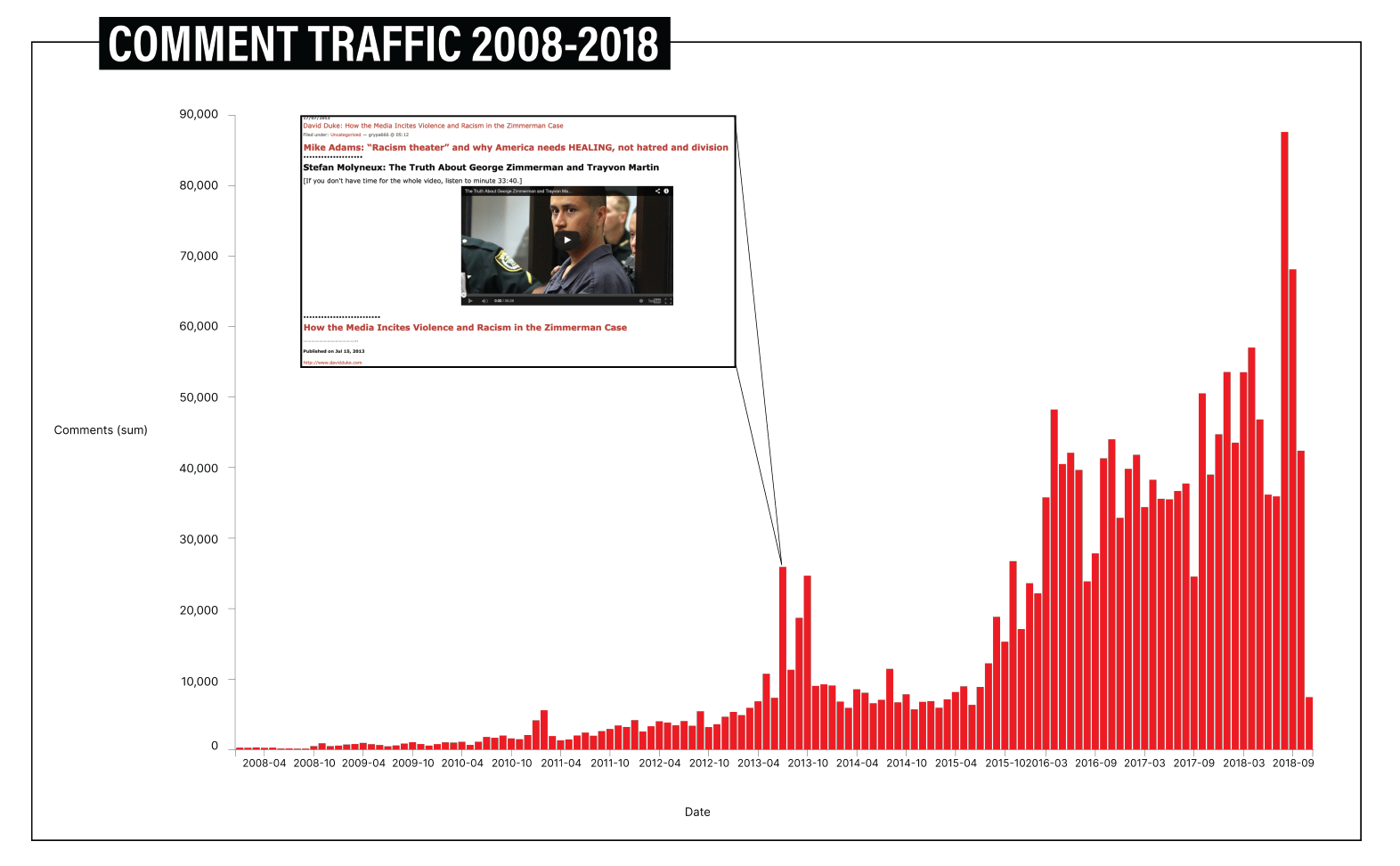
Our first analysis aims to uncover important moments in the development of Molyneux’s participatory community through his YouTube comment section (Fig 1).


Figure 1 shows that Molyneux progressively attracted more participatory audiences, with a significant first peak of engagement occurring in 2013. This peak corresponds with Molyneux’s video analysis of the highly publicised criminal case and trial of George Zimmerman. Zimmerman, a neighbourhood watch volunteer, was charged with the second-degree murder of the 17-year-old African American teenager Trayvon Martin. In their book Meme Wars, Joan Donovan, Emily Dreyfuss, and Brian Friedberg argued that the Zimmerman trial was a key moment in developing white supremacist internet culture—a hypothesis we can underline with the findings. But while on 4Chan the Zimmerman Trial became part of reactionary meme culture, Molyneux’s video titled ‘The Truth About George Zimmerman and Trayvon Martin’ took a serious approach pointing out that mainstream media were not telling the truth and misreporting the facts (the video can still be watched on YouTube).

The Zimmerman Trial seems to be a turning point in Molyneux’s discourse and audiences—his community was more concerned with libertarian ideas before. The video was shared by David Duke and circulated among white supremacist audiences, which explains some of the overt racism in the comments. This point was also noted by an audience member who had been commenting on his channel since 2011:

This video about Zimmerman has drawn out some very savage comments from those who don’t seem remotely interested in the truth (really makes me appreciate the normal comments). I wonder if this video is being exposed via google recommendations to a wider mainstream audience.

The Zimmerman trial was one of the first moments that Molyneux’s community significantly grew outside its libertarian origin, with various audiences joining the online culture wars. As Stuart Hall theorised, audiences performed preferred, negotiated, and oppositional readings of Molyneux’s takes, and it is important to note that the audience is not monolithic but an aggregation. Audiences have different uses and gratifications for watching Molyneux, such as expressing anger, trolling, hate-watching, mocking etc., making it difficult to assess any direct effect of the video on anyone’s political beliefs. The current conception within political persuasion theory is that people have “stable, cognitively efficient predispositions that are commonly activated and reinforced – but rarely changed – by information disseminated by persuasion campaigns and within social media”.

That being said, the Zimmerman trial does reveal a key new discursive element, which cannot be found in any comment before the trial—race-baiting. While traditionally used to identify a racist act, the term was used by reactionaries around the Zimmerman trial to claim that mainstream media were clouding “logic and facts by appealing to emotion through false accusations of racial discrimination”. As we have argued elsewhere, Molyneux increasingly evoked this framing of a highly emotive media vis a vis him as an objective and rational “philosopher”, mediating between the “ugly truth” of objectivism and the wishful thinking of social constructivists. This discourse is highly important in his later discussions on scientific racism. As Molyneux stated in an interview with Dave Rubin, “there is almost nothing harder to absorb than this question of differences in IQ between groups”, juxtaposing his personal uncomfortableness with the ‘facts’ about the hierarchy of different eugenic ‘races’.

Audiences’ Pursuit of the Truth

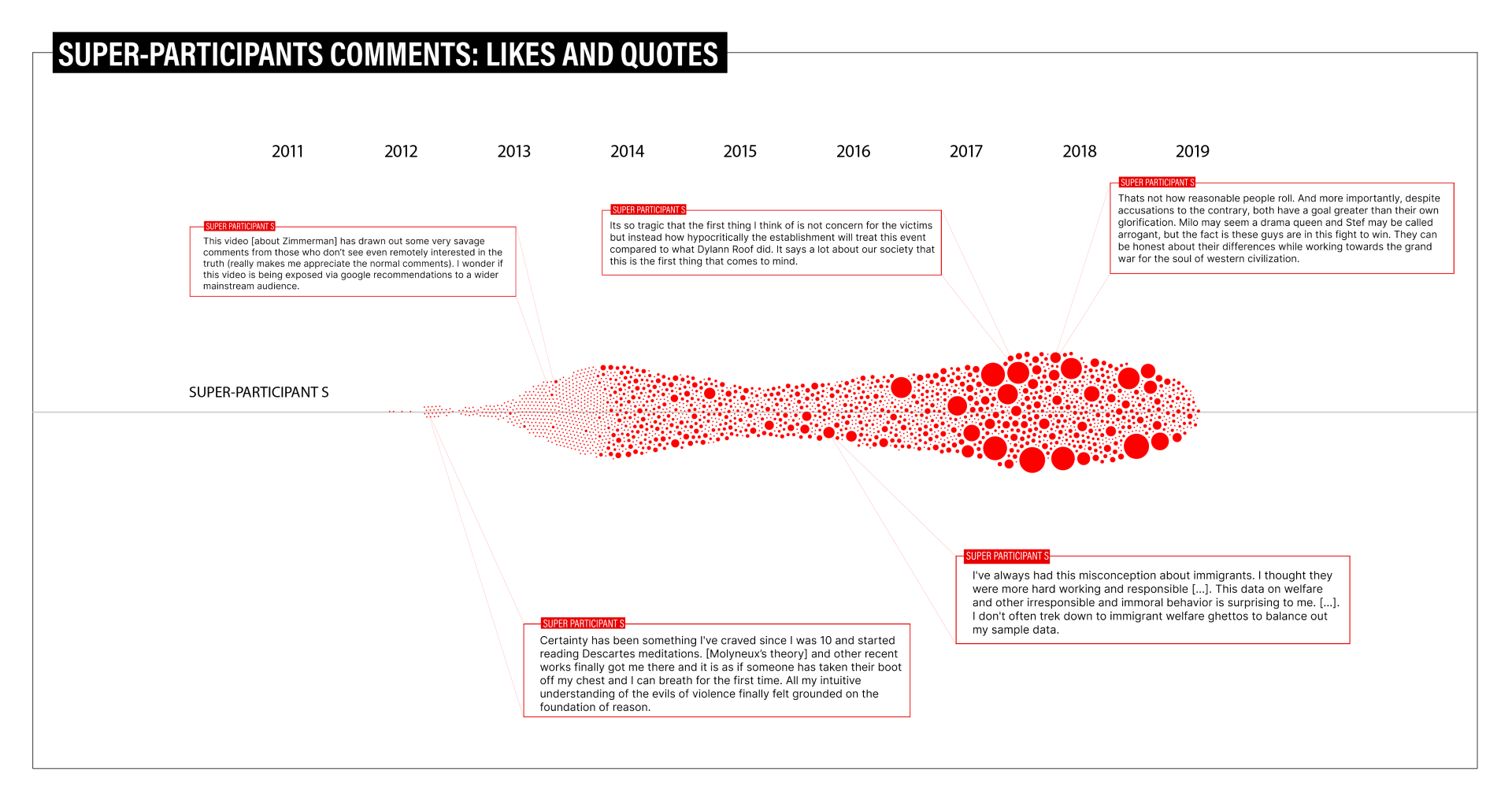
The ‘logic and facts’ framework is useful for understanding certain radicalising dynamics in the commenting behaviour of long-time super-participants in Molyneux’s community. The key takeaway from close reading highly involved audiences’ comments is that they pack some extensive reflections. Molyneux seems to offer his community members an ‘objective’ framework that allows them to make sense of the world and their place in it. Using super-participant S’s trajectory here as an illustration, we see how this ‘objectivity’ becomes more extreme (Fig. 2).


Having started commenting in 2011, super-participant S wrote in 2012:

Certainty has been something I’ve craved since I was 10 and started reading Descartes meditations. [Molyneux’s theory] and other recent works finally got me there and it is as if someone has taken their boot off my chest and I can breath for the first time. All my intuitive understanding of the evils of violence finally felt grounded on the foundation of reason.

Molyneux offers this feeling of liberation and freedom through ‘logic’, ‘facts’, ‘reason’, and ‘Truth’. This philosophical framework allows audiences to change their minds on politically charged topics like immigration. For instance, super-participant S captures a reframing of immigration discussions in 2015 following a dispassionate analysis of the data:

I’ve always had this misconception about immigrants. I thought they were more hard working and responsible […]. This data on welfare and other irresponsible and immoral behavior is surprising to me. […]. I don’t often trek down to immigrant welfare ghettos to balance out my sample data.

Building onto the concepts of ‘logic’, ‘facts’, ‘reason’, and ‘Truth’, long-time members of Molyneux’s community underline their objectivist worldview by using deeply ethical frames where terms such as ‘evil’ and ‘immoral’—previously used for libertarian discussions—are applied to more extreme discussions. This type of sensemaking occurs across various manifestations of ‘online othering’ in Molyneux’s comment sections, including extreme political polarisation, racism, and sexism, amongst other forms of discrimination. The trajectory of super-participant S in our dataset ends with full involvement in the “grand war for the soul of western civilisation”.

Conclusion
Our exploratory study of the comments on Stefan Molyneux’s YouTube channel sheds light on a historical moment of radicalisation on the platform. Using close and distant reading techniques of audience engagement, our analysis provides a unique perspective on the radicalisation process that broadens the focus beyond algorithmic recommendations. We find that Molyneux’s core audiences participate in a perceived ‘intellectual’ discourse that differentiates their community from the mainstream media, the emotive left, and overt racism. We discovered an almost obsessive relationship with logic, reasoning, and truth as core values among Molyneux’s most engaged audiences, who frame extreme ideas as the ‘sad truth.’

The culture wars in which reactionary actors leverage facts, logic, and reason are expected to remain part of the digital space for some time. We would therefore align ourselves with scholars who question the assumption that the issues discussed above can be reduced to problems of misinformation as fact-checking. Rather, we need to attune ourselves to how platforms afford participatory far-right communities to construct their knowledge and build their worldviews in order to counter their persuasive rhetoric.

We know that such radicalisation dynamics are challenging to track and scale; however, now that YouTube has taken on the more active moderating role, giving external parties access to removed data should be the start. As YouTube tends to downplay the scale of the issue, it remains unclear how it will address the persistence of similar far-right discourse on the platform. We hope our analysis of Molyneux’s community from a period when YouTube treated ‘the alt-right’ as a ‘content vertical’ can shed light on how to address these issues in the future.

Daniel Jurg is a PhD Candidate in Media and Communication Studies at the Vrije Universiteit Brussel. He is part of the research unit on News: Uses, Strategies & Engagements within the research group imec-SMIT at the Vrije Universiteit Brussel and the Open Intelligence Lab at the University of Amsterdam. Working on a scholarship from the Research Foundation Flanders (FWO), he studies the history of alternative influence on YouTube.

Maximilian Schlüter is a PhD Student of Information Science at the Graduate School of Arts from Aarhus University, Denmark. His research project revolves around studying and understanding disinformative memes in far-right online spaces using feminist critical theory.

Marc Tuters is an Assistant Professor in the University of Amsterdam’s Media Studies faculty where he is affiliated with the Digital Methods Initiative and the Open Intelligence Lab, studying political subcultures at the bottom of the Web.


https://gnet-research.org/2023/05/17/inside-the-cult-of-stefan-molyneux-a-historical-exploration-of-far-right-radicalisation-on-youtube/

Apr 27, 2019

'My child left us to join a cult': Mother reveals son was brainwashed into thinking she abused him

In 2008 Barbara Weed's son Tom Bell abruptly left his family after listening to thousands of podcasts by the founder of Freedomain Radio Stefan Molyneux

NATALIE CORNER
The Mirror
August 20, 2015

A young teen who believed his parents had 'mistreated' him walked out on his family to join a cult.

Barbara Weed's son Tom Bell abandoned his family aged 18 in 2008 to join the Freedomain Radio, founded by Stefan Molyneux, and never looked back.

For his distraught mother, who has not seen her son for over six years, she has stopped looking for him but remains optimistic that he will one day return.

Speaking on the Channel 5 documentary Trapped in a Cult, Barbara said she discovered her son's letter disowning his family one day out of the blue.

It said: 'Dear family, I need to take an indefinite amount of time away from the family, so I've moved in with a friend. Please do not contact me. Tom.'

It was a distressing time for Barbara who believes her son is in a cult run by Stefan Molyneux, she thought the sounds of the Freedomain Radio were part of her son's homework until he left.

Speaking in the documentary she said Molyneux had told Tom that his family were 'abusing' him and that he needed to deFOO them - which meant getting rid of your family of origin.

Stefan Molyneux has in the past denied to the press that Freedomain Radio "is the furthest thing from a cult".

https://www.mirror.co.uk/tv/tv-news/my-child-left-join-cult-6286534

Aug 18, 2017

I Lost My Son to the Alt-Right Movement

“I knew he was going to Charlottesville and I was worried.”
Anonymous As Told To Alexa Tsoulis-Reay
The Cut
August 18, 2017

My son was in Charlottesville. He probably went with his friends, but I don’t know for sure because I haven’t talked to him in about three years.


Maybe some alt-righters were born into racist families and then they just follow along, but we weren’t like that. He grew up in a big, multicultural city. When he was a kid, he was very accepting — his friend group was ethnically diverse, we often hosted overseas exchange students. He was dating someone who wasn’t white. He was a responsible kid. I mean, he would occasionally drink and smoke pot and stuff like that, but he wasn’t getting into trouble or anything. He had a few close friends, but he was not that great with getting girlfriends.

He was a good student, smart, sweet, and we were close. He always told me he loved me. But over time he began to change. I was worried it was drugs or depression. He started treating me like shit. I remember one time I went to hug him and he nearly ripped me a new one just for touching him. He said, “We have nothing in common.” I was hurt. That was just the beginning.

When he was in his late teens, he started listening to this podcast FreeDomain Radio. After he told me about it, I googled it, and from that point forward, my life was never the same. It was founded by this guy Stefan Molyneux, who I later learned is a major figure on the alt-right. He spews horrible things. I heard him listening to the podcasts in his bedroom. My son started saying things like, If we could just get the Asians out of here it wouldn’t be so crowded. I realized he was getting into really dangerous stuff. He was beyond the point where we could have a rational discussion. Not long after, I told him I thought he should move out.

After he left, we stopped talking and he pretty much alienated his closest friends. The only way I could keep track of him was by watching his online presence on Facebook, Twitter, and YouTube (I remembered his nicknames from when he lived at home). I saw that he was questioning the Holocaust, and tweeting about Trump, white supremacy, and all this horrible stuff about women. On his YouTube account, people were commenting that women don’t need to have education because their place is at home having babies. I panicked and approached a local religious group that’s very knowledgeable about cults and they said, Just wait it out and take care of yourself.

These days, I check up on him whenever I’m on the computer — it’s constant. I’ve got all his social-media pages pinned on Google Chrome. Sometimes he removes posts quickly and sometimes he makes things public and leaves them there. Maybe he wants me to see? I make sure I’m not logged in when I look at his accounts because I don’t want him to block me.

I recently saw him on a video, he looks healthy. Taking good care of yourself is all part of the white-supremacy thing, right? They have to be in good shape in case there’s violence, and they have to be fit so they can make good white babies. My thinking these days is God forbid he should have kids.

I knew from his tweets that he was going to Charlottesville and I was nervous because I know these things can turn violent. And throughout the day I was anxious, waiting for him to tweet so I knew he was okay. I’m horrified that he was there. From his tweets, it sounds like he was hanging around with neo-Nazis. It’s hard for me to believe. And then there’s a part of me that hopes he does something and gets caught because that’s one way to get him reformed.

I think the biggest thing with him is he needed a father figure. His dad really disappointed him. The alt-right is definitely a group that people are recruited into. I really do believe that. They take a “normal” level of fear of difference to the extreme. And I think that time of life — after school, when you are in your early 20s, is a real period of transition, of finding yourself. These kids think they have found the answer in these alt-right groups, you know? Like, I can be a part of something that’s bigger than me … and then they feel like they’re really going to make a difference, they even have a passion for making a difference.

All parents look back at how they raised their children and think they could have done something different, but I did the best I could. I raised him alone for a big part of his life. When he was younger, I had more control, but you can’t be with them 24/7. You don’t know what they’re listening to. They take their laptops to school. You can’t know everything that’s on the internet. Once they find it and feel like it speaks to them, they’re not going to listen to you.

These days the only way I can reach him is email. I sometimes send him videos of our dog. I have an extension on email that shows me if he reads it. The last thing I sent him was a video of our dog, but you could hear my voice … I secretly hope he felt something when he heard my voice, because deep inside I know he must miss me.

*Some names and details have been changed.

https://www.thecut.com/2017/08/charlottesville-white-supremacy-parenting-alt-right.html

Feb 15, 2016

TV Alert: Stefan Molyneux

February 18th on Showtime’s Dark Net Docuseries - Trapped


The February 18th episode of Showtime’s Dark Net docuseries will discuss online cults.  It will feature a segment about Stefan Molyneux and the Freedomain Radio community.

Feb 5, 2016

Meet the ‘Cult’ Leader Stumping for Donald Trump

Daily Beast
January 5, 2016

It starts with podcasts and YouTube videos starring Stefan Molyneux, the blogger currently debunking ‘untruths’ about Trump. Then there’s a note on the door—and Molyneux’s acolytes are never heard from again.

Two weeks ago on Reddit's largest community for Donald Trump supporters, a user named WolfOfAnarchy dropped by with a request that was becoming almost tediously common for regulars on the site.

“Sanders supporter here,” he began. “Can you convince me (just not with idiotic oneliners) that Trump is not who the media makes him out to be? Thanks.”

“If you have any time, you should watch this,” another user jumped in.

That comment, which had the highest score, linked to a website: UntruthAboutDonaldTrump.com.

Other Trump supporters piled on, saying they were sick of having to post this same video over and over again. “I really wish our mods would sticky this (or affix it to the top of the website permanently) so we don’t have to link this all the time,” one user wrote.

“That one video would clear up so much all the time,” said another.

Why? Because this video, for some reason, tends to work. And now, again, Trump's online supporters got to watch it in action: someone being told the real truth about Donald Trump for the very first time.

“I’m 5 minutes in, very very interesting so far,” WolfOfAnarchy reported back. “Trump is not stupid, that’s clear, damn.”

When you click through to UntruthAboutDonaldTrump.com, you simply see this: a balding man smiling through a salt-and-pepper goatee, clad in an ironed button-down shirt, and standing well-lit in front of a static white background. He greets you warmly in a trusting, even-toned Irish accent. His name is Stefan Molyneux.

“Hope you’re doing well,” he says. “We’re going to go through a list of untruths about Donald Trump, just so you can get a fair assessment of the man’s character and avoid the sensationalistic nonsense and get to the man’s actual positions and policies—which are well worth an examination, and certainly not above criticism.”

Basically, as subreddit users put it, Molyneux sets out to make a reasoned, calm, intellectual argument for the candidacy of Donald Trump.

And for the first few minutes, it’s hard to disagree with him. Molyneux, slowly reading along from a PowerPoint-like text of talking points, breaks down passages from Trump’s Art of the Deal. He contends that Trump can’t possibly be as dimwitted as the media makes him out to be and convincingly argues that it all must be part of Trump’s plan. Molyneux, 49, is charismatic, open, immediately transfixing—almost enough for you to forget the video’s 73-minute run time.

“15 minutes in,” WolfOfAnarchy wrote. “Jesus, the misinformation of the media is insane. I have never listened to a Trump speech, only the media. I now read his quotes and holy fuck have the media been turning my mind into a certain direction.”

Later on comes the questionable stuff from Molyneux—sentences like, “It’s crazy you have to go to the former KGB leader to get the truth about the American presidential race”—but by the time he gets there, Molyneux has you hooked.

It’s a pattern all too familiar for some families who’ve had a child watch Molyneux’s videos and listen to his podcasts. At first, it’s just their kid watching videos about something controversial but familiar—The Matrix, The Martian, or Donald Trump.

Then, a few months and a few more podcasts later, there’s a note on the door. After that moment, they never see their child again.

***

Barbara Weed said she never understood the appeal of Molyneux’s videos. She always found him “loathsome.”

But Weed said she knows the feeling this first-time Molyneux watcher is experiencing all too well.

She said it’s the feeling her son, Tom Bell, had a little over eight years ago, the last time she saw him. It’s the feeling he had before he ran away from home to join what she and experts like those at the British Cult Information Center call “Molyneux’s cult.”

“My son is still gone. He’s alive, in a foreign country. He cut off not just me, but all of the family and all of his friends. I haven’t had direct contact with him since 2008,” said Weed, a Labour councilor from South Leamington in the U.K. “It sounds a bit strange when I say that to people.”

One day eight years ago, Weed came home to see a note on her doormat from her son. It said he was moving in with a friend and it instructed her not to contact him.

About six months before that, she had heard him listening to podcasts in his room. It all started with a school assignment for his Critical Thinking & Philosophy class. That led him to a YouTube video called “Introduction to Philosophy.” It shows Molyneux pacing around a room in 2006, talking about perceptions of what is really “true.”

Tom initially tried to introduce his mother to it, but she said she simply wasn’t interested.

“My politics were just very different from [Molyneux’s],” she said.

Still, that Introduction to Philosophy podcast had Tom hooked. His mother thought he was listening to the same one over and over again in his bedroom, as Molyneux droned on about the same ideas: identity, an extreme version of libertarianism, and the inherent abuse embedded in the concept of family.

It turns out, however, they were all different episodes, and sometimes there were group Skype chats with Molyneux and his fellow diehards.

“He told me he was getting advice from people on the Internet,” she said. “I didn’t know what he was planning to do. I didn’t know how deeply he was involved.”

What she also didn’t know was that Molyneux’s uniform advice to his dedicated listenership was a simple, cruel plan: Move away from your parents, because it is almost impossible for any mother or father not to have abused you in some way over the course of your lifetime.

“I’ve interviewed former insiders, and I’ve learned a fair bit about [Molyneux] and about the cult,” said Steve Hassan, a licensed mental health counselor and leading American cult expert. “He thinks that anyone who has circumcised a child is a child abuser and convinces his followers to cut off all contact from family and friends—even if it was a sibling who has nothing to do with it.”

Last year, Hassan was hired by a family to help them reunite with a child who had run away under the influence of Molyneux’s ideology. Hassan said he believes this kind of “YouTube cult” can often be more dangerous than a sect with a built-in church or community, as it can convince vulnerable young men and women with nowhere to go to leave on a moment’s notice—and without any support system to help them get by.

All of it is part of a process Molyneux calls “deFOOing,” or extracting oneself from their “family of origin.”

Molyneux’s wife, Christina Papadopoulos, a licensed therapist in Canada, was sanctioned by the College of Psychologists of Ontario in Mississauga in 2012 for appearing on her husband’s podcast and advocating for precisely that. The panel found her guilty of professional misconduct for giving improper advice and telling people to leave their families.

Molyneux’s group, which organizes in forums online and sometimes in person, was called a “therapy cult” by family members in Canada’s Globe & Mail.

In response to allegations that his group is a cult in a 2008 Globe & Mail interview, Molyneux called it “the c-word” and said, “I’m sure a few marriages broke up because of feminism. It doesn’t make feminism a cult.”

On Molyneux-affiliated defoo.org, however, the group now self-identifies as a “highly profitable self-knowledge cult.”

Molyneux did not respond to repeated requests for comment from The Daily Beast.

“Partly what’s going on with the people on the Internet who are indoctrinated, they spend lots of hours on the computer. Videos can have them up all night for several nights in a row,” said Hassan. “Molyneux knows how to talk like he knows what he’s talking about—despite very, very little academic research. He cites this and cites that, and presents it as the whole truth. It dismantles people’s sense of self and replaces it with his sense of confidence about how to fix the world.”

Molyneux’s plan to fix the world may start with disassociation from family, but it also relies on devotees sending him cash—although recently he has insisted it’s not necessary—in a tiered donation system not unlike the one Scientology uses. Weed said her son had been giving money to Molyneux in order to reach the highest level of membership and, in turn, become part of Molyneux’s inner circle.

“That level is called Philosopher King,” said Weed. “Tom was giving all of his money to him to become one of his special little friends, despite being a starving student.”

“He’s making a living off of people donating money,” said Hassan.

Worse yet, Molyneux’s staff and followers publicly shame and post personal information about those who leave the group. Molyneux’s group calls the process of reuniting and making amends with family “reFOOing.”

Former inner-circle members often speak out in videos posted to YouTube and in the support group for spurned family members and ex-Molyneux acolytes, FDRLiberated.com. (FDR is short for FreeDomainRadio, Molyneux’s YouTube and podcast channel.)

Once members leave the group, bios are posted ondefoo.org that outrank any other mention of that member’s name on Google. Those bios include every previous address, phone number, family member, and traffic violation, plus texts with a clear aim to shame the individual in question. A typical example reads:

“[A former member] gave up on FDR because the community didn’t support the wearing of makeup. After breaking up with [redacted], she needed to attract a new male and was having trouble without her precious face paint. She has struggled with acne and feels insecure if people can see it. [That former member] now applies a thick layer of makeup to her face every day. It’s almost as thick as her False Self.”

That sort of shaming—and the thousands of dollars Tom Bell has poured into Molyneux’s coffers—is why Barbara Weed doesn’t think she’ll see her son again any time soon.

“I don’t know where Tom is. I don’t have the money to get a cult expert, either. I don’t think Tom would listen to anybody else, even if I did,” said Weed. “All I can do is wait and try and get the message out to people that Molyneux is doing horrible things, and that it’s a cult.”

Hassan said it’s standard brainwashing, but there is good news: Molyneux isn’t all that good at it.

“I guess, on the scale of things, I would say he’s not that successful. He doesn’t have that many people in his core,” he said. “You talk to former members and critics, and they talk about what’s really going on at the core, that he’s acting like a total megalomaniac, that he says his gift to his mother was that he didn’t kill her.”

Hassan said he worries more about what Molyneux represents: charismatic people with a platform taking advantage of disaffected people who are “upset with how the relationships in their lives are going anyway” and are in desperate search for meaning.

“My life’s work is explaining it to everybody—to not get taken over by black-and-white, us-vs.-them thinkers,” he said. “In terms of politics, right now, does that sound familiar?”

***

Hassan believes there’s a clear reason Donald Trump attracts people like Molyneux and his supporters, or fans of conspiracy websites like InfoWars, which sells end-of-the-world food rations and which Trump called “amazing” in December.

Basically, both cater to the same idea: Get rid of one major thing from your life, and everything will work out.

“It’s no surprise he’s so into Trump,” Hassan said. “When Trump first talked about banning the Internetand Muslims, it was like that: They wanted to impose a one-sided view of what reality really is.”

Both Trump and Molyneux, Hassan said, make an appeal for your respect by offering a “truth” that the media simply won’t tell you. Only Molyneux and Trump can show you that it’s all one big “untruth,” anyway.

“Trump is the quintessential, stereotypical cult leader in that the crux of his argument is that ‘they’ lie all the time,” said Hassan. “‘Don’t you wanna follow someone who is trustworthy? If they lie to the public, how do you know they’re not lying to you? Why would you consciously want to follow someone who’s a liar?’ It’s an appeal for respect for people who want a black-and-white answer.”

Weed said she has a hard time watching Trump’s speeches on TV because she sees the same in Molyneux as she does in the presidential candidate.

“If you try and write down what Molyneux has said, it’s incomplete sentences. It’s not a logical flow of thought. There’s nothing like a conclusion. He just rambles. He’ll just jump midsentence to somewhere else, just like Trump does,” she said. “He uses very extreme language, except Molyneux is a bit more extreme, with a direct plan.”

Still, Weed doesn’t think Molyneux is all that much of a Trump supporter, after all. She believes he’s using Trump’s name as a new way to drag people away from their families and into his group.

Molyneux has done the same with videos about anything slightly countercultural but accessible, above all. He’s made videos about The Matrix. He’s made podcasts attacking President Obama. He’s created episodes about police shootings that were initially anti-police, but eventually started making videos that defended police and criticized the families of victims like Michael Brown.

“He’s gotten better and better at getting attention by just being controversial,” said Weed. “It’s just clickbait. At the end of the day, it’s whatever will bring more people to his site.”

After all, Tom got there because he felt he was finally being told the truth about the world from a YouTube video with a search engine-friendly title: an Introduction to Philosophy.

Now, almost a decade later, Weed is still holding out hope that her son will catch wind of the dozens of ex-members who post their horror stories on YouTube, or that Molyneux’s group will fold as, she said, “these cults tend to do.” Or maybe he’ll just drift away, as she said lot of Tom’s friends already have.

“It’s possible Tom will leave some day. Or, one day, Molyneux might just drop dead,” she said. “That would be lovely. He might get hit by a truck. A meteorite might fall on his head. I could have my son back.”

http://www.thedailybeast.com/articles/2016/02/05/meet-the-cult-leader-stumping-for-donald-trump.html

Oct 23, 2015

Teal Swan vs Stefan Molyneux

Published on Sep 28, 2015

"Teal and Stefan have both been accused of running cults and not just by outside observers but by people who have defected from their “inner circles”."


Dec 22, 2014

Controversial podcaster listened in on therapist wife and clients: lawsuit

Tu Thanh Ha
The Globe and Mail
December 19, 2014

Already controversial for counselling his followers to shun their parents, a Toronto-area podcaster is facing allegations he listened in on his therapist wife as she met with distraught patients.

Stefan Molyneux is a self-described libertarian philosopher. His wife, Christina Papadopoulos, is a psychological associate in Mississauga.

Photo of Stefan Molyneux, the founder of Freedomain Radio
The College of Psychologists of Ontario found Ms. Papadopoulos guilty of professional misconduct in November, 2012, faulting her for adopting Mr. Molyneux’s views and using the Internet to counsel people to sever ties with their families.

A civil court complaint filed on Oct. 24 in California says Mr. Molyneux boasted in a 2006 podcast that he would listen while his wife talked with her patients, even interjecting and suggesting they sign up with his website.

The allegations are part of a lawsuit filed by a Texas woman who has accused Mr. Molyneux of abusively invoking U.S. copyright law to silence her criticism of his podcasts.

Mr. Molyneux has not filed a statement of defence and could not be reached for comment. Ms. Papadopoulos and her lawyer declined to comment.

Catherine Yarrow, executive director of the College of Psychologists, said she could not specifically comment on the latest allegations against Ms. Papadopoulos. However, she said both the college’s regulations and Ontario laws make it illegal to disclose personal information without a client’s consent.

While not a household name, Mr. Molyneux is a controversial figure whose views have earned him both supporters and detractors. Several parents have told The Globe and Mail that their children became estranged from their families after listening to him.

In the recent lawsuit, the Texas woman, identified as J. Raven, says in her complaint that she started a YouTube channel criticizing Mr. Molyneux after discovering his podcasts and his boast that his website, Freedomain Radio, is the “most popular philosophical conversation in the world.”

Her lawsuit said one of her video criticisms quoted from a Molyneux podcast in which he said “that he listens in on his wife’s confidential sessions with her patients in her home office and interferes with the therapy sessions to suggest the patients join and donate to Freedomain Radio.”

The comments are not in the version of podcast 291 now on Mr. Molyneux’s YouTube channel, but are in a longer version Ms. Raven provided after a request from The Globe and Mail.

In the version provided by Ms. Raven, Mr. Molyneux states that it is June 21, 2006. He then speaks about listening in as his wife meets with “messed up and sobbing” clients at her home office.

“I’m in the vent system, listening, and I’m – she calls it heckling, but I don’t really call it heckling, I just call it providing suggestions about how things should go and that the people should donate to Freedomain Radio,” he says in the podcast.

“I mean, it takes them a while to figure what on Earth that is, but I do, sort of, try to put my two cents in and Christina says that sometimes can be distracting and so on. But even with the combined weight of her, directly in front of them, and me, my ghostly voice floating in through the vents, they still have trouble making the kind of personal changes that really have a positive effect on their lives.”

Ms. Raven says in her lawsuit that her YouTube channel was shut down after complaints from an associate of Mr. Molyneux, Michael DeMarco, who invoked the Digital Millennium Copyright Act (DMCA), a U.S. law regulating intellectual property.

Under the DMCA, an Internet provider facing allegations that its clients violated copyright can avoid liability by removing the contentious content, even without investigating the validity of the complaint. As a result, so-called DMCA takedowns have been criticized as an abusive form of censorship.

“Molyneux apparently believes that it is acceptable to use the copyright laws to silence his critics – without any claimed copyright basis – by publishing false accusations,” the lawsuit said, noting that Mr. Molyneux previously opposed intellectual property.

Ms. Papadopoulos appeared before a disciplinary panel of the college in 2012 after two formal complaints that she offered improper advice on podcasts she made with Mr. Molyneux.

The college said she advocated a practice called deFOOing, or dissociating from one’s family of origin. “Your statements in support of deFOOing are not supported by current professional literature or consistent with the standards,” the panel ruled.

It added: “Your objectivity, competence and effectiveness were compromised by financial interests since you and the Freedomain Radio website … actively solicited donations.”

She was found guilty and reprimanded.

http://m.theglobeandmail.com/news/national/controversial-podcaster-listened-in-on-therapist-wife-and-clients-lawsuit-alleges/article22158708/?service=mobile