A charismatic and rebellious monk built an ultra-religious commune at the very edge of Europe. Now he’s under arrest and his followers are left in limbo.
Gabriel Gavin
VIICE
September 29, 2021
“Will you die if I ask you to?” That was the question Father Sergei Romanov asked of his nuns. One by one, the women approached the head of their convent, draped in black robes, his long gray hair tied back into a ponytail. “I’ll die with joy,” came the reply. “If you bless me, I will die.”
Wearing thick winter jackets, their heads covered, the women queued to kiss his hands and receive a blessing while he raged against drunkenness and moral decay. The sermon, held last December at the convent in the forests outside Ekaterinburg in Russia’s Urals region, 900 miles east of Moscow – where Europe ends and Asia begins – would be one of the controversial Russian monk’s last. A video of the eerily-lit exchange went viral on social media last year, prompting a police inquiry.
Already excommunicated from the Orthodox Church and now facing claims he was running a secretive death cult, Romanov and his hundreds of followers prepared to make their last stand at Sredneuralsk monastery. “Let them come,” he told the congregation around him. “Let them try to fight with our spiritual power… this will be their first lesson in defeat.”
And, on the evening of the 29th of December last year, they did come. Armed riot police stormed the snowy complex. As their flashing blue lights lit up the hand-painted murals of saints which adorn the white walls of the convent buildings, officers from Russia’s national guard detained Romanov and his deputies.
By morning, he had been bundled into a plane and flown westwards to Moscow, where a court read out the charges – encouraging his followers to kill themselves, violating their basic rights and causing outrage to religious believers across the country.
Just months before, the local archbishop had accused him of vanity, lying and suffering from “schizophrenic delirium” as part of a dispute with Church officials, who he branded heretics and denied access to the monastery. The breakaway convent had also been plagued by allegations from former students that drug-addicted monks were plying teenagers who lived there with narcotics, as well as subjecting them to corporal punishment and abuse. After a 15-year-old girl died at the monastery last year detectives launched a probe.
Around the same time, three young people who had been involved with the church told popular TV journalist Ksenia Sobchak that they had been beaten with electrical cord, and locked in a shed without food. She and her camera crew were chased away by Romanov’s followers as they tried to gain entry to the complex while filming a documentary, and her director was left with a broken wrist.
The monastery and its enigmatic priest have captured the imagination of Russians, with the media uniformly portraying the church as a shadowy sect. Pictures of Romanov looking bedraggled and hauled up in front of court have made the front pages. Little has been said, though, of the people that said they would follow Romanov to the grave.
VICE World News met one of those followers, “Elena,” outside a KFC in Ekaterinburg, before driving out to one of Romanov’s former monasteries. She’d agreed to show us around one of the country’s holiest sites, speaking on the condition that her name be changed, to avoid drawing unwanted attention from the authorities or criticism from others in the church.
If alleged death cults are supposed to attract a certain type of person, Elena probably wouldn’t fit the mould. With a good job and a young family, her eyes lit up when she said how she’d started attending church because of the 66-year-old branded online as “mad Sergei” (a reference to the “mad monk” nickname given to Rasputin), and how she’d struggled since the monastery was shuttered by the authorities.
“When I first went to him, I felt love from him,” she said as we sped down the highway. “I felt he cared for people and helped them. I had some problems, and I didn’t have to tell him. He knew straight away.”
We were driving to Ganina Yama, a collection of wooden churches and shrines built around a colossal pit out in the woods. The former mineshaft is said to be the spot where communist revolutionaries dumped the bodies of the Romanovs, Russia’s last royals. In 1918, as loyalist forces closed in on Ekaterinburg, the family were taken down to the basement of the house where they had been imprisoned, and executed by their drunken guards. The bullet-ridden corpses of Tsar Nicholas II, his wife and children, were pushed down the shaft, before the Bolsheviks poured in acid and blew it up.
In death, the family has taken on a mythical status for many Orthodox Christians, especially those who followed Romanov. A steady stream of coaches and minibuses ferry religious Russians to the quiet forest shrine each week, where pilgrims can kneel on a platform in front of the pit and chant prayers, their voices carrying through the trees. “We are praying not just for the Romanovs,” one worshipper told VICE World News, “but for the forgiveness of all Russians. We’ll never know who carried out the murders, so we pray for all of our ancestors.” The royals were given sainthoods by the Church not long after the fall of Communism and, for many believers, the slaughter of the head of the Orthodox faith and his innocent children marked the start of eight decades of oppressive, atheistic Soviet rule.
By a strange twist of fate, before becoming a monk and taking on a new name, Father Sergei had been born Nicholas Romanov – just like the last Tsar himself. A former Soviet police investigator who dramatically fell from grace in the uncertain times before the implosion of the USSR, Romanov confessed to an armed robbery and the murder of a man in 1985. He claims he found faith while sentenced to 13 years behind bars in a special prison colony for law enforcement officers.
A year before he was sentenced, Romanov was involved in a car collision while committing a crime, killing one person and leaving him hospitalised in a coma for three days. According to Elena, that planted the seeds for his conversion, and “he only started to believe in God after he was involved in the crash.” While technically his criminal convictions should have blocked him from the priesthood, Romanov claims that the then-head of the Orthodox Church, Patriarch Alexey II, personally waived the rules and welcomed him as a reformed man. As religious leaders worked to regain their flocks after years of Soviet repression, the newly ordained monk was conveniently positioned as the model of a sinner who had seen the light, and quickly moved up through the ranks to preside over his own congregation.
Inspired by a near-death experience, infatuated with the murdered Romanovs and with a congregation pledging their willingness to die, the priest has struggled to shake off the morbid reputation he has gained in recent years. Elena, however, denied that the group has an unhealthy obsession with suicide, as prosecutors allege. “When Russians join the army, they pledge they are ready to die for the country. So why is it different when it’s about God?” she asked.
However, their apathy towards the mortal world seems to have made the group a threat in the eyes of officials since the start of the pandemic last year. Romanov stood almost alone among religious leaders when he defied orders to suspend his sermons and encourage mask-wearing to prevent the spread of the virus. “All the problems began in the time of Covid,” Elena sighed. “Before, everything was OK, but he said he wouldn’t listen to the government. We believe in God, so how can we be afraid of Covid?” she added. “We believe that even if you die, you will be OK… it is God’s will.” Romanov was also belligerently opposed to government efforts to convince priests to encourage their flocks to sign up for the vaccine.
While Elena insists the church’s teachings aren’t far outside the mainstream, she acknowledges that their piousness can seem strange to outsiders. “Some people don’t like him of course – for example we took our friends and they were afraid because when he prayed, some people started screaming – speaking in tongues. And they were like ‘oh God,’ they weren’t ready for this, it was too much. They thought it was a cult.” Stories of parents searching for children who had run away to sign up with the group haven’t helped its reputation locally either.
Now, former members of the church claim the authorities are monitoring them to make sure they don’t regroup in Romanov’s absence, with the most devoted of his followers put out on the street.
Although the charges their spiritual leader is facing stem from his supposed mistreatment of followers and calls for them to kill themselves, Elena says the authorities were more worried by how strongly the church’s members felt about him and the fact the breakaway group had rejected control from senior bishops. “I think they are afraid people will break the law, because Romanov says a lot of bad things about the government, and they’re worried that it is dangerous for society, like we will start some kind of revolution,” she said. “But it isn’t true – we won’t do this. We will never start an insurrection.”
One top Orthodox clergyman, Moscow Deacon Andrei Kuraev, however, warned last year that even if the monk’s teachings are peaceful, it is his personal hold over his congregation that is potentially dangerous. According to the church official, Romanov was more interested in being adored by his supporters than living a humble, godly life. “A monk is someone who says I am shit, and you can walk over me like a doormat,” he told local media as the case made headlines. Romanov, however, “has nothing like this in his face, intonations, eyes or behaviour. He feels like a Fuhrer who is ready to lead everyone.”
According to Professor Nikolai Shaburov, one of the country’s leading religion experts, describing the group as a “cult” is not helpful in understanding them. “The terms cult and sect are best avoided altogether, since they’re basically pejorative terms and have lacked all meaning,” he says. Instead, he said, Romanov’s group is better understood as a “new religious movement” within the Orthodox Church, made up of highly-motivated young people looking for inspiration. “The peculiarity in Russia is the fact that these groups are becoming more influential in society,” he said, adding that “it is common for the authorities to take a negative view towards them.”
One of the problems, he went on, is that top bishops take a dim view of individuality in local preachers. “The Russian Orthodox Church isn’t known for its tolerance”, Shaburov says. The row with leaders over his refusal to suspend sermons and encourage mask wearing in 2019, as well as his harsh criticism of top bishops, could also play a role. “I note that Father Sergei was accused of authoritarianism only after conflict with the Church leadership,” Shaburov added.
Cult or not, as the controversial monk languishes in a Moscow jail cell awaiting trial, his followers have been left trying to pick up the pieces and trying to keep their community together, while praying the court finds him not guilty later this year. In the meantime, though, like the Romanovs, Sergei has become just another holy figure, taken away from them too soon.
https://www.vice.com/en/article/88nywg/the-covid-denying-tsar-loving-russian-cult-thats-too-extreme-for-putin
Showing posts with label Russian Orthodox. Show all posts
Oct 3, 2021
Oct 11, 2016
Boom in clairvoyants that Moscow didn’t see coming
October 11, 2016
The Times
The Russian Orthodox Church is more popular than ever, but many Russians are also seeking pagan forms of healing.
As Russia’s economy flounders, its people are flocking to self-proclaimed witches, psychics and clairvoyants in search for magical solutions to their problems.
The so-called magical services industry is thought to be worth billions of pounds every year, with occult practitioners able to earn an estimated £13,000 a month in big cities such as Moscow. The Russian Academy of Sciences says that there are about 800,000 occult and faith healers operating in the country, compared with 640,000 doctors. It also estimates that 67 per cent of Russian women have sought help from a psychic or sorcerer. The figure for men is…
Read more:
http://www.thetimes.co.uk/edition/world/boom-in-clairvoyants-that-moscow-didn-t-see-coming-vpcdmtdt0
Jan 14, 2016
Czarist echo? Russian Orthodox Church drives to restore its political clout
Fred Weir
Christian Science Monitor
January 4, 2016
MOSCOW — Baikonur Cosmodrome may lie in Kazakhstan, but it is an iconic symbol of modern Russia: the coming together of cutting-edge science and Space Age power.
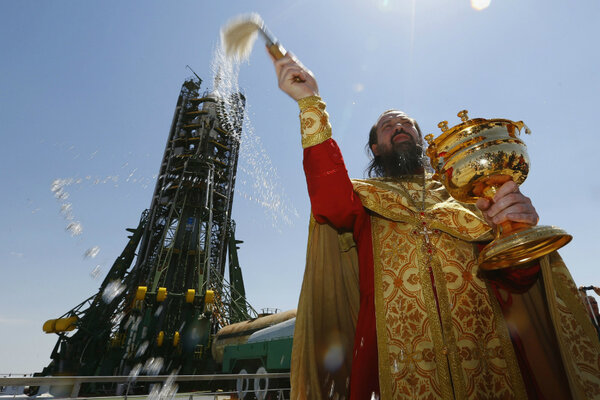
But just before the mid-December blastoff of the latest Soyuz mission to the International Space Station, the countdown procedure was halted to allow a robed and bearded Russian Orthodox priest a few minutes to shuffle around the mighty rocket, sprinkling holy water on its fuselage, murmuring snatches of biblical verse, and calling upon God to keep it safe. He also blessed each of the three astronauts – American, Russian, and British – about to make the journey.
Such is the new normal in today’s Russia. The 1993 Constitution strictly defines Russia as a secular state, in which no religion is the official or obligatory one. But many people in post-Soviet Russia yearn for ideological certainties to fill the void left by communism. And with the ascent of Vladimir Putin and Russia’s new order, the Russian Orthodox Church, an ancient institution that was nearly annihilated during seven decades of Soviet rule, is returning to a highly visible and central role in the life of the country.
Furthermore, the line between sacred and secular appears increasingly blurred in Russia. Unlike in the West, where religion and politics occupy separate spheres, the Orthodox Church sees itself as the spiritual generator of public policy and the ideological bulwark of the state. Priests have become regular fixtures in the Army, schools, hospitals, and other public institutions. When President Putin gave his recent state-of-the-nation address to parliament, Patriarch Kirill – the Orthodox equivalent of the pope – was seated prominently among top government officials in the audience.
That has prompted leaders to supplement their dubious democratic legitimacy with backing from the church that’s been a key pillar of Russian statehood for 1,000 years.
“The main idea our temporal authorities are offering these days is a return to Russian ‘great power’ status,” says Nikolai Svanidze, a historian and leading TV personality. “What the church brings to that is historical depth, clear philosophical outlook, and cultural traditions that most Russians relate to.
“But it’s a hopelessly archaic institution, profoundly reactionary, and with a long habit of subordinating itself to the state,” he adds. “It’s incapable of taking any kind of progressive stand in favor of the country’s development, and together with our current authorities it is driving Russia down the blind alley of the past.”
About 70 percent of Russians identify themselves as “Orthodox” – though only a small fraction go to church regularly – and polls show the church is one of the most highly respected institutions in the country.
But clerical support for the authorities comes with a hefty price tag. Under Putin, the Kremlin has transferred back to the church about 28,000 objects once nationalized by the Soviets and worth billions of dollars, including churches, monasteries, and precious artifacts, mostly at the expense of state museums.
The church’s move into banking
There seems little doubt that the church hopes to expand its social influence by moving into areas that are considered part of the public space in most Western countries. One ambitious plan officially put forward by the church is to create an Orthodox banking system, similar to the Islamic one, which would ban usury and be based on Christian principles. The idea has reportedly been endorsed by several banks and Russia’s chamber of commerce.
“It’s not clear what the church wants to accomplish through this, whether they are seeking greater public responsibility or just acting to lower interest rates” for the population in these difficult times, says Marina Mchedlova, an expert with the official Institute of Sociology of Religion in Moscow.
More important, the church has achieved some successes at influencing public policy. When the female punk rock group Pussy Riot staged an irreverent and illicit performance in Moscow’s main cathedral, the church was among those insisting the charges be increased from simple “hooliganism,” which suggests a minor offense, to include the sentence-multiplying addition “with intent to foment religious hatred,” because the anti-clerical content offended many Orthodox believers. The church’s view won, and the three young women were given two years in labor camps.
In recent years, the church has successfully lobbied for a law banning “homosexual propaganda” and has continued to push for much tougher legislation against issues including “blasphemy,” abortion, and pornography.
“Many people think the church is only clergy, and it should not speak about secular matters, but we have overcome this Soviet legacy,” says Archpriest Vsevolod Chaplin, who was the church’s most recognizable spokesman until he was abruptly fired by the patriarch Dec. 24. “The church is millions of people, and they have every right to speak about the concerns of society, especially ethical ones like family values, corruption, education policy, abortion, and relations with power. Many priests do speak out about such things these days, and I think that’s a good thing.”
Ironically, Father Chaplin told the media that disagreements over the church’s relationship with the state played a role in his dismissal. He said that the church should speak to the Kremlin in a clear voice rather than through cozy personal relationships, and slammed the patriarch for snuffing out independent voices inside the church.
“Immoral elites are hampering the nation’s development,” he said, adding that “to prevent a revolution, we need to actively offer models of peaceful reforms,” according to the Interfax news agency.
A debate in the church on how far to go
Indeed, experts say there is considerable debate within the church itself over how far it should carry efforts to regain its czarist-era role as the main arbiter of Russian spirit and morality, and hence the chief legitimizer of the state’s policies and actions.
“The church is divided, and there is no single plan for how to project influence” outside the realm of purely religious authority, says Iosif Diskin, chair of the interreligious affairs commission of the Russian Public Chamber, a semiofficial civil society assembly. “Most agree that religion brings a moral dimension to social and political life, without which we cannot have a stronger and more united nation. But there is disagreement over methods, with some favoring direct political action, others calling for moral persuasion. There is no one position.”
But the church has created external tools to project its will into the political arena in the form of public organizations with names like Orthodox Rus, The Orthodox Brotherhoods, and the Union of Orthodox Women. There are now dozens of such groups that enjoy ongoing connections with the church but are able to operate independently.
Much of their work involves noncontroversial activities, such as charity work, religious outreach, and public support for the church. They operate scores of radio stations and several newspapers and websites; they also prepare programming for the church’s own nationwide TV network Spas (Salvation). Through such channels they keep up a running critique against what they see as a wave of blasphemy, sin, and moral degradation that’s washing over Russia.
“We don’t go in for politics, and we want the church to avoid the temptations of involvement in government and financial operations as well,” says Viktor Semyonov, head of the year-old Orthodox Rus movement, which describes its goal as the revival of Russia’s spiritual traditions based on Orthodox culture. “Our church survived 70 years of Soviet repression because of its spiritual strength. It still doesn’t get the respect it deserves because there are so many forces arrayed against it.”
But there are darker allegations that church-founded organizations may be linking up with – or at least providing religious cover for – nationalist and ultrapatriotic groups that sometimes turn violent.
Vandals attack ‘blasphemous’ art
The Sakharov Center in Moscow, a museum and art gallery named after the famous Soviet-era dissident, has seen its exhibitions smashed repeatedly by gangs of vandals who accuse it of sponsoring “blasphemous” art. Whenever lesbian, gay, bisexual, or transgender Russians attempt to stage a public protest, similar gangs appear to intimidate and often physically attack them as police look on.
If you compare the harsh prison sentence handed to the Pussy Riot band, whose actions were peaceful and caused no property damage, with the routinely lenient treatment of violent right-wing and pro-religious vandals by the courts, it gives a clear indication of which side the state is on, says Alexei Makarkin, deputy director of the independent Center for Political Technologies in Moscow.
“Those Pussy Riot women were treated as criminals and got two years” for dancing provocatively in a church, he says. “People who break into an exhibition and destroy works of art are charged with misdemeanors and given two days. That’s pretty indicative. No one is saying the church is behind such actions, but it does fail to condemn them.”
Putin invites church leaders to state events
Leaders of church front groups do seem to evince ultraconservative views, which make them outliers even in Russia.
Vladimir Osipov, co-chair of the Union of Orthodox Brotherhoods, with 50 chapters around Russia, says his group’s purpose is “to strengthen Orthodox faith in Russia. We are struggling for purity of the Orthodox religion against evasions and heresies. We believe that monarchy is the ideal” form of government. “There are a lot of sad things going on in our society. In the West they cultivate homosexuality and other perversions,” he says. “Our people are against such things.”
Mr. Osipov even says the Orthodox Church should withdraw from the World Council of Churches, the main global forum for interreligious dialogue.
“We thought they might be enlightened by Orthodox faith, but the majority there turn out to be Protestants who introduce unacceptable ideas like same-sex marriage and women priests. We should leave,” he says.
It’s not clear how far the Kremlin is prepared to go to accommodate demands from the church and its supporters. Many leading Russian officials, including Putin, are devout believers. In addition to inviting church figures to participate in major state functions, and putting in appearances at key religious ones, Putin reportedly pays frequent, unpublicized private visits to famous churches and sites of Orthodox significance whenever he is traveling around the country.
Recently the Russian government seriously inconvenienced itself by postponing a lavish reburial of two members of the late Czar Nicholas II’s family – which was to have been attended by Putin, many top Russian figures, members of the exiled royal family, and other international dignitaries – because the church expressed doubts about the authenticity of the remains.
The church reciprocated when the Kremlin intervened militarily in Syria’s civil war recently. Chaplin went on TV to declare the Russian mission “a holy war against terrorism.”
But disagreements occasionally surface as well. Patriarch Kirill was notably absent from the grand ceremony where Putin announced the annexation of Crimea in 2014, and the church has remained largely silent about Russian involvement in Ukraine’s subsequent civil war.
Experts say that’s because the turmoil has strengthened the breakaway Ukrainian Orthodox Church in its struggle to win over millions of Ukrainian believers who still pay allegiance to the Moscow-based church.
“The patriarch disappeared from view, because he was against Russian intervention in Ukraine. Anything that erodes the authority of his church takes priority for him,” says Nikolai Petrov, a professor at Moscow’s Higher School of Economics.
“What role the church should play in our society is seen very differently from the church and the Kremlin points of view. They appear to act together when interests coincide, but there is no doubt in Putin’s mind that the church has to play a subordinate role.
“Any attempts by the church to play an equal or independent role in politics will be rebuffed,” Dr. Petrov says. “There is no doubt about who is in charge here.”
http://www.csmonitor.com/World/Europe/2016/0104/Czarist-echo-Russian-Orthodox-Church-drives-to-restore-its-political-clout
Christian Science Monitor
January 4, 2016
MOSCOW — Baikonur Cosmodrome may lie in Kazakhstan, but it is an iconic symbol of modern Russia: the coming together of cutting-edge science and Space Age power.
But just before the mid-December blastoff of the latest Soyuz mission to the International Space Station, the countdown procedure was halted to allow a robed and bearded Russian Orthodox priest a few minutes to shuffle around the mighty rocket, sprinkling holy water on its fuselage, murmuring snatches of biblical verse, and calling upon God to keep it safe. He also blessed each of the three astronauts – American, Russian, and British – about to make the journey.
Such is the new normal in today’s Russia. The 1993 Constitution strictly defines Russia as a secular state, in which no religion is the official or obligatory one. But many people in post-Soviet Russia yearn for ideological certainties to fill the void left by communism. And with the ascent of Vladimir Putin and Russia’s new order, the Russian Orthodox Church, an ancient institution that was nearly annihilated during seven decades of Soviet rule, is returning to a highly visible and central role in the life of the country.
Furthermore, the line between sacred and secular appears increasingly blurred in Russia. Unlike in the West, where religion and politics occupy separate spheres, the Orthodox Church sees itself as the spiritual generator of public policy and the ideological bulwark of the state. Priests have become regular fixtures in the Army, schools, hospitals, and other public institutions. When President Putin gave his recent state-of-the-nation address to parliament, Patriarch Kirill – the Orthodox equivalent of the pope – was seated prominently among top government officials in the audience.
That has prompted leaders to supplement their dubious democratic legitimacy with backing from the church that’s been a key pillar of Russian statehood for 1,000 years.
“The main idea our temporal authorities are offering these days is a return to Russian ‘great power’ status,” says Nikolai Svanidze, a historian and leading TV personality. “What the church brings to that is historical depth, clear philosophical outlook, and cultural traditions that most Russians relate to.
“But it’s a hopelessly archaic institution, profoundly reactionary, and with a long habit of subordinating itself to the state,” he adds. “It’s incapable of taking any kind of progressive stand in favor of the country’s development, and together with our current authorities it is driving Russia down the blind alley of the past.”
About 70 percent of Russians identify themselves as “Orthodox” – though only a small fraction go to church regularly – and polls show the church is one of the most highly respected institutions in the country.
But clerical support for the authorities comes with a hefty price tag. Under Putin, the Kremlin has transferred back to the church about 28,000 objects once nationalized by the Soviets and worth billions of dollars, including churches, monasteries, and precious artifacts, mostly at the expense of state museums.
The church’s move into banking
There seems little doubt that the church hopes to expand its social influence by moving into areas that are considered part of the public space in most Western countries. One ambitious plan officially put forward by the church is to create an Orthodox banking system, similar to the Islamic one, which would ban usury and be based on Christian principles. The idea has reportedly been endorsed by several banks and Russia’s chamber of commerce.
“It’s not clear what the church wants to accomplish through this, whether they are seeking greater public responsibility or just acting to lower interest rates” for the population in these difficult times, says Marina Mchedlova, an expert with the official Institute of Sociology of Religion in Moscow.
More important, the church has achieved some successes at influencing public policy. When the female punk rock group Pussy Riot staged an irreverent and illicit performance in Moscow’s main cathedral, the church was among those insisting the charges be increased from simple “hooliganism,” which suggests a minor offense, to include the sentence-multiplying addition “with intent to foment religious hatred,” because the anti-clerical content offended many Orthodox believers. The church’s view won, and the three young women were given two years in labor camps.
In recent years, the church has successfully lobbied for a law banning “homosexual propaganda” and has continued to push for much tougher legislation against issues including “blasphemy,” abortion, and pornography.
“Many people think the church is only clergy, and it should not speak about secular matters, but we have overcome this Soviet legacy,” says Archpriest Vsevolod Chaplin, who was the church’s most recognizable spokesman until he was abruptly fired by the patriarch Dec. 24. “The church is millions of people, and they have every right to speak about the concerns of society, especially ethical ones like family values, corruption, education policy, abortion, and relations with power. Many priests do speak out about such things these days, and I think that’s a good thing.”
Ironically, Father Chaplin told the media that disagreements over the church’s relationship with the state played a role in his dismissal. He said that the church should speak to the Kremlin in a clear voice rather than through cozy personal relationships, and slammed the patriarch for snuffing out independent voices inside the church.
“Immoral elites are hampering the nation’s development,” he said, adding that “to prevent a revolution, we need to actively offer models of peaceful reforms,” according to the Interfax news agency.
A debate in the church on how far to go
Indeed, experts say there is considerable debate within the church itself over how far it should carry efforts to regain its czarist-era role as the main arbiter of Russian spirit and morality, and hence the chief legitimizer of the state’s policies and actions.
“The church is divided, and there is no single plan for how to project influence” outside the realm of purely religious authority, says Iosif Diskin, chair of the interreligious affairs commission of the Russian Public Chamber, a semiofficial civil society assembly. “Most agree that religion brings a moral dimension to social and political life, without which we cannot have a stronger and more united nation. But there is disagreement over methods, with some favoring direct political action, others calling for moral persuasion. There is no one position.”
But the church has created external tools to project its will into the political arena in the form of public organizations with names like Orthodox Rus, The Orthodox Brotherhoods, and the Union of Orthodox Women. There are now dozens of such groups that enjoy ongoing connections with the church but are able to operate independently.
Much of their work involves noncontroversial activities, such as charity work, religious outreach, and public support for the church. They operate scores of radio stations and several newspapers and websites; they also prepare programming for the church’s own nationwide TV network Spas (Salvation). Through such channels they keep up a running critique against what they see as a wave of blasphemy, sin, and moral degradation that’s washing over Russia.
“We don’t go in for politics, and we want the church to avoid the temptations of involvement in government and financial operations as well,” says Viktor Semyonov, head of the year-old Orthodox Rus movement, which describes its goal as the revival of Russia’s spiritual traditions based on Orthodox culture. “Our church survived 70 years of Soviet repression because of its spiritual strength. It still doesn’t get the respect it deserves because there are so many forces arrayed against it.”
But there are darker allegations that church-founded organizations may be linking up with – or at least providing religious cover for – nationalist and ultrapatriotic groups that sometimes turn violent.
Vandals attack ‘blasphemous’ art
The Sakharov Center in Moscow, a museum and art gallery named after the famous Soviet-era dissident, has seen its exhibitions smashed repeatedly by gangs of vandals who accuse it of sponsoring “blasphemous” art. Whenever lesbian, gay, bisexual, or transgender Russians attempt to stage a public protest, similar gangs appear to intimidate and often physically attack them as police look on.
If you compare the harsh prison sentence handed to the Pussy Riot band, whose actions were peaceful and caused no property damage, with the routinely lenient treatment of violent right-wing and pro-religious vandals by the courts, it gives a clear indication of which side the state is on, says Alexei Makarkin, deputy director of the independent Center for Political Technologies in Moscow.
“Those Pussy Riot women were treated as criminals and got two years” for dancing provocatively in a church, he says. “People who break into an exhibition and destroy works of art are charged with misdemeanors and given two days. That’s pretty indicative. No one is saying the church is behind such actions, but it does fail to condemn them.”
Putin invites church leaders to state events
Leaders of church front groups do seem to evince ultraconservative views, which make them outliers even in Russia.
Vladimir Osipov, co-chair of the Union of Orthodox Brotherhoods, with 50 chapters around Russia, says his group’s purpose is “to strengthen Orthodox faith in Russia. We are struggling for purity of the Orthodox religion against evasions and heresies. We believe that monarchy is the ideal” form of government. “There are a lot of sad things going on in our society. In the West they cultivate homosexuality and other perversions,” he says. “Our people are against such things.”
Mr. Osipov even says the Orthodox Church should withdraw from the World Council of Churches, the main global forum for interreligious dialogue.
“We thought they might be enlightened by Orthodox faith, but the majority there turn out to be Protestants who introduce unacceptable ideas like same-sex marriage and women priests. We should leave,” he says.
It’s not clear how far the Kremlin is prepared to go to accommodate demands from the church and its supporters. Many leading Russian officials, including Putin, are devout believers. In addition to inviting church figures to participate in major state functions, and putting in appearances at key religious ones, Putin reportedly pays frequent, unpublicized private visits to famous churches and sites of Orthodox significance whenever he is traveling around the country.
Recently the Russian government seriously inconvenienced itself by postponing a lavish reburial of two members of the late Czar Nicholas II’s family – which was to have been attended by Putin, many top Russian figures, members of the exiled royal family, and other international dignitaries – because the church expressed doubts about the authenticity of the remains.
The church reciprocated when the Kremlin intervened militarily in Syria’s civil war recently. Chaplin went on TV to declare the Russian mission “a holy war against terrorism.”
But disagreements occasionally surface as well. Patriarch Kirill was notably absent from the grand ceremony where Putin announced the annexation of Crimea in 2014, and the church has remained largely silent about Russian involvement in Ukraine’s subsequent civil war.
Experts say that’s because the turmoil has strengthened the breakaway Ukrainian Orthodox Church in its struggle to win over millions of Ukrainian believers who still pay allegiance to the Moscow-based church.
“The patriarch disappeared from view, because he was against Russian intervention in Ukraine. Anything that erodes the authority of his church takes priority for him,” says Nikolai Petrov, a professor at Moscow’s Higher School of Economics.
“What role the church should play in our society is seen very differently from the church and the Kremlin points of view. They appear to act together when interests coincide, but there is no doubt in Putin’s mind that the church has to play a subordinate role.
“Any attempts by the church to play an equal or independent role in politics will be rebuffed,” Dr. Petrov says. “There is no doubt about who is in charge here.”
http://www.csmonitor.com/World/Europe/2016/0104/Czarist-echo-Russian-Orthodox-Church-drives-to-restore-its-political-clout
Jan 8, 2014
Nationalise Maharishi's Trusts, Members Urge Shinde
Monday, 18 March 2013 | PNS | New Delhi
Intense tussle is going on between the relatives, followers and members of several charitable trusts of late Maharishi Mahesh Yogi for control of massive properties spread across the country as well as abroad.
Accusing land grabbing and illegal sale of properties by the relative of the Maharshi, some trust members and followers have complained to Home Minister Sushilkumar Shinde for the nationalisation of the assets of Maharishi’s trusts.
The complaint to the Home Minister alleged that certain relatives of Maharishi had “illegally sold off and grabbed” thousands of crores worth properties of the trusts in Delhi, Noida, Durg in Chhattisgarh, Bhopal and Goa.
Maharishi who passed away five years ago had founded several trusts including SRM Foundation, Ved Vigyan Vidyapeeth, Mahila Dayan Vidyapeeth, Swami Brahmanad Charitable Trust, Maharishi Shiksha Sansathan and Maharishi Gandharv Ved Vidyapeeth. Maharishi, considered as Guru of Beatles, was headquartered in Holland in his last years. His network of institutions have land value of more than Rs 60,000 crores.
For the past three years, several legal battles are going on in different courts in India and abroad between the family members and trust members for the control of the high value trusts. Meanwhile, Income Tax Department recently issued notices to the sellers and buyers of the controversial properties belong to the trust.
In the petition, the complainants alleged that 900 acres of Maharishi Nagar in Noida and thousands of crore worth lands in Golf Links in Delhi are all about to be grabbed by certain real estate agents and influential persons in connivance with Maharishi’s kin.
Urging for nationalisation of the properties of the trusts, the complainants have alleged that certain relatives of Maharishi executed sale deeds by forging signatures.
It has also been alleged that some relatives of the Maharishi illegally transferred the lands of the trusts to certain companies, where they are themselves directors.
http://www.dailypioneer.com/nation/nationalise-maharishis-trusts-members-urge-shinde.html
Intense tussle is going on between the relatives, followers and members of several charitable trusts of late Maharishi Mahesh Yogi for control of massive properties spread across the country as well as abroad.
Accusing land grabbing and illegal sale of properties by the relative of the Maharshi, some trust members and followers have complained to Home Minister Sushilkumar Shinde for the nationalisation of the assets of Maharishi’s trusts.
The complaint to the Home Minister alleged that certain relatives of Maharishi had “illegally sold off and grabbed” thousands of crores worth properties of the trusts in Delhi, Noida, Durg in Chhattisgarh, Bhopal and Goa.
Maharishi who passed away five years ago had founded several trusts including SRM Foundation, Ved Vigyan Vidyapeeth, Mahila Dayan Vidyapeeth, Swami Brahmanad Charitable Trust, Maharishi Shiksha Sansathan and Maharishi Gandharv Ved Vidyapeeth. Maharishi, considered as Guru of Beatles, was headquartered in Holland in his last years. His network of institutions have land value of more than Rs 60,000 crores.
For the past three years, several legal battles are going on in different courts in India and abroad between the family members and trust members for the control of the high value trusts. Meanwhile, Income Tax Department recently issued notices to the sellers and buyers of the controversial properties belong to the trust.
In the petition, the complainants alleged that 900 acres of Maharishi Nagar in Noida and thousands of crore worth lands in Golf Links in Delhi are all about to be grabbed by certain real estate agents and influential persons in connivance with Maharishi’s kin.
Urging for nationalisation of the properties of the trusts, the complainants have alleged that certain relatives of Maharishi executed sale deeds by forging signatures.
It has also been alleged that some relatives of the Maharishi illegally transferred the lands of the trusts to certain companies, where they are themselves directors.
http://www.dailypioneer.com/nation/nationalise-maharishis-trusts-members-urge-shinde.html
Dec 6, 2013
Russian Orthodox Church Urges Inquiry Into Religious Cult
RIA Novosti
December 2, 2013
A spokesman for the Russian Orthodox Church called for an inquiry Monday into the activities of a Russian sect that he says “imitates Orthodoxy.”
The unregistered Kuzya-the-God religious group, which experts say bears the hallmarks of a totalitarian sect, gained notoriety last week after its members allegedly attacked a Russian TV crew that was investigating its activities. An adherent of the group reportedly sprayed an unknown chemical on the team of journalists, inflicting chemical burns on some of them and damaging video equipment.
“Law enforcement agencies and society in general should look most carefully into how legitimate this group’s actions are: whether fraud, deception and the use of force against followers have taken place, and as what [type of offense] the outrageous attack on the TV crew and the use of an unknown chemical substance against it should be qualified,” said Vsevolod Chaplin, who heads the Russian Orthodox Church’s press service.
According to the Pravoslavie i Mir religious news portal, the so-called Kuzya-the-God sect was founded by 36-year-old Andrei Popov, who calls himself Kuzya in honor of his late parrot. His followers believe that Kuzya is the reincarnation of both Jesus Christ and the Virgin Mary.
“The person who heads it has styled himself as a god on numerous occasions, and before that he posed as an Orthodox priest and even a bishop,” Chaplin said. “We have said many times that this person is not a priest of the canonical Orthodox Church, and so he should be regarded as an impostor by any Orthodox Christian.”
The Russian Orthodox Church launched a crackdown on the sect when it discovered that Kuzya-the-God followers, pretending to be Orthodox monks and priests, were collecting thousands of dollars in donations at Orthodox fairs.
In 2011, the Church established a commission to oversee the numerous religious fairs that have become increasingly popular in Russia. According to the commission, Kuzya-the-God followers were collecting millions of rubles in profit at fairs on a daily basis.
http://en.ria.ru/russia/20131202/185219376/Russian-Orthodox-Church-Urges-Inquiry-Into-Religious-Cult.html
Subscribe to:
Posts (Atom)
