Aug 11, 2026
Traumatic Narcissism Theory: A Contemporary Introduction
Jun 10, 2026
Traumatic Narcissism: Thirty years of research and practical information for survivor recovery
Jun 5, 2026
CultNEWS101 Articles: 6/5/2026
New Event: Expert Talk & Book Release with Daniel Shaw: Understanding the Allure & the Dangers of CultsThursday, June 11, 2026
6:00 PM 7:00 PM
Daniel Shaw is an award-winning psychotherapist, practicing in New York City and in Nyack. He is the author of three books on the subject of traumatic narcissism, the latest being Traumatic Narcissism Theory: A Contemporary Introduction, published in May of 2026 by Routledge.
At this talk, Dan will share excerpts from this most recent book, providing insight into the specialty of his practice and answering questions from the audience.
As a psychoanalytically trained professional, Dan has been recognized for his impactful work with cult survivors by The International Cultic Studies Association who presented him with the Margaret Thaler Singer Award for advancing awareness of coercive control and undue influence.
Reservations are required as space is limited for this event.
Dan will have copies of his new book available for purchase at the event, or you can order one online through the link below.
Get your copy here!
The Panacea Society was a fascinating, highly organized millenarian religious community founded in 1919 in Bedford, England. Originally calling themselves The Community of the Holy Ghost, the group was composed primarily of affluent, middle-class Edwardian women—many of whom were war widows and former suffragettes looking for a distinct spiritual and social purpose after the trauma of the First World War.
At its height in the 1920s and 1930s, the society grew from a localized commune into an international movement with thousands of external members, bound together by unique eschatological beliefs, a global healing ministry, and an incredibly persistent public advertising campaign.
Core Origins and the 'Visitation'The theological roots of the Panacea Society rested on Southcottianism, a lineage of English prophetic tradition tracking back to Joanna Southcott (1750–1814), a self-proclaimed Devonshire prophetess. Southcott had declared that an imminent Millennium (a 1,000-year era of divine peace) was coming and that a final female spiritual avatar would appear before Christ’s return.
The Panacea Society was organized around the belief that this line of revelation, known as "The Visitation," was actively manifesting through their own leader:
- Mabel Barltrop (Octavia): The widow of an Anglican clergyman, Barltrop emerged as the group's absolute spiritual authority. Her followers identified her as the "Divine Daughter of God" and the eighth prophet of the Visitation, giving her the name Octavia.
- The Daily Script: Every evening, Octavia delivered written revelations—the "daily script"—prescribing both divine prophecy and strict, meticulous rules dictating how her followers should dress, behave, and maintain their households.
The Two Pillars of ActivityThe group is remembered historically for two massive, highly funded initiatives that reached across the globe.1. The Campaign to Open Joanna Southcott’s BoxJoanna Southcott had left behind a famous, tightly sealed wooden box containing her final prophecies. She left specific instructions that it must only be opened during a time of dire national crisis, and crucially, only in the presence of 24 bishops of the Church of England who were expected to spend days studying its contents.The Panaceans believed the chaos of WWI and the interwar period was the exact crisis Southcott foretold. They spent vast sums of money on national billboard campaigns, newspaper advertisements, and petitions demanding that the Anglican episcopate fulfill its duty. They even purchased a large property adjacent to their headquarters specifically designed to host and house the 24 bishops when they finally arrived. The bishops, however, consistently ignored the requests.
2. The Universal Healing MinistryThe society adopted the name Panacea in 1923 to reflect a healing cure they offered freely to the world to eradicate all physical and mental illness.The cure relied entirely on ordinary tap water energized by pieces of linen over which Octavia had breathed and prayed. The society shipped these small squares of linen completely free of charge to anyone who wrote to their Bedford headquarters. Recipients were told to immerse the linen in a pitcher of water to create "Water A," which they drank four times a day or diluted into bathwater ("Water B"). Remarkably, between 1924 and 2012, the society mailed out these healing packets to over 130,000 applicants across 90 countries, maintaining meticulous archives of the letters sent back by believers reporting their recoveries.
The Bedford Campus and EdenThe society acquired a series of Victorian villas along Albany Road in Bedford, creating an intentional, enclosed community campus. The members believed that Bedford was the literal, original geographic site of the Garden of Eden.Within this secure enclave, they prepared for the apocalypse with pristine domestic order. They even meticulously maintained an end-of-terrace house known as The Ark, keeping it fully furnished, empty, and ready to serve as the immediate residence for the Messiah upon the Second Coming.
Evolution into a Modern TrustFollowing Octavia's death in 1934 and the subsequent passing of her successor Emily Goodwin in 1943, the community’s resident numbers steadily dwindled. However, because early members had systematically signed over their personal wealth and real estate legacies to a formal structural framework established back in 1926, the society became extraordinarily wealthy.By the early 2000s, the society held millions of pounds in property assets but had only a single digit number of surviving members. The last resident member, Ruth Klein, passed away in 2012.Following her death, the organization officially closed its religious era and transformed into the Panacea Charitable Trust. Today, the historic campus operates as The Panacea Museum in Bedford, preserving the extensive archives of scripts, global healing correspondence, and the famous unopened box, while using its substantial endowment to fund local social initiatives and mental health services.....
The Ark
Gulf Harbour Tragedy: Inside "The Ark" and the Trial of Kaixiao Liu and Lanyue Xiao
A major trial underway in the Auckland High Court has pulled back the curtain on a secretive, isolated religious environment operating out of a residential home in Orewa, New Zealand. What began in March 2024 as a disturbing mystery—when a fisherman discovered the body of an elderly woman wrapped in plastic bags floating in Gulf Harbour—has evolved into a complex prosecution involving allegations of extreme coercive control, forced isolation, and fatal physical abuse.
The Discovery and the InvestigationOn March 12, 2024, the remains of 70-year-old Shulai Wang, who had traveled to New Zealand from China’s Hainan province in 2023, were found wrapped in layers of plastic bags.The breakthrough in the police investigation came down to the specific retail packaging used to conceal the body:• The Clue: The body was bound with black tape and enclosed in two distinct, large plastic rice bags. Garden stones had been placed inside to weigh it down.• The Paper Trail: Using the serial numbers printed on the 10-kilogram rice bags, police tracked a bulk purchase of 15 identical bags to a North Shore supermarket.• The Suspects: The bank account used for the purchase belonged to 38-year-old Kaixiao Liu. In July 2024, Liu and his wife, 38-year-old Lanyue Xiao, were arrested at Auckland Airport.Inside "The Ark"Crown prosecutors allege that Kaixiao Liu operated a high-demand, highly regimented communal home that he and his followers referred to as "The Ark."When police executed a search warrant at the Orewa residence, they uncovered a deeply insular environment. Living in the home were Liu, Xiao, their four young children, Liu's parents (Xiuyun Li, 63, and Jingui Liu, 65), and five other adult women who had moved into the home.
Key Elements of the Group's Beliefs and Dynamics• The Leadership Structure: Shulai Wang reportedly traveled to New Zealand specifically to seek "religious instruction" from Kaixiao Liu, who acted as the spiritual leader of the household.• Ethereal Worship Culture: In the years leading up to the trial, Liu heavily invested in projecting a specific spiritual identity. In the summer of 2020/2021, he hired dozens of freelance classical musicians and high-end recording studios in Auckland to record complex orchestral music he composed. Freelancers reported he described the music as an "ethereal, god-like" tool meant to "connect people across the universe." Following his initial arrest, a YouTube channel under his name continued to upload original Mandarin worship videos focusing on salvation and Jesus.• Extreme Rules and Punishment: According to Crown Prosecutor Emma Kerr's opening statement, life inside "The Ark" was governed by rigid, absolute household rules. The Crown alleges that Wang was subjected to severe discipline for allegedly breaking these rules.• The Charges: Prosecutors state that before her death, Wang suffered blunt force injuries to her head, face, and arms, was denied food, and was locked away inside a tent in the home. Four family members—Kaixiao Liu, Lanyue Xiao, and Liu's parents—now face charges of kidnapping and manslaughter.
The Intersection of Isolation and Coercive ControlFor researchers and practitioners monitoring high-demand groups, "The Ark" presents a classic text-book case of rapid isolation. By blending traditional religious themes (salvation, Christian-adjacent worship) with idiosyncratic household rules, total physical isolation from the broader New Zealand community, and severe physical punishments, the environment cross-sections how coercive control operates behind closed doors in small, family-centric high-demand cells.
References & Further Reading1. Radio New Zealand (RNZ) / Otago Daily Times (May 25, 2026): "Religious group accused of killing woman, dumping body in harbour" – Details from the High Court opening statements, the retail tracking of the rice bags, and the conditions inside "The Ark."2. Otago Daily Times / RNZ Investigation (September 18, 2024): "Body in bag accused releases Christian music videos" – Background on Kaixiao Liu’s musical projects, interviews with hired freelance orchestral musicians, and his YouTube presence.3. Matakana Coast App / NZ Herald (August 2, 2024): "Gulf Harbour body: Pair charged in relation to woman found dead in bag named" – Coverage of the initial court appearance, identification of Kaixiao Liu and Lanyue Xiao, and their arrest at Auckland Airport.
News, Education, Intervention, Recovery
Intervention101.com to help families and friends understand and effectively respond to the complexity of a loved one's cult involvement.
CultRecovery101.com assists group members and their families make the sometimes difficult transition from coercion to renewed individual choice.
CultNEWS101.com news, links, resources about: cults, cultic groups, abusive relationships, movements, religions, political organizations, and related topics.
The selection of articles for CultNEWS101 does not imply that Patrick Ryan, Joseph Kelly or Ashlen Hilliard endorse the content. We provide information from multiple perspectives to foster dialogue.
Please forward articles that you think we should add to cultintervention@gmail.com.
Jun 2, 2026
Traumatic Narcissism Theory: A Contemporary Introduction
Distinguishing the Traumatic Narcissism Theory (TNT) from other dominant psychoanalytic theories of narcissism, Shaw begins by retelling the ancient myth of Narcissus with an emphasis on the character of Echo, the victim of Narcissus' cruelty. Acknowledging the seminal contributions of Sigmund Freud and highlighting the work of Otto Kernberg and Heinz Kohut, Shaw clarifies that, rather than treating narcissistic personality disorders, TNT is intended for the therapeutic healing and recovery of victims of narcissistic abuse. Shaw highlights the impact of a wide range of thinkers on the development of TNT, from Erich Fromm to the relational psychoanalysts and contemporary traumatologists. Emphasizing the clinical utility of the traumatic narcissism concepts, Shaw integrates both theoretical and clinical material to show how TNT enables victims to recover their wounded subjectivity and heal the self-alienation that results from the traumatizing narcissist's manipulation and abuse.
This book is a vital resource for clinicians working with victims of narcissistic abuse, for those conducting psychoanalytic and trauma training programs, and for the wider public interested in the impact of narcissistic abuse and exploitation.
Expert Talk & Book Release with Daniel Shaw: Understanding the Allure & the Dangers of Cults
Thursday, June 11, 2026
6:00 PM 7:00 PM
Daniel Shaw is an award-winning psychotherapist, practicing in New York City and in Nyack. He is the author of three books on the subject of traumatic narcissism, the latest being Traumatic Narcissism Theory: A Contemporary Introduction, published in May of 2026 by Routledge.
At this talk, Dan will share excerpts from his most recent book, provide insight into the specialty of his practice, and answer questions from the audience.
As a psychoanalytically trained professional, Dan has been recognized for his impactful work with cult survivors by The International Cultic Studies Association, which presented him with the Margaret Thaler Singer Award for advancing awareness of coercive control and undue influence.
Reservations are required as space is limited for this event.
Dan will have copies of his new book available for purchase at the event, or you can order one online through the link below.
Mar 24, 2025
CultNEWS101 Articles: 3/24/2025 (Video, Scientology, Jehovah's Witnesses, LDS, Event, Traumatizing Narcissists, Dan Shaw)
"Scientology is an odd religion (If it is even a religion). My friend Lindsey Medenwaldt knows a ridiculously random amount of information about this religion. So, naturally, I couldn't resist luring her onto my channel to spill the tea on all things Scientology. Where did this "religion" come from? What do they believe? And why are so many celebrities a part of the most bizarre cult in America?"
"In this ... episode, a former Mormon Church employee who worked with confidential records and the Strengthening Church Members Committee (SCMC) comes forward to expose the behind-the-scenes machinations of the LDS Church. From secret surveillance of members to how the Church tracks and manages dissent, to how the Church handles those who ask their names to be removed, this insider reveals ... details that the Church doesn't want you to know."
Saturday, March 29th, 10am -1pm EST, Zoom
About the Event: The world is witnessing a surge of nationalist cults led by authoritarian demagogues who combine sociopathy with narcissism—malignant narcissists. Daniel Shaw developed the theory of traumatic narcissism from his experience with cult leaders and followers. After working with patients who described relationships similar to cult dynamics, Shaw profiled the traumatizing narcissist and how they use undue influence to subjugate and exploit others.
Shaw explores the traumatizing narcissist's "delusion of omnipotence" and outlines eight controlling behaviors they use to construct systems of subjugation. Anticipating his third book on the topic, Shaw's presentation will clarify for clinicians how to identify traumatizing narcissists and address challenges when working with their subjugated victims.
As more patients report abuse by unregulated figures—coaches, wellness gurus, psychics, healers, and facilitators of psychedelic journeys—the need for clinicians and patients to understand who the traumatizing narcissist is, what they do, and why they do it has never been greater.
News, Education, Intervention, Recovery
Intervention101.com to help families and friends understand and effectively respond to the complexity of a loved one's cult involvement.
CultRecovery101.com assists group members and their families make the sometimes difficult transition from coercion to renewed individual choice.
CultNEWS101.com news, links, resources about: cults, cultic groups, abusive relationships, movements, religions, political organizations, and related topics.
The selection of articles for CultNEWS101 does not mean that Patrick Ryan or Joseph Kelly agree with the content. We provide information from many points of view to promote dialogue.
Please forward articles that you think we should add to cultintervention@gmail.com.
Thanks,
Ashlen Hilliard (ashlen.hilliard.wordpress@gmail.com)
Joe Kelly (joekelly411@gmail.com)
Patrick Ryan (pryan19147@gmail.com)
If you do not wish to be subscribed to this list, or you think you are being maliciously subscribed to the list, or have any other questions, send them to: pryan19147@gmail.com or send an email to: cultnews101+unsubscribe@googlegroups.com.
Sep 16, 2024
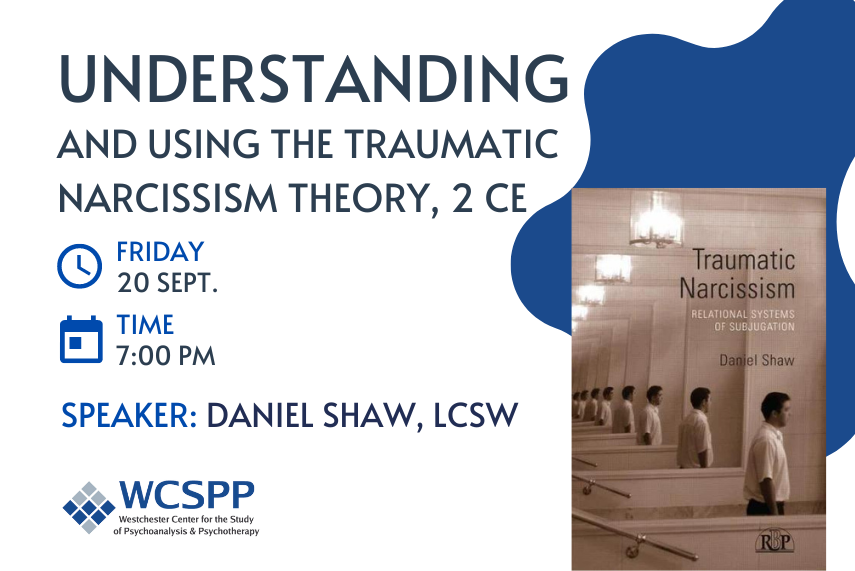
Understanding and Using the Traumatic Narcissism Theory

Understanding and Using the Traumatic Narcissism Theory
September 20 @ 7:00 pm - 9:00 pm

Since the publication of his 2014 book, Traumatic Narcissism: Relational Systems of Subjugation, Daniel Shaw has been refining and updating the psychological profile of the traumatizing narcissist, specifically for the purpose of helping victims of narcissistic abuse inflicted by parents, romantic partners or others. Many patients have difficulty articulating what happens to them in these relationships, and clinicians often miss the important clues that indicate this type of relational abuse. In this presentation, Shaw outlines the most prominent controlling behaviors of the traumatizing narcissist, how they impact his or her victims, and the specific ways that these patients can be helped to restore their critical thinking, their self-esteem, and their freedom from subjugation.
Presenter
Daniel Shaw, LCSW, is an author, teacher and psychotherapist in private practice in New York City and Nyack, NY. Integrating contemporary trauma theories with psychoanalytic work, Shaw works internationally with survivors of narcissistic abuse as well as cult survivors, and consults to other mental health professionals individually and in groups. www.danielshawlcsw.com.
2 CE HOURS available for:
NY Practitioners – LCSWs, LMSWs, LPs, LMFTs, LMHCs, LCATs, PHDs, PSYDs
CT Practitioners – LCSWs, LMSWs, LMFTs, LPCs and Licensed Psychologists
Teaching Method: Lecture, Discussion and Q & A.
Learning Objectives:
Participants will be able to:
1. identify the most prominent behaviors of the traumatizing narcissist.
2. formulate treatment goals for victims of narcissistic abuse suffering from Complex-PTSD.
3. utilize psychoeducation about the traumatic narcissism theory to help patients consolidate therapeutic gains.
A completed survey must be submitted after the meeting for 2 CE hours.
Who should attend: Psychiatrists, psychologists, social workers, psychoanalysts, other mental health professionals, nurses, graduate students.
Details
- Date:
- September 20
- Time:
- 7:00 pm - 9:00 pm
- Website:
- https://www.eventbrite.com/e/understanding-and-using-the-traumatic-narcissism-theory-tickets-938072248347?aff=oddtdtcreator
Aug 9, 2024
Subjugation, Mind Control, and Cultural Betrayal: Attachment Healing through Relational Connection
International Society for the Study of Trauma and Dissociation
Friday, October 25, 2024
Saturday, October 26, 2024
ISSTD Washington, DC Regional Conference Registration Link
" ... I am excited to share information about our upcoming ISSTD regional conference. This in-person conference is on Friday, October 25, 2024 and Saturday, October 26, 2024 in Arlington, Virginia. This conference is open to everyone! If you feel comfortable doing so, then please share information about our conference with your networks. I sincerely believe this will be an incredible learning opportunity.
Daniel Shaw, LCSW, Jennifer Gómez, PhD, and Richard Loewenstein, MD, will present on the multifaceted impact of narcissistic abuse, complex relational trauma, cultural betrayal trauma, and dissociative identity adaptations on attachment and healing. Although these ISSTD members need no introduction, I have shared their bios and a brief synopsis of their presentations below.
Daniel Shaw, LCSW is a New York based psychoanalyst who is an activist in support of individuals and families traumatically abused in cults. Additionally, he is a faculty member and supervisor at The National Institute for the Psychotherapies in New York. Daniel has published papers in Psychoanalytic Inquiry, Contemporary Psychoanalysis, and Psychoanalytic Dialogues. Daniel's book, Traumatic Narcissism: Relational Systems of Subjugation, was nominated for the distinguished Gradiva Award, and in 2018, the International Cultic Studies Association awarded Daniel the Margaret Thaler Singer Award for advancing the understanding of coercive persuasion and undue influence. In 2022, Daniel's book entitled Traumatic Narcissism and Recovery: Leaving the Prison of Shame and Fear was published and continues to receive much acclaim.
Daniel's presentation will provide a theoretical understanding of the traumatizing narcissist while highlighting the subjugation and recovery process for survivors. He will discuss his clinical frame when working with those who have survived traumatizing narcissists by comparing and contrasting his work with Kernberg's and Kohut's traditional theoretical conceptualizations of narcissism. Finally, Daniel will focus on the delusional omnipotence of the traumatizing narcissist and its impact on survivors.
May 11, 2024
Traumatic Narcissism in Cult Leaders - Interview with Daniel Shaw
Cult Vault: Traumatic Narcissism in Cult Leaders - Interview with Daniel Shaw
October 14, 2022
https://youtu.be/YD7_6jlbQwY?si=aoU70oS8P-U6m0kL
Aug 7, 2023
Conspirituality: Deep Cut: Post-Cult Shame
- Survivor shame over what has been lost, and how one has been complicit.
- Apologist shame: turned inside out and externalized as aggression.
- Popular shaming, which tries to deflect attention from how close to home cultic dynamics really are.
- In the cult landscape, shame is a common denominator. In this contemplation, Matthew unpacks various aspects, with help from the writing of cult theorists and recovery counselors Alexandra Stein, Daniel Shaw, and Holocaust survivor Primo Levi.
https://www.conspirituality.net/episodes/deep-cut-post-cult-shame
Jul 17, 2023
Recovering from a Traumatic Narcissistic Cultic Relationship with Dan Shaw
Nov 11, 2022
Traumatic Narcissism and Recovery
Mar 26, 2022
Heaven's Gate 25 Years Later: Former Cult Member Turned Recovery Counselor Explains How Cults Recruit
Mary Ellen Cagnassola
March 26, 2022
On March 26, 1997, 39 people dressed in matching black shirts, black sweatpants and Nike Decades prepared themselves to board a spacecraft trailing the impending Hale-Bopp comet and ascend to another level of human existence.
At least that's what was told to them by Marshall Applewhite, the cunning and charismatic leader of the group that called themselves Heaven's Gate. In separate groups, Applewhite and his followers mixed the barbiturate phenobarbital into applesauce and washed it down with a swig of vodka, tying plastic bags over their heads to assure asphyxiation.
Over the course of three days, the Southern California mansion that the group called home would become the site of what remains the largest mass suicide in United States history. Police would find Applewhite and the Heaven's Gate members draped in purple shrouds — save for two who were the last to die — each with five dollar bills and three quarters in their pockets.
"Being in the Heaven's Gate cult was an experience in which I gave my power away on all levels," Frank Lyford, a Heaven's Gate member who left the group before its tragic end, told PEOPLE in 2019. "I had to wake up to the fact that I had given that power away before I could wake up to the fact that I could take it back."
Heaven's Gate, now known as one of the most notorious cults, isolated its members from their loved ones and the outside world. They sustained themselves through an early-Internet web design business, Higher Source, and according to survivors who left the group, many never set foot outside their Rancho Santa Fe compound.
In honor of the 25th anniversary of the tragedy, PEOPLE sat down with Daniel Shaw, a psychoanalyst with expertise in cult recovery and a former member of the Siddha Yoga group, to talk about the warning signs of cult ideology, its modern-day iterations and how to help someone in danger.
Siddha Yoga, a spiritualist group that rose to popularity in the 1970s, was founded by the guru Swami Muktananda and later taken over by Swami Chidvilasananda, also known as Gurumayi. Still operational, its leaders have been accused of sexual abuse, pedophilia, harassment, rape and other crimes.
PEOPLE: Tell me a little about your background and your journey to helping victims of cult ideology. Do you consider yourself a survivor?
Shaw: I entered the mental health profession after spending 13 years participating in a religious group, which I came to view as an abusive cult. Once I was licensed as a mental health professional, I began to work with survivors of cults, families with loved ones in cults, and other kinds of abusive, controlling relationships and groups. My own experience with that kind of group is what has led to my working with other survivors, and I consider myself a survivor.
I was a full-time resident and worker in a religious group, where ultimately I was treated in a very abusive way and exploited. It took me more than a decade to understand what was happening. Finally, once I left, I began to study cults, and I met other cult experts, and then wrote about my experience, specifically about traumatic abuse in cults.
PEOPLE: How did you come to join Siddha Yoga?
Shaw: I grew up in a pretty secular Jewish home in New York, and there was no cult activity on anybody's part. We were a socially conscious family, progressive. I was a young adult in the '70s, when everybody was trying to recruit you into something. I managed to avoid getting recruited into anything until the end of my 20s, when I was drawn to Siddha Yoga, which was very popular with a lot of people in the arts at the time, which I was involved with. I got fully drawn into it and decided to commit myself to it and a certain point. Ten years later, I left recognizing how abusive the group really was and how abusive the leader really was.
PEOPLE: Why do people feel compelled to join these abusive groups?
Shaw: The reason anybody gets involved in a group that ultimately can be seen as a cult is that this group is promising a community of people who are committed to a meaningful purpose. In the case of Siddha Yoga, the meaningful purpose was to bring peace and enlightenment to others through meditation. My own experience, upon being introduced to the group and meditation, was absolutely phenomenal and felt incredibly different to anything I'd experienced before.
I felt connection and peace in a way that I had never felt and actually immediately improved some of the things I was struggling with — my anxiety — and it helped me feel much more motivated and more positive. So the initial impact of being introduced to meditation through this group was very powerful. Little by little, my experiences were so meaningful and powerful that I wanted to become a part of the organization, not just a visitor, and because it felt like the most meaningful thing I've ever experienced.
Most people who enter this kind of group — and it doesn't have to be religious, it can be political, it can be a business-oriented group, a self-help group — these kinds of groups attract people who are looking to be more successful, to be more productive, be more happy in their personal lives, to be able to contribute more to society. So the idealistic aims of the people who get involved are taken advantage of in these groups, because the groups themselves claim to have all of these kinds of idealistic purposes.
When a group is a cult, it's because the leader is a malignant narcissist, and these kinds of narcissists can be profound and incredibly charismatic. They make all kinds of claims for super intelligence and all kinds of accomplishments, very often those are fraudulent claims. Back when I got involved, there was no internet, so you didn't have a place to look up a group and find out its background. People who join initially believe that they're part of something very meaningful and important, that they can make a meaningful contribution to, and that they can benefit from you. The deeper you go in, really never an end to what's going to be asked of you. You're going to be asked to give and give and give. If you're not receiving what you were told you would, you'll be told that that's your fault, because you're not giving enough.
PEOPLE: How did you realize you were being taken advantage of and leave the group?
Shaw: In my own case, and in the case of most people in these groups, the participation is initially very exciting and very invigorating. You're in a group of people who are similarly highly motivated and everybody's working very hard towards the goals of making the group a success, and bringing the group's message to a wider audience. But if you get more and more deeply involved in a cultic group, what you begin to understand is that the leader is entirely self-aggrandizing and that the purpose and mission that is stated is never getting fulfilled. The only thing happening is that the leader is becoming more powerful and every way, having more control over the followers having more money, in many cases having whatever person they want to have sex with at their disposal.
Most people who spend anyone's time deeply involved in the group become exhausted and burned out. They work night and day, they're always on high alert. Everything is always a crisis. Many cult members blame themselves and their failure to be committed and motivated enough. I certainly was in that position for a while before I left, and once I left, I did so because I witnessed a great deal of abuse and cruelty and manipulation of people, including myself. When I heard a story from another follower about a young woman in the group who was being sexually abused by one of the higher-ups, who was told that it was her fault, and that she should never tell her mother. Actually, it was hearing that story that finally snapped me out.
PEOPLE: What are some warning signs that someone is becoming a victim of cult ideology?
Shaw: A group that has the characteristics of a cult, you don't necessarily have immediate exposure to the leader, you're more exposed to the followers at that point. The followers who are already involved are eager to welcome new recruits and make them feel very important and special. We call that love bombing. Once you've been recruited, and you really want to commit to being in the group, you may start to have more exposure to the leader and to other group dynamics, because the group kind of follows the behavior of the leader. That behavior in social psychology is called intermittent reinforcement. So if you're in a relationship or a group in which your experience is that you are greatly appreciated and loved and paid attention to, interspersed with being intimidated, that's the first and most important red flag.
PEOPLE: What can loved ones do to help a friend or family member who is recruited by one of these groups?
Shaw: Loved ones are in a very painful situation. They often feel helpless and unable to reach the person who's gotten involved in this kind of group. Being angry at them, confronting them, trying to prove them wrong, typically will drive people deeper into the group and further alienate them from you. So in order to try not to create further alienation, family members can try to extend themselves in a loving and empathetic way. It's very difficult because they have to hide their fear and their pain when they do that, but if it's maintaining that connection, they have a chance sooner or later — and it's often quite a bit later — for that family member to come back and realize they are loved unconditionally. That is an ideal situation.
PEOPLE: In the case of Heaven's Gate, how do these groups escalate to such a level of tragedy?
Shaw: Most groups don't end in this kind of mass suicide tragedy, but the ones that have ended in that way certainly get the most publicity, because it's the ultimate example: giving everything to the group and to its mission, including your life. Many, many people are in cults where they're giving everything just short of their actual life, and are being drained and exhausted. But when a group goes to that ultimate level, this has to do with the acute, near-schizophrenic kind of paranoia of the leader. For many group members, the leader is God, and if God is saying something, then it must be true. It's devastating for the survivors who were helpless all along to extract the loved one from the group. Law enforcement has its hands tied. We have laws about religious freedom, for example, or other kinds of freedoms.
PEOPLE: How can one spread awareness of the dangers of cult ideology in a way that avoids simply retelling its more sensational associations?
Shaw: There's a problem currently with trust in sources of information, and so many people who are currently involved in groups, such as QAnon and other splinter groups, are only receiving information from very limited sources, and are convinced that any other information is fake news. This is one of the problems we face, and people can easily just decide that they don't trust any information other than from the source that they're getting it from. There's no easy answer, but reliable information that is researched, that is backed up by evidence is available, and anybody who wants to research a group now and learn about its history, all of that information is readily available.
It's much more diffuse, and there are many branches. It's also fed by different groups who seek different aims. We don't quite have the means of fully protecting our citizens from disinformation. It's unfortunate that the internet has become one of the biggest recruiting tools in the history of the planet for actors who are creating cult-like groups.
https://people.com/crime/revisiting-heavens-gate-cult-expert-explains-how-groups-recruit/