May 18, 2023

3 Religions That Are Banned In Some Countries Around The World

Banned Beliefs: 3 Religions That Face Restrictions in Certain Countries


Andrei Tapalaga
History of Yesterday
May 17, 2023

Religious freedom is a fundamental human right, yet in some parts of the world, certain religions face severe restrictions and even outright bans. Today, we will explore three religions that have been banned or heavily persecuted in various countries: Falun Gong, Ahmadiyya, and Jehovah’s Witnesses. These religions have faced significant challenges in their practice, with restrictions imposed by governments based on political, social, or religious grounds.

Falun Gong: A Spiritual Movement Suppressed


Falun Gong, also known as Falun Dafa, is a spiritual practice that emerged in China in the early 1990s. Combining elements of meditation, qigong exercises, and moral teachings, Falun Gong attracted millions of followers within a short span of time. However, its rapid growth and popularity raised concerns among Chinese authorities, leading to a ban in 1999.

The Chinese government labeled Falun Gong as an “evil cult” and launched a massive crackdown on its practitioners. Thousands of adherents were detained, tortured, and subjected to forced labor and re-education programs. The authorities justified their actions by claiming that Falun Gong threatened social stability and national security.


Ahmadiyya: A Sect Targeted for Its Beliefs


Ahmadiyya is a sect within Islam that originated in India in the late 19th century. It emphasizes the belief that Mirza Ghulam Ahmad was a messiah and prophet, which has been considered heretical by mainstream Islamic sects. As a result, Ahmadi Muslims have faced persecution and legal restrictions in several countries, particularly Pakistan.

In Pakistan, Ahmadiyya Muslims have been declared non-Muslims by the state, which severely restricts their religious practices. They are prohibited from calling themselves Muslims, reciting the Islamic declaration of faith, or engaging in Muslim religious practices. Ahmadiyya mosques have been targeted, and violence against Ahmadiyya community members has occurred.


Jehovah’s Witnesses: A Faith on the Margins


Jehovah’s Witnesses is a Christian denomination known for its distinctive beliefs and practices, such as refusing military service, blood transfusions, and participation in political activities. Their non-conformity has led to bans and restrictions in various countries around the world.

Russia has been one of the countries where Jehovah’s Witnesses have faced significant challenges. In 2017, the Russian Supreme Court labeled the organization as extremist and banned its activities. Jehovah’s Witnesses’ properties were confiscated, and their members faced arrests and imprisonment for practicing their faith.


The Impact of Religious Bans: Human Rights and Freedom of Belief

The bans on these religions raise important questions about human rights and religious freedom. Restricting or banning a religious group’s activities not only infringes upon individual freedom of belief but also undermines broader principles of human rights. These restrictions stifle religious diversity and pluralism, hindering the free expression of one’s faith.

Despite facing bans and persecution, followers of Falun Gong, Ahmadiyya, and Jehovah’s Witnesses have engaged in advocacy efforts to seek change and challenge the restrictions imposed on their religious practices. They have utilized various avenues, such as legal challenges, international pressure, and raising awareness through media and human rights organizations.

The banning and persecution of religious groups like Falun Gong, Ahmadiyya, and Jehovah’s Witnesses highlight the challenges faced by believers seeking to exercise their religious freedom. These restrictions not only violate the principles of human rights but also hinder religious diversity and the expression of individual beliefs. As we strive for a world that embraces tolerance and respect, it is essential to recognize and address the barriers faced by these religious communities in their quest for freedom of belief.


https://historyofyesterday.com/3-religions-that-are-banned-in-some-countries-around-the-world/

Kenyan cult deaths hit 226 as 15 more bodies exhumed

Times Reporter
New Times
May 18, 2023

The death toll in a probe into a Kenyan cult suspected of urging followers to starve themselves to death rose to 226 on Wednesday after 15 more bodies were found, the authorities said, AFP reports.

Investigators are poring over the forest hideout of a group called the Good News International Church, located near the Indian Ocean town of Malindi.

Its founder, Paul Nthenge Mackenzie, a taxi driver-turned-preacher, is accused of inciting acolytes to fast to death "to meet Jesus”.

"Following today's exercise, 14 bodies were exhumed, and one was found in the forest," Coast Regional Commissioner Rhoda Onyancha said.

“Another person was found alive by emergency teams,” she said.

112 autopsies have been carried out so far, most of which show that the individuals died of hunger, investigators say.

Others, including children, show signs of having been strangled, beaten or suffocated.

Court documents filed last week said some of the corpses had their organs removed, with police alleging the suspects were engaged in forced harvesting of body parts.

But Kenya’s Interior Minister Kithure Kindiki has urged caution, telling reporters that "it is a theory they are investigating".

Onyancha on Saturday said 26 people had been arrested, including Mackenzie and an "enforcer gang" tasked with ensuring that no one broke their fast or left the forest hideout alive.

The grim saga has stunned Kenyans and led President William Ruto to set up a commission of inquiry into the deaths, as well as a task force to review regulations governing religious bodies.

Ezekiel Odero, a high-profile and wealthy televangelist, has been accused of links to Mackenzie and to the bodies found in the forest.

https://www.newtimes.co.rw/article/7588/news/religion/kenyan-cult-deaths-hit-226-as-15-more-bodies-exhumed

Analyzing Word Salad w/ Kayla from Keya’s World

The IndoctriNation Podcast: Analyzing Word Salad w/ Kayla from Keya’s World


Kayla is a YouTube creator and launched her channel Keya’s World back in 2021 to discuss toxic positivity, hustle culture, self-help, spirituality, scams, and everything in between.

Let Your Light Shine: Secrets in the Shadows

This book is about Lucia's experience of being raised within a religious cult. She left at the age of sixteen where she had to choose between her family and her own life. Lucia was then out in the world where she had to face some harsh realities, but also experienced freedom and the wilder side of life. She later explored other spiritual paths that were the start of a fascinating journey.

Duggar Family - and Their Religion - Exposed in Explosive Prime Video Docuseries Featuring Jill and Amy (Exclusive)

Shiny Happy People: Duggar Family Secrets premieres June 2 on Prime Video

People

By Dory Jackson

May 18, 2023 Share

The dark side of the infamous Duggar family is set to be exposed in an explosive new Prime Video docuseries — and PEOPLE has the exclusive first look.

The limited series, Shiny Happy People: Duggar Family Secrets, aims to go beneath the surface as it explores the wholesome family's troubling ties to a radical religious organization, the Institute in Basic Life Principles. In doing so, it unveils how the organization has shaped — and negatively impacted — the once-beloved TLC brood, which has since experienced a series of controversial scandals.

In PEOPLE's exclusive look at the first trailer, a man claims: "World domination was the goal."

"The IBLP teachings aren't Christianity," a woman then alleges. "They're something entirely different."

 A History of the Ups & Downs of the Duggar Family

The trailer eventually teases Jill (Duggar) Dillard, Derick Dillard and Amy (Duggar) King's involvement.

"There's a story that's going to be told," Jill, 32, says. "And I would rather be the one telling it."

Thinking back to her upbringing, Jill adds of her family: "We were part of IBLP as early as I can remember."

More accusations fly throughout the trailer, as one man alleges that IBLP founder Bill Gothard "turned every father into a cult leader and every home into an island."

At one point, a lady equates her experience within the organization to Hulu's acclaimed Handmaid's Tale series, which sees women being subjugated in extreme ways.

Another woman alleges that "the institute raises little predators." Following that, a news announcer speaks about the Duggars's "dark family secret" involving Jill's brother, Josh Duggar.

 Jinger Duggar Says She Hasn't Seen 'True Change' in Brother Josh Duggar: 'I Just Pray for the Victims'

The 35-year-old was found guilty in December 2021 of knowingly receiving and possessing child pornography. Before that, Josh admitted in a police report that he molested four Jane Does when he was between the ages of 12 and 15. Two of the victims that came forward were his sisters Jill and Jessa (Duggar) Seewald.

"It's like the epitome of evil," a woman says. "It breaks my heart to think about the girls."

Despite the insidiousness within the family, the docuseries declares that "this is much bigger than the Duggars."

 Amy Duggar King Say It's 'Ok to Have Huge Boundaries' with Family amid Josh Duggar Legal Drama

Another woman alleges that IBLP is "playing the long game" in hopes of getting kids within the devoted base "training in political engagement" to get them prominent roles in office. (As some may recall, Duggar family patriarch Jim Bob Duggar previously served in the Arkansas House of Representatives and later had several unsuccessful attempts seeking higher office.)

"The shiny, happy images is the sugar, and we're all high on it," a different woman says. "They were just deceiving us all."

Shiny Happy People: Duggar Family Secrets premieres June 2 on Prime Video


https://people.com/tv/duggar-family-prime-video-docuseries-shiny-happy-people-trailer-exclusive/


May 17, 2023

Inside the Cult of Stefan Molyneux: A Historical Exploration of Far-Right Radicalisation on YouTube

Inside the Cult of Stefan Molyneux: A Historical Exploration of Far-Right Radicalisation on YouTube

Daniël Jurg, Maximilian Schlüter and Marc Tuters
Global Network on Extremism and Technology
May 17, 2023

Introduction

On June 29, 2020, YouTube removed 25,000 channels, including several prominent white supremacist figures such as David Duke, Richard Spencer, and Stefan Molyneux. While Duke and Spencer were generally well-known white supremacist figures, Molyneux specifically built his reputation on YouTube. The self-described philosopher has been labelled a cult leader spreading white supremacist ideas to millions of YouTube users, radicalising impressionable young men. The New Zealand Royal Commission also concluded that the Christchurch shooter watched and donated to Molyneux’s channel. Although watchdog organisations like the Southern Poverty Law Center extensively warned of Molyneux’s extremism, popular narratives about YouTube radicalisation still often focus on passive algorithmic pipelines and extreme cases of political violence. However, there is scarce empirical evidence on how audiences engage with problematic YouTube channels. YouTube’s current deplatforming efforts, by simply removing all data from public view, limit further critical analysis and understanding.

In this Insight, we present the key takeaways from an exploratory audience engagement study using an archival dataset of approximately two million YouTube comments from a ten-year period (2008 – 2018) on Molyneux’s YouTube channel. This rare dataset offers unique insight into an important moment in the growth of online far-right radicalisation—one currently invisible through the platform’s application programming interface (API). This piece aims to show the ‘everyday’ aspects of audience engagement with extremism on YouTube. To make our case, we first argue for a more participatory cultural understanding of YouTube radicalisation, highlighting active audience participation. We then present our methods and findings, revealing key participatory and discursive elements in Molyneux’s community. While Molyneux’s audiences express a wide range of opinions using various engagement tactics, we show how core audience members engage with extremist discourse from the perception of pursuing ‘Truth.’

YouTube Radicalisation

Over the past decade, YouTube has become notorious for its ‘radicalising power.’ Commentators such as the sociologist Zeynep Tufekci claimed that YouTube ‘may be one of the most powerful radicalising instruments of the 21st century.’ Although reporting is shifting, YouTube radicalisation is mostly attributed to sophisticated algorithms and how they expedite far-right extremism. However, recent research argues that such techno-centric analyses fail to account for demanding audiences: extreme political communities have incredibly high participation rates. Indeed, as audience studies have consistently demonstrated, viewers, readers, and listeners actively create meaning from and with the media they consume. As we have argued elsewhere, audiences in these communities “perceive themselves less as observers and more as participants in a conversation in which their voices matter”. It is thus worth asking how and why audiences engage with such extreme political narratives.

It might seem perplexing for outsiders of these YouTube communities that ideas about ‘scientific racism,’ eugenics and white supremacism would engage vast audiences. However, on YouTube, such ideas are often embedded within a specific vernacular culture, appealing to existing sensibilities by translating extreme political ideas to the platform logic to which users are already predisposed. For example, Becca Lewis pointed out that extreme political figures on YouTube use tactics like other popular influencers, engaging in interviews, guest appearances, debates, vlogging, and reaction videos.

Media studies have well documented how such practices are fruitful in building and maintaining audiences and establishing high levels of intimacy and parasocial relationships. YouTube increases this parasocial potential by affording audience engagement through features such as ‘likes’ and ‘comments’. In fact, YouTube’s technological facilitation of reciprocity is often seen as one of the platform’s core strengths. Extreme political figures on YouTube do not merely broadcast their ideas to a passive and receptive audience but develop them in dialogue with their audience, who present their own ideas, sources, and arguments.

Methodology

Using an archival dataset containing approximately two million YouTube comments from a ten-year period (2008 – 2018) on Molyneux’s YouTube channel, initiated by Dutch journalists at De Volkskrant and Correspondent, we could (1) analyse when Molyneux attracted active audience engagement and (2) follow how audiences engaged over time. The engagement mapping was done by plotting monthly comments and contextualising the emerging peaks. We used computer-assisted content analysis with 4CAT to detect important discussion points. On a micro-level, we specifically analysed the comments of six (anonymised) highly engaged audience members over time.

Operationalising the concept of ‘radicalisation’ is tricky. This is partly due to the divergent and sometimes vague interpretations of the concept from a diverse set of fields, including criminology, anthropology, social movement studies, and media and communications studies. When we talk about radicalisation in the context of this Insight and our study of ‘everyday’ extremism on YouTube more broadly, we follow the definition of radicalisation as “the process of developing extremist ideologies and beliefs”. As Peter Neumann points out, extremism does not necessarily imply violent acts or terrorism but may refer more broadly to adopting “political ideologies that oppose a society’s core values and principles”.

The Zimmerman Trial

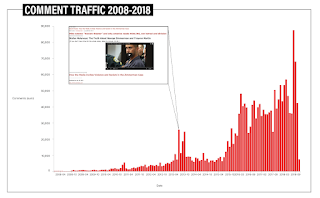
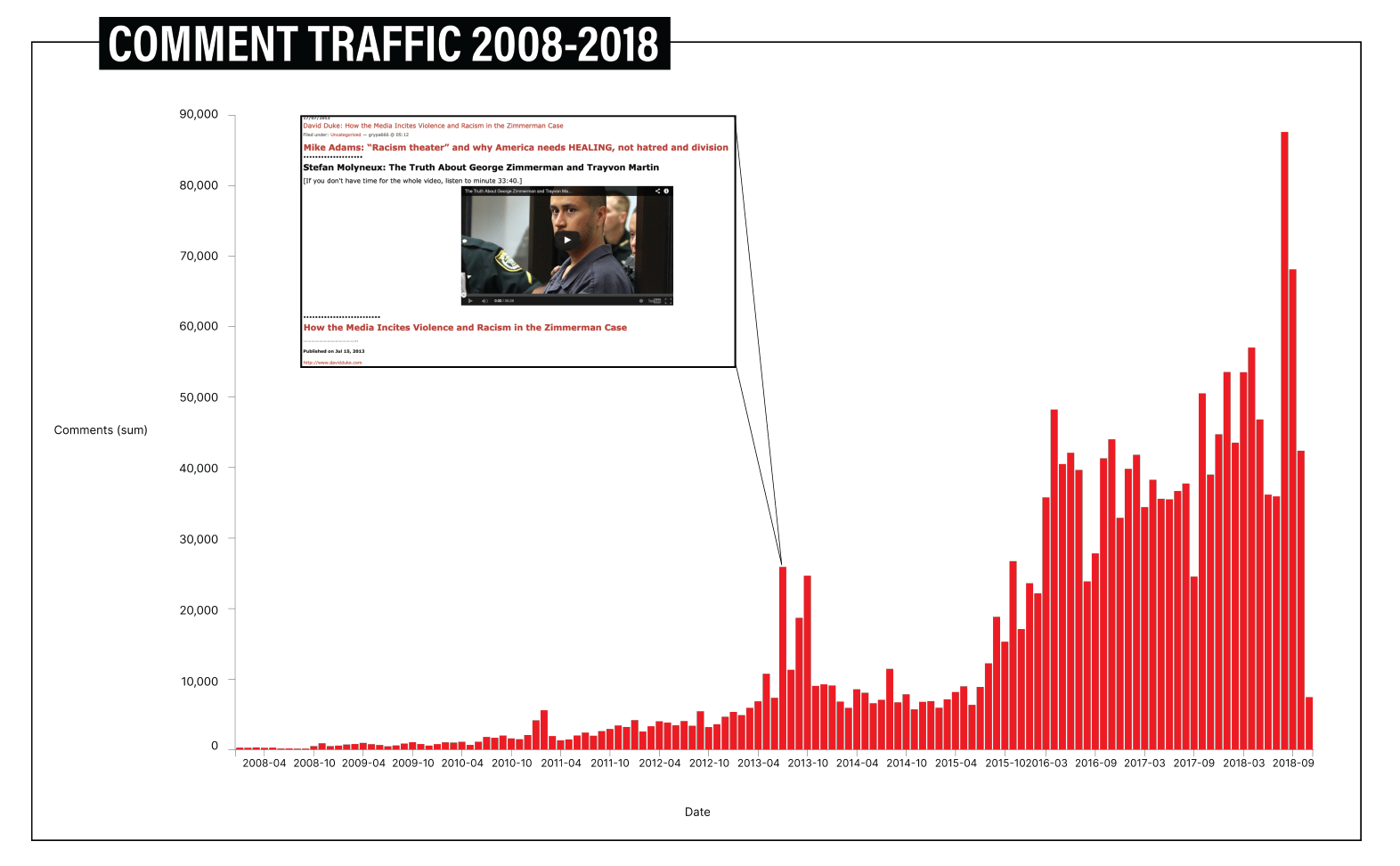
Our first analysis aims to uncover important moments in the development of Molyneux’s participatory community through his YouTube comment section (Fig 1).


Figure 1 shows that Molyneux progressively attracted more participatory audiences, with a significant first peak of engagement occurring in 2013. This peak corresponds with Molyneux’s video analysis of the highly publicised criminal case and trial of George Zimmerman. Zimmerman, a neighbourhood watch volunteer, was charged with the second-degree murder of the 17-year-old African American teenager Trayvon Martin. In their book Meme Wars, Joan Donovan, Emily Dreyfuss, and Brian Friedberg argued that the Zimmerman trial was a key moment in developing white supremacist internet culture—a hypothesis we can underline with the findings. But while on 4Chan the Zimmerman Trial became part of reactionary meme culture, Molyneux’s video titled ‘The Truth About George Zimmerman and Trayvon Martin’ took a serious approach pointing out that mainstream media were not telling the truth and misreporting the facts (the video can still be watched on YouTube).

The Zimmerman Trial seems to be a turning point in Molyneux’s discourse and audiences—his community was more concerned with libertarian ideas before. The video was shared by David Duke and circulated among white supremacist audiences, which explains some of the overt racism in the comments. This point was also noted by an audience member who had been commenting on his channel since 2011:

This video about Zimmerman has drawn out some very savage comments from those who don’t seem remotely interested in the truth (really makes me appreciate the normal comments). I wonder if this video is being exposed via google recommendations to a wider mainstream audience.

The Zimmerman trial was one of the first moments that Molyneux’s community significantly grew outside its libertarian origin, with various audiences joining the online culture wars. As Stuart Hall theorised, audiences performed preferred, negotiated, and oppositional readings of Molyneux’s takes, and it is important to note that the audience is not monolithic but an aggregation. Audiences have different uses and gratifications for watching Molyneux, such as expressing anger, trolling, hate-watching, mocking etc., making it difficult to assess any direct effect of the video on anyone’s political beliefs. The current conception within political persuasion theory is that people have “stable, cognitively efficient predispositions that are commonly activated and reinforced – but rarely changed – by information disseminated by persuasion campaigns and within social media”.

That being said, the Zimmerman trial does reveal a key new discursive element, which cannot be found in any comment before the trial—race-baiting. While traditionally used to identify a racist act, the term was used by reactionaries around the Zimmerman trial to claim that mainstream media were clouding “logic and facts by appealing to emotion through false accusations of racial discrimination”. As we have argued elsewhere, Molyneux increasingly evoked this framing of a highly emotive media vis a vis him as an objective and rational “philosopher”, mediating between the “ugly truth” of objectivism and the wishful thinking of social constructivists. This discourse is highly important in his later discussions on scientific racism. As Molyneux stated in an interview with Dave Rubin, “there is almost nothing harder to absorb than this question of differences in IQ between groups”, juxtaposing his personal uncomfortableness with the ‘facts’ about the hierarchy of different eugenic ‘races’.

Audiences’ Pursuit of the Truth

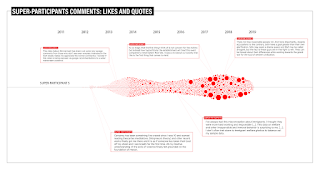
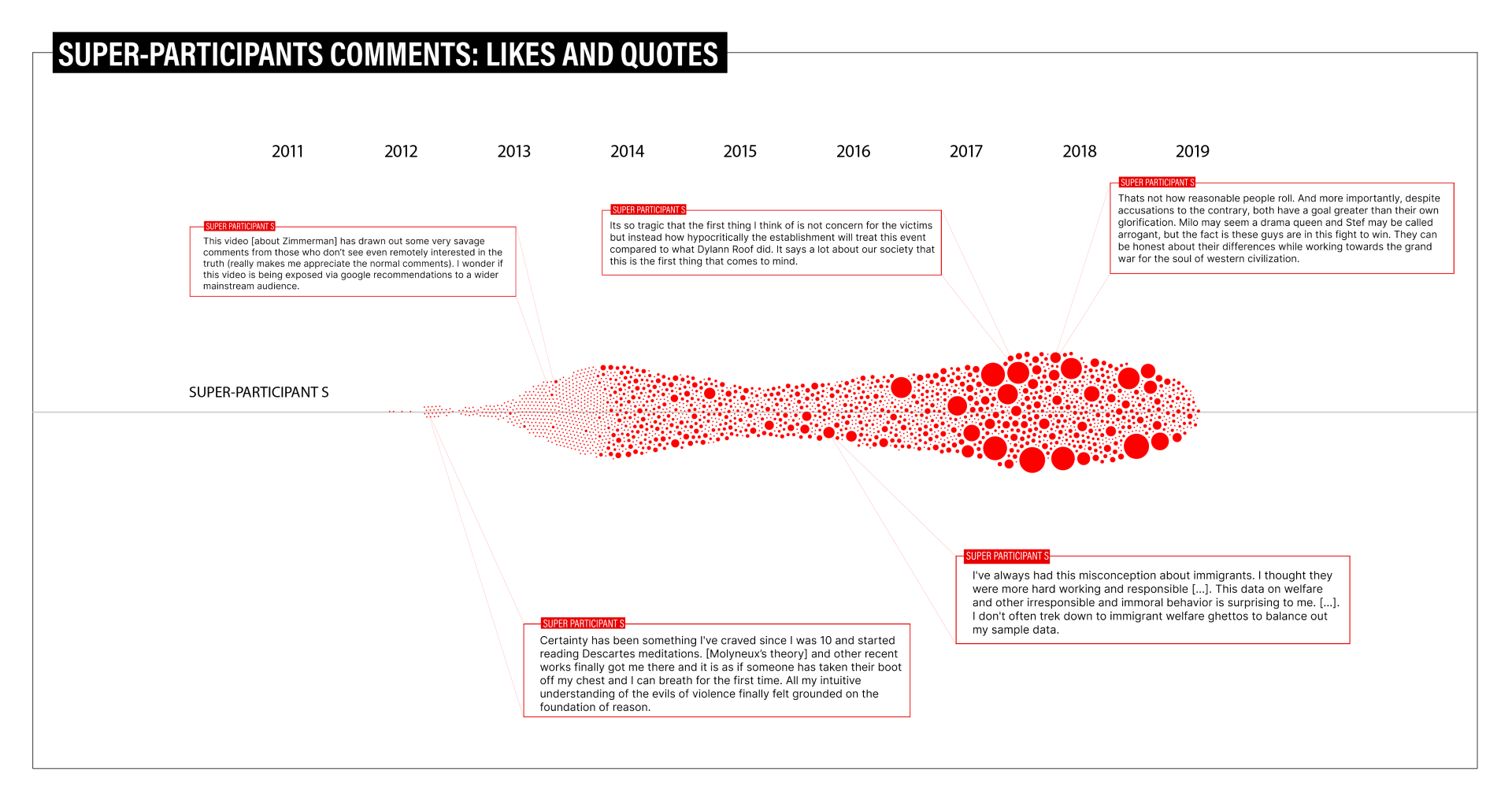
The ‘logic and facts’ framework is useful for understanding certain radicalising dynamics in the commenting behaviour of long-time super-participants in Molyneux’s community. The key takeaway from close reading highly involved audiences’ comments is that they pack some extensive reflections. Molyneux seems to offer his community members an ‘objective’ framework that allows them to make sense of the world and their place in it. Using super-participant S’s trajectory here as an illustration, we see how this ‘objectivity’ becomes more extreme (Fig. 2).


Having started commenting in 2011, super-participant S wrote in 2012:

Certainty has been something I’ve craved since I was 10 and started reading Descartes meditations. [Molyneux’s theory] and other recent works finally got me there and it is as if someone has taken their boot off my chest and I can breath for the first time. All my intuitive understanding of the evils of violence finally felt grounded on the foundation of reason.

Molyneux offers this feeling of liberation and freedom through ‘logic’, ‘facts’, ‘reason’, and ‘Truth’. This philosophical framework allows audiences to change their minds on politically charged topics like immigration. For instance, super-participant S captures a reframing of immigration discussions in 2015 following a dispassionate analysis of the data:

I’ve always had this misconception about immigrants. I thought they were more hard working and responsible […]. This data on welfare and other irresponsible and immoral behavior is surprising to me. […]. I don’t often trek down to immigrant welfare ghettos to balance out my sample data.

Building onto the concepts of ‘logic’, ‘facts’, ‘reason’, and ‘Truth’, long-time members of Molyneux’s community underline their objectivist worldview by using deeply ethical frames where terms such as ‘evil’ and ‘immoral’—previously used for libertarian discussions—are applied to more extreme discussions. This type of sensemaking occurs across various manifestations of ‘online othering’ in Molyneux’s comment sections, including extreme political polarisation, racism, and sexism, amongst other forms of discrimination. The trajectory of super-participant S in our dataset ends with full involvement in the “grand war for the soul of western civilisation”.

Conclusion
Our exploratory study of the comments on Stefan Molyneux’s YouTube channel sheds light on a historical moment of radicalisation on the platform. Using close and distant reading techniques of audience engagement, our analysis provides a unique perspective on the radicalisation process that broadens the focus beyond algorithmic recommendations. We find that Molyneux’s core audiences participate in a perceived ‘intellectual’ discourse that differentiates their community from the mainstream media, the emotive left, and overt racism. We discovered an almost obsessive relationship with logic, reasoning, and truth as core values among Molyneux’s most engaged audiences, who frame extreme ideas as the ‘sad truth.’

The culture wars in which reactionary actors leverage facts, logic, and reason are expected to remain part of the digital space for some time. We would therefore align ourselves with scholars who question the assumption that the issues discussed above can be reduced to problems of misinformation as fact-checking. Rather, we need to attune ourselves to how platforms afford participatory far-right communities to construct their knowledge and build their worldviews in order to counter their persuasive rhetoric.

We know that such radicalisation dynamics are challenging to track and scale; however, now that YouTube has taken on the more active moderating role, giving external parties access to removed data should be the start. As YouTube tends to downplay the scale of the issue, it remains unclear how it will address the persistence of similar far-right discourse on the platform. We hope our analysis of Molyneux’s community from a period when YouTube treated ‘the alt-right’ as a ‘content vertical’ can shed light on how to address these issues in the future.

Daniel Jurg is a PhD Candidate in Media and Communication Studies at the Vrije Universiteit Brussel. He is part of the research unit on News: Uses, Strategies & Engagements within the research group imec-SMIT at the Vrije Universiteit Brussel and the Open Intelligence Lab at the University of Amsterdam. Working on a scholarship from the Research Foundation Flanders (FWO), he studies the history of alternative influence on YouTube.

Maximilian Schlüter is a PhD Student of Information Science at the Graduate School of Arts from Aarhus University, Denmark. His research project revolves around studying and understanding disinformative memes in far-right online spaces using feminist critical theory.

Marc Tuters is an Assistant Professor in the University of Amsterdam’s Media Studies faculty where he is affiliated with the Digital Methods Initiative and the Open Intelligence Lab, studying political subcultures at the bottom of the Web.


https://gnet-research.org/2023/05/17/inside-the-cult-of-stefan-molyneux-a-historical-exploration-of-far-right-radicalisation-on-youtube/

Kenya cult death toll hits 200, with more than 600 reported missing

The death toll linked to a doomsday cult in Kenya has hit 201 after police exhumed 22 more bodies on Saturday


Associated Press
EVELYNE MUSAMBI
May 13, 2023

NAIROBI, Kenya -- The death toll linked to a doomsday cult in Kenya hit 201 Saturday after police exhumed 22 more bodies, most of them bearing signs of starvation, according to the coast regional commissioner.

The bodies are believed to be those of followers of a pastor based in coastal Kenya, Paul Mackenzie. He's alleged to have ordered congregants to starve to death in order to meet Jesus.

More than 600 people are still missing.

Mackenzie, who was arrested last month, remains in custody. Police plan to charge him with terrorism-related offenses.

Hundreds of bodies have been dug up from dozens of mass graves spread across his 800-acre property, located in the coastal county of Kilifi.

Mackenzie insists that he closed his church in 2019 and moved to his property in a forested area to farm.

Autopsies conducted on more than 100 bodies last week showed the victims died of starvation, strangulation, suffocation and injuries sustained from blunt objects.

Local media outlets have been reporting cases of missing internal body organs, quoting investigators in the case.

Mackenzie, his wife and 16 other suspects will appear in court at the end of the month.

Coast regional commissioner Rhoda Onyancha on Saturday said the total number of those arrested stood at 26, with 610 people reported as missing by their families.

It is unclear how many survivors have been rescued so far from the search and rescue operations on Mackenzie's vast property. Some of them were too weak to walk when they were found.

Cults are common in Kenya, which has a religious society.

Police across the country have been questioning other religious leaders whose teachings are believed to be misleading and contrary to basic human rights.

President William Ruto last week formed a commission of inquiry to investigate how hundreds of people were lured to their deaths at the coast and recommend action on institutions that failed to act.

Mackenzie had in the past been charged with the deaths of children in his church in a case that is ongoing in court. Residents nearby had raised the alarm after his followers moved to the forested area.

https://abcnews.go.com/International/wireStory/kenya-cult-death-toll-hits-200-600-reported-99306474

Danny Masterson used drugging, Scientology to get away with rape, prosecutor says

Andrew Dalton
CTV News
The Associated Press
May 16, 2023

Danny Masterson drugged women's drinks so he could rape them, then relied on his prominence in the Church of Scientology to avoid consequences for years, a prosecutor told jurors Tuesday in closing arguments at the actor's trial.

"The defendant drugs his victims to gain control. He does this to take away his victims' ability to consent," Deputy District Attorney Ariel Anson told the jury of seven men and five women. "You don't want to have sex? You don't have a choice. The defendant makes that choice for these victims. And he does it over and over and over again."

The 47-year-old former star of "That '70s Show" is on rape trial for a second time after the first ended in a mistrial in December, with a jury hopelessly deadlocked on all counts. The new jury is expected to get the case Wednesday morning when prosecutors complete their final rebuttal.

Masterson has pleaded not guilty to raping three women at his home between 2001 and 2003. His attorney, Philip Cohen told jurors during his closing that inconsistencies in the women's stories that he said Anson downplayed are essential and should make it easy for jurors to have reasonable doubt of Masterson's guilt.

"She did a very nice job of ignoring many of them," Cohen said. "What she views as little inconsistencies are at the heart of trying to determine, `Is somebody, reliable, credible, believable enough for a criminal conviction?"'

He dwelled on one woman testifying that Masterson pulled a gun from a nightstand at one point during the night she said she was attacked, though there was no mention of it in the report from her initial police interview. She insisted she had told police about it then. Cohen said that alone was enough to crater her credibility and introduce reasonable doubt that Masterson is guilty.

Anson took aim at the Church of Scientology, of which Masterson is a member and all three women are former members, throughout her argument, emphasizing that church authorities kept the women from accepting what had happened to them and from reporting it to police for years.

"The church taught his victims, `Rape isn't rape, you caused this, and above all, you are never allowed to go to law enforcement,"' she said. "In Scientology, the defendant is a celebrity and he is untouchable."

The church has denied having any policy discouraging members from going to law enforcement.

Actor Leah Remini, a former member of the church who has become one of its most prominent public opponents, sat in the courtroom, her arm around one of the accusers, who testified during both trials that Masterson raped her in 2003.

"Why have we heard so much about Scientology?" Cohen said in his closing. "Could it be because there are problems with the government's case?"

He emphasized an instruction that said jurors could not hold his religion as a sign against his character, and a stipulation from both sides that no evidence was presented at trial that Masterson had harassed the women.

Cohen said Claire Headley, a former Scientology official who testified as a prosecution expert in an element not allowed at the first trial, had credibility problems based on an unsuccessful lawsuit against the church and a relationship with Remini.

"She came with a bias and a motive," Cohen said.

Anson guided jurors through the testimonies of all three women. One is a former girlfriend who said Masterson raped her five years into their relationship in 2001. The two others are women he knew through social circles surrounding the church.

The Associated Press does not typically name people who say they have been sexually abused.

All three testified that they became unusually groggy and had gaps in consciousness and memory after consuming drinks Masterson gave them. Los Angeles Superior Court Judge Charlaine Olmedo allowed the prosecution during the second trial to directly say he drugged the women, after only allowing descriptions of their states at the first.

There is no forensic proof of any drugging. The investigation that led to Masterson's arrest did not begin for about 15 years after the women say they were raped. Anson told jurors the women's accounts and the testimony of a police toxicology expert who described symptoms should be enough.

"What is not here is evidence of drugs," Cohen said in response. "Miss Anson presented a case as if she was arguing a drugging case. Maybe it's because there is no evidence of force or violence."

Cohen argued that the women contaminated their testimony by communicating with each other after the police investigation began in 2016.

Anson said during her presentation that the women had no reason to lie and that it is not plausible that they were engaging in a "grand conspiracy" to get Masterson.

Cohen said he was "not claiming some grand conspiracy."

"It is a tweak here, a massaging a word there, a saying something over here," the defense attorney said. "That's what contamination really is."

Cohen also said civil lawsuits brought by the women are evidence they have a financial incentive.

"If you're looking for motives why they might not be truthful, there are motives all over the place," he said.

Fewer than half of jurors voted to convict Masterson on any count after the first trial.

His attorney emphasized Tuesday that even if they believe it is likely he is guilty, they must acquit.

"If you say, `I think he is probably guilty,' you know what that leads to?" Cohen said, then made a buzzer sound. "Not guilty."


https://www.ctvnews.ca/entertainment/danny-masterson-used-drugging-scientology-to-get-away-with-rape-prosecutor-says-1.6401629

May 16, 2023

Internal church probe into Christian 'cult' leader not trusted by victims

Rev Canon Mike Pilavachi stepped back from CofE ministry while an internal investigation into allegations about his behaviour is ongoing.


Gabriella Swerling, SOCIAL AND RELIGIOUS AFFAIRS EDITOR
The Telegraph
May 13, 2023


Victims of a Christian youth festival founder accused of spiritual abuse are calling for an independent investigation into his behaviour, warning they “don’t trust the church to mark its own homework”.

It was announced in April that Rev Canon Mike Pilavachi, founder of Soul Survivor Watford church and its namesake youth festivals, which attracted tens of thousands of teenagers from around the world, was stepping back from Church of England ministry.

The move came amid an ongoing internal investigation and following allegations revealed by this newspaper accusing him of forming inappropriate intimate relationships with young people.

The Telegraph revealed details of the allegations surrounding the 65-year-old leading evangelical preacher, as victims spoke out for the first time claiming he ran “a cult” in which young men were encouraged to receive full-body massages on his bed and engage in wrestling matches.

‘A cruel game’

They also claimed that they suffered psychological torment and spiritual abuse in what they described as “a cruel game” at the hands of their vicar who they say “left a trail of broken, young male adults scattered all around the world”.

The Diocese of St Albans and the Church of England’s National Safeguarding Team (NST) are currently leading an internal investigation into Rev Canon Pilavachi. However, it has since emerged that some of the allegations against him are more recent. It is understood that the allegations span at least three decades and some are as recent as 2020.

Now, victims have spoken out, claiming that they do not trust the church to conduct its own investigation.

‘Require transparent investigation’

Some of the victims have released a statement through Richard Scorer, head of abuse law and public inquiries at the law firm Slater and Gordon, who is advising them. It said: “The days when churches could plausibly investigate themselves and mark their own homework are long gone.

“The allegations against Mike Pilavachi are extremely serious. They clearly require comprehensive, independent and transparent investigation, covering both the allegations themselves and, crucially, the institutional response to those allegations, both within Soul Survivor and across the wider Church of England.

“Given the network of connections between Soul Survivor and the Church of England, we do not believe that any Church of England body, whether the Diocese of St Albans or the NST, can plausibly conduct an independent, objective and transparent investigation at this time.

“There are simply too many connections between the Church of England and Soul Survivor, both at diocesan and national level, and too many potential conflicts of interest, for survivors to have confidence in the independence and transparency of any church-run investigation.”

The statement concluded by calling on the Church of England and the NST to accept that a trusted independent body should be appointed to conduct this investigation, and to engage with survivors in the selection of such an agency.

Gathering accolades

The Soul Survivor summer festivals in the UK ran from 1993 to 2019 in the UK, and attracted around 30,000 young people from all over the world.

As recently as 2020, Rev Canon Pilavachi was gathering accolades from the Archbishop of Canterbury, the Most Rev Justin Welby, who awarded him at Lambeth Palace for his “outstanding contribution to evangelism and discipleship amongst young people”. That same year he was also appointed an MBE in the New Year Honours for his services to young people.

Yesterday Paul Martin, founder of the US branch of Soul Survivor, became the first whistleblower to go on the record claiming that Soul Survivor leaders in the UK were aware of allegations surrounding Rev Canon Pilavachi as early as 2002 and that concerns had again been reported to them in 2004. He also raised concerns about the Church of England conducting its own internal investigation.

“I believed and I assumed that the leadership in the UK was dealing with this,” he said.

“I was told the allegations/behaviours were being looked at and I expected that measures were put in place to ensure any confusion or misconduct was dealt with,” he added.

“Given that Mike continued to minister, it was naturally expected that leadership had done its job.

“I’m not sure an investigation by the Church of England is an independent investigation, given that it’s part of the denomination,” he added.

“Churches and denominations historically do a horrible job at this... and so I’m concerned – gravely concerned – because this has been going on for 20 years and I hope they get it right. I have not been confident so far.”

‘Conveyor belt’

Former Soul Survivor staff members, as well as Rev Canon Pilavachi’s victims, claim that in hindsight they were part of a “conveyor belt” of young, athletic, attractive men, usually aged around 18 to 21 from broken homes or with traumatic childhoods, who were preyed upon and made to feel “special” by their celibate vicar who they say led them to believe he held the key to their careers, happiness and futures.

Many of the people The Telegraph has spoken to say they first encountered the now 65-year-old charismatic evangelist through his church’s gap-year programme, Soul Time, now known as Soul61.

Some became either his official or unofficial interns, and described him as a magnetic, “powerful” man with “a direct dial to God” who could determine their future within the church.

One man, speaking on condition of anonymity, said that he has “deep concerns” about the church’s “ability to conduct a thorough and unbiased investigation into its own affairs, particularly when it comes to sensitive and controversial issues such as those relating to Pilavachi”.

He added: “The church’s hierarchical structure and insular operations make it difficult for independent scrutiny to take place.

“Pilavachi’s influence bled across the veins of the church – both in the UK and across the world – and he has, or at least had, friends in high places who will have vested interests in the current investigation.

“I am aware of cases where the church has to have covered up or mishandled cases of abuse, both recent and non-recent, so I have little to no confidence in them handling the Pilavachi investigation properly.

“Because of this, I believe it is of the utmost importance for a truly independent body to be appointed to investigate Pilavachi so that the whole truth can be brought into the light to allow justice to prevail.”

‘Entirely independent’

In response, a Church of England spokesperson said: “The investigation is being run by safeguarding professionals from the National Safeguarding Team, NST, and diocese of St Albans and is entirely independent of Soul Survivor.

“We would urge anyone with any information to come forward and we can assure them that they will be treated with the utmost sensitivity.

“We cannot comment on any details shared by individuals, but we recognise the courage it takes to come forward and we would urge anyone who has information or wants support to contact the diocese or NST.

“We continue to offer support to all those involved and are also signposting to Safe Spaces, an independent support service.”

Rev Canon Pilavachi did not respond to a request for comment.

https://www.telegraph.co.uk/news/2023/05/13/alleged-victims-dont-trust-internal-church-probe/

May 15, 2023

Lori Vallow: US doomsday cult mum guilty of murdering children, rival

Chelsea Bailey & Holly Honderich
BBC News, Washington
May 13, 2023

An Idaho mother in a doomsday cult has been found guilty of murdering her two children and her husband's former wife, in a case that shocked the US.

Lori Vallow and her husband, Chad Daybell, were charged with murder, conspiracy and grand theft in the killings.

The 49-year-old beautician now faces up to life in prison.

The bodies of Joshua "JJ" Vallow, seven, and Tylee Ryan, 16, were found buried at Mr Daybell's home in 2020.

Vallow, flanked by her lawyers, sat impassively as the jury returned its verdict, finding her guilty on all six counts of murder, conspiracy and grand theft.

Tearful relatives inside court sat arm-in-arm as the judge closed the nearly five-week trial.

Prosecutors produced 60 witnesses over the course of the trial and detailed at times gruesome evidence of how the children were killed and their remains discovered.

Vallow's defence lawyers did not produce witnesses and she did not testify in her own defence.

Chad Daybell's trial is still months away.

Mr Daybell is an author who has written several apocalyptic novels loosely based on Mormon religious teachings.

The couple are thought to have met through their involvement in a movement that promoted preparing for the end of the world.

Vallow's attorney, Jim Archibald, argued that she was a loving mother who had fallen for a "weird" religious cult leader and that there was no evidence tying her to the killings.

But prosecutors said Vallow had joined Mr Daybell to set in motion a chain of disturbing events that led to the deaths of JJ, Tylee and Mr Daybell's late wife, Tammy.

"Remember, the defendant will remove any obstacle in her way to get what she wants, and she wanted Chad Daybell," Fremont County Prosecutor Lindsey Blake said during the trial.

"The defendant used money, power and sex to get what she wanted."

Dark spirits

In 2006, Vallow married businessman Charles Vallow and the two raised Tylee - Lori's daughter from a previous marriage. In 2014, the Vallows adopted JJ, the grandson of Charles' sister.

But in 2017, family and friends said Vallow's demeanour changed as she began reading the books by Chad Daybell, a religious author whose fictional books focused on the apocalypse were loosely drawn from the beliefs of the Church of Jesus Christ of Latter-day Saints.

The two eventually met sometime in 2018 and began recording a religious podcast together.

At the time, both were married. But together, Vallow and Mr Daybell's views veered towards the extreme, the prosecutor said.

Media caption,

Watch: 'Why Lori', asks JJ Vallow's grandfather

The two deemed people either "light" or "dark" spirits and called those who had been taken over by evil spirits "zombies".

The only way to free someone's soul from the darkness, the couple said, was to kill them.

Vallow 'thought she was a god'

In January 2019, Charles Vallow went to police, saying his wife had become "unhinged" and thought she was a god preparing for the end of days. He also told authorities she had threatened to murder him.

Mr Vallow eventually filed for divorce from his wife, saying in court documents he feared for his and the children's safety.

Police records show Mr Vallow visited a home where his estranged wife was staying with her brother, Alex Cox, to pick up his son.

Once inside, a confrontation occurred that ended when Mr Cox fatally shot Mr Vallow.

Mr Cox told police he killed his former brother-in-law in self-defence. He was never charged.

In the fall of 2019, Lori Vallow relocated with JJ and Tylee to Rexburg, Idaho, a town nestled at the base of the Teton mountains, close to where Mr Daybell lived.

The following month, Tammy Daybell, Mr Daybell's wife of 28 years, suddenly died.

In an interview with the CBS News programme 48 Hours, Mr Daybell's children said a local coroner had told them it appeared their mother, who had been in ill health, had died in her sleep.

They declined a post-mortem examination because they believed Tammy's death to be natural.

Her body was exhumed in December 2019 during the investigation into Vallow and Mr Daybell. An autopsy revealed Tammy was killed by asphyxiation, the trial heard.

Roughly two weeks after his wife's death, Chad Daybell and Lori Vallow were married in Hawaii.

Where are the children?

It was around this time that JJ's grandparents, Kay and Larry Woodcock, called Rexburg, Idaho, police to request a welfare check on the seven-year-old.

The call would launch a nationwide manhunt for the two children after police learned they had not been seen for weeks.

For months, Vallow and Mr Daybell refused to say where the children were. Instead they told relatives and friends that the children were "safe and happy", according to the CBS 48 Hours programme.

In December 2019, as investigators continued their search, Vallow and Mr Daybell went on holiday to Hawaii, where she remained until she was extradited and arrested in February 2020.

Authorities eventually found the remains of JJ and Tylee in the backyard Mr Daybell's home in June 2020.

"Charred remains, that's what was left of Tylee," a prosecutor said at trial, showing jurors a photo.

"You will hear it explained as a mass of bone and tissue. That's what was left of this beautiful young woman."

Investigators believe on 8 September 2019, Vallow took her children on a trip to Yellowstone National Park. It was the last time they were photographed alive, police said.

Tylee Ryan disappeared that day, police said. Jurors were shown GPS mobile phone data from the following morning that placed Lori Vallow's brother, Alex Cox, in Chad Daybell's backyard, where he remained on the property for nearly two hours.

JJ Vallow was last seen on 22 Sept 2019, according to police. The next day, investigators again traced Mr Cox's GPS data to Mr Daybell's backyard where he remained for 17 minutes, according to records produced during the trial.

Mr Cox died of natural causes in December 2019.


https://www.bbc.com/news/world-us-canada-65567072

7 Buddhist monks accused of embezzling more than $5.3 million donated to temple in Thailand

JINTAMAS SAKSORNCHAI
AP
May 11, 2023

BANGKOK (AP) — Seven Buddhist monks are among nine suspects who are being held in pretrial detention after being arrested for allegedly embezzling assets worth about 300 million baht ($8.9 million) from donations received by a temple in Thailand’s northeast, authorities said Thursday.

The Criminal Court for Corruption and Misconduct Cases said the actions of the ringleaders in the case “gravely undermined Buddhism.”

Five monks and a driver were sent to pretrial detention on Thursday, according to a statement from the court in Bangkok. They were arrested at Wat Pa Thammakhiri in Nakhon Ratchasima province when police conducted a raid Tuesday and uncovered property worth about 100 million baht ($2.9 million) allegedly hidden by the suspects.

Cash, jewelry and amulets were found in many spots, including the monks’ private quarters, police said. Some items were buried underground.

The first arrests in the case occurred last Friday, when police took into custody the temple abbot and a famous monk, Kom Kongkaew, who were accused of stealing over 180 million baht ($5.3 million) of the temple’s money.

Kom, his sister, and the abbot were denied bail Monday. The court said that after he was taken into custody, Kom instructed the six suspects arrested this week to hide the valuables that were discovered by police. The court deemed all nine to be flight risks who might tamper with evidence.

Police said the abbot, Wutthima Thaomor, told them that Kom advised the monks to use some of the stolen funds to purchase jewelry.

The abbot, along with Kom and his sister, are accused of taking the donation money by withdrawing cash from the temple’s bank account and handing it over to be deposited in the sister’s bank account, in which police discovered 130 million baht ($3.8 million). Another 51 million baht ($1.5 million) in cash was found at her home.

Some Buddhist temples in Thailand are extremely wealthy because their followers donate large amounts as a way of making religious merit.

https://apnews.com/article/thailand-buddhism-monks-embezzlement-61b7cf3d81315581974b8d2c02358799

May 14, 2023

New Play Looks for Dark Humor Beneath the Sarah Lawrence Sex Cult Ordeal

A small production that involves faculty and graduates largely mirrors Lawrence Ray’s yearslong exploitation of vulnerable students. Some of his victims object.

Corey Kilgannon
The New York Times
May 13, 2023

Carson Marie Earnest, a New York City actress, recently came across a casting call for a “darkly funny, cautionary play in two acts, based on the true story of Larry Ray and the ‘sex cult’ at Sarah Lawrence College.”

“Oh my gosh, I know this story,” thought Ms. Earnest, who several years earlier had been shocked when the news broke in 2019 just as she was set to graduate from the school just north of the city.

“Everyone was talking about it,” Ms. Earnest said. She soon learned that a writing teacher at Sarah Lawrence, Melvin Jules Bukiet, had written the play with one of his former students, Finnegan Shepard.

“The circumstances were intrinsically dramatic,” Mr. Bukiet said. “It just felt like it wanted to be on a stage.”

And so “Runts” will open Monday at the Teatro Latea on the Lower East Side as part of the New York Theater Festival.

Mr. Bukiet called the play “loosely based” on reality: It is set at a verdant liberal arts college near New York City and the plot largely mirrors how Mr. Ray moved into his daughter’s dorm and then took over her suitemates’ lives for years.

The production has no formal connection to the college. But as it happens, six of the 10 people involved do, from the director, Oliver Conant, a graduate, to the lighting technician, who is a current student.

Understand the Sarah Lawrence Cult Case

Card 1 of 5

The case. Lawrence Ray, who was found guilty of extortion, sex trafficking and other offenses that prosecutors said he perpetrated after moving into his daughter’s college dorm room, was sentenced to 60 years in prison. Here is what to know:

A bizarre tale. Ray began spending nights at Sarah Lawrence College in Westchester County in 2010, after being released from prison on charges related to a child custody dispute. Soon after, he started “therapy sessions” with her roommates.

Years of abuse. According to the authorities, Ray acted like a cult leader, exploiting victims he met at Sarah Lawrence by alienating them from their parents and convincing them that they were “broken and in need of fixing.” His physical and psychological abuse continued for about a decade, as he kept exploiting a group of the students who had moved in with him at a one-bedroom apartment on Manhattan’s Upper East Side.

Victim and accomplice. Isabella Pollok, one of the Sarah Lawrence students who fell under the influence of Ray, pleaded guilty to conspiring to launder money, after being accused by prosecutors of serving as the man’s “trusted lieutenant” in crimes he perpetrated. On Feb. 22, Pollok was sentenced to four and a half years in prison.

A guilty verdict After a nearly monthlong trial in 2022, jurors found Ray guilty of 15 counts, including extortion, sex trafficking and racketeering conspiracy. Prosecutors claimed that he had used his sway over the young adults to extort money from them, to make them work without pay and to force a young woman into prostitution.

Mr. Bukiet wrote the play without consulting the Sarah Lawrence administration, which would probably prefer the story not resurface, and had no comment for this article.

Mr. Bukiet figures tenure will protect his job — “At least, I hope so” — but added, “I’m not going to stand under any windows outside the administration building. That’s for sure.”

Some of Mr. Ray’s victims objected to their travails becoming fodder for a play that bills itself as “darkly funny.”

Daniel Barban Levin, now a writer in Los Angeles who published a book about his experience, called the production an “insidious” revictimization. After suffering under Mr. Ray, he said, “It’s hard for me to hear that a Sarah Lawrence teacher, a representative of Sarah Lawrence, is taking more from us.”

“It’s enough to get tortured, but when people further exploit our trauma it only duplicates the experience of our lives being stolen all over again,” he said.

Mr. Bukiet said the real-life story was merely a “spark” for a dramatic exploration of “how susceptible people can be.”

Image

He avoided researching the details “because I didn’t want the reality of it to intrude on my imagination,” and said he was confident the play would deepen a viewer’s empathy.

At a recent rehearsal, the actors ran through scenes, beginning with the main character, Zander Bay, a tough guy with a shady past, showing up at his daughter Jane’s townhouse dorm and moving in. Mr. Ray had showed up in 2010 fresh out of prison and needing a couch to crash on.

Like Mr. Ray, Zander is a master manipulator who works his way into the minds of vulnerable students. Through counseling sessions and “family” meetings, he coerces them into sex, theft and prostitution.

Participants in the production said they expected Sarah Lawrence graduates would make up a good portion of the audience.

“All of us were drawn to this because it’s a therapeutic way to discuss the situation,” Ms. Earnest said, acknowledging that discomfort remains.

“I still feel a bit of that trepidation going into rehearsal,” she said. “I’m nervous about representing the story in the correct way, especially because I have that connection to the school.

“I don’t want to represent Sarah Lawrence negatively,” she added. “It was a great place and I’m glad I went there.”

Her familiarity with the college has helped her embody Jane, a role she auditioned for because of her fascination with Talia Ray: “How could someone let their father come in and do this?” she said.

Zander is played by Jack Coggins, a schoolteacher from Hoboken, N.J., whose son attended Sarah Lawrence. “I’m going from trying to be the ideal Sarah Lawrence parent to the most evil one you can imagine,” Mr. Coggins said.

He said Mr. Ray “was definitely in my consciousness” when he saw the casting call for a manipulative, Rasputin-like “bad dad.” He auditioned several days before Mr. Ray was sentenced in January.

“It helped that I knew Sarah Lawrence, because I could see how someone could become a wolf in sheep’s clothing and could stay anonymous for a long time without being discovered by the administration,” he said.

The director, Mr. Conant, said his son, who graduated shortly after Mr. Ray was on campus, liked the play. But his mother, Miriam Bernheim Conant, 91, who taught political theory at Sarah Lawrence for 40 years, was “appalled.”

“She said, ‘Isn’t this just dirty laundry?’” he said.

“From the school’s perspective, it might be regarded as that,” he said. “But I see it as a story about conformists following a con man, and that’s a story that looms very large in this country right now.”

Corey Kilgannon is a Metro reporter covering news and human interest stories. He was also part of the team that won the 2009 Pulitzer Prize for breaking news. @coreykilgannon • Facebook


https://www.nytimes.com/2023/05/13/nyregion/sarah-lawrence-sex-cult-play-runts.html

He Told Followers to Starve to Meet Jesus. Why Did So Many Do It?

Hundreds were drawn to a remote wilderness in southeastern Kenya by the End Times preaching of pastor Paul Mackenzie. Relatives and ex-members tried to intervene, but some did not want to be rescued.

Andrew Higgins
New York Times
May 14, 2023


Andrew Higgins traveled to the pastor’s estate in the Shakahola Forest and villages on the coast of Kenya.

Delirious from hunger, a believer who had brought his family to live with a Christian doomsday cult in a remote wilderness in southeastern Kenya sent a distraught text to his younger sister last week. While he begged for her help to escape, he was still in the grip of the preacher who had lured him there, promising salvation through death by starvation.

“Answer me quickly, because I don’t have much time. Sister, End Times is here and people are being crucified,” Solomon Muendo, a former street hawker, told his sister. “Repent so that you’re not left behind, Amen.”

Mr. Muendo, 35, has been living in the Shakahola Forest since 2021, when, like hundreds of other believers, he abandoned his home and moved there with his wife and two young children.

They were following the call of Paul Nthenge Mackenzie, a former taxi driver turned televangelist who, declaring that the world was about to end, marketed Shakahola to his followers as an evangelical Christian sanctuary from the fast-approaching apocalypse.

Instead of a haven, however, the 800-acre property, a sun-scorched wasteland of scrub and spindly trees, is now a gruesome crime scene, scattered with the shallow graves of believers who starved themselves to death — or, as Mr. Mackenzie would have it, crucified themselves so that they could meet Jesus.

As of this past week, 179 bodies have been exhumed and moved to a hospital mortuary in the coastal town of Malindi, around 100 miles east of Shakahola, for identification and autopsy. The government’s chief pathologists reported last week that while starvation caused many deaths, some of the bodies showed signs of death by asphyxiation, strangulation or bludgeoning. Some had had organs removed, a police affidavit said.

Hundreds more people are still missing, perhaps buried in undiscovered graves. Others are wandering the property without food like Mr. Muendo — whose wife and children are missing, his sister said.

The horrific scale of what the Kenyan news media called the “Shakahola Massacre” has left the government struggling to explain how, in a country that counts itself among Africa’s most modern and stable nations, law enforcement had for so long missed the macabre goings-on in an expanse of land located between two popular tourist destinations, Tsavo National Park and the Indian Ocean coast.

That so many people disregarded the most basic human instinct to survive and chose instead to die through fasting has raised sensitive questions about the limits of religious freedom, a right that is enshrined in the Kenyan Constitution.

Evangelical Christianity — and freelance preachers — have surged in popularity across Africa, part of a religious boom on the continent that stands in stark contrast to the rapid secularization of former colonial powers like Britain, which governed Kenya until 1963. About half of Kenyans are evangelicals, a far higher proportion than in the United States.

Unlike Roman Catholic or Anglican churches, which are governed by hierarchies and rules, many evangelical churches are run by independent preachers who have no oversight.

Kenya’s president, William Ruto — a fervent believer whose wife is an evangelical preacher — has been wary of imposing restrictions on religious activities, though last week he asked a group of church leaders and legal experts to propose ways to regulate Kenya’s chaotic faith sector.

For Victor Kaudo, a rights activist in Malindi who visited Shakahola in March, the freedom granted preachers like Mr. Mackenzie has gone too far. Tipped off by defectors from the cult, Mr. Kaudo found emaciated believers who, though in the throes of death, cursed him as “an enemy of Jesus” when he tried to help.

A starving woman, her head shaved on orders from the cult leadership, flailed angrily on the ground as Mr. Kaudo approached offering sustenance, a video he recorded showed.

“I wanted these starving people to survive, but they wanted to die and meet Jesus,” Mr. Kaudo recalled. “What do we do? Does freedom of worship supersede the right to life?”

Mr. Mackenzie has told investigators that he never ordered his followers not to eat and merely preached about the End Times agonies prophesied in the Book of Revelation, the final chapter of the New Testament. He was arrested in April, set free and then quickly rearrested. He is under investigation over accusations of murder, terrorism and other crimes. His lawyer declined to comment.

Appearing briefly before a court in Mombasa this month, Mr. Mackenzie, 50, wearing a pink jacket, cut a jaunty figure as he waved imperiously from inside a metal cage to get the magistrate’s attention. The magistrate ignored him and extended his detention.

‘It Was a Normal Church at the Beginning’


Mr. Mackenzie’s journey from destitute taxi driver to cult leader with his own television channel began in 2002 in a stone courtyard opposite a Catholic primary school in Malindi. The property belonged to Ruth Kahindi, who had met Mr. Mackenzie at a nearby Baptist church and invited him to preach at her home.

Together they formed their own church, Good News International, using Ms. Kahindi’s home as its base.

“It was a normal church at the beginning,” recalled Ms. Kahindi’s daughter Naomi, who remembers Mr. Mackenzie as a powerful speaker who initially stuck to the standard evangelical message of salvation through faith in Christ alone and the Bible as the ultimate spiritual authority.

fter years of close partnership, Ms. Kahindi split with Mr. Mackenzie around 2008, the daughter said, after he became increasingly apocalyptic in his preaching.

There were also quarrels over cash, Ms. Kahindi’s daughter said, adding that Mr. Mackenzie was suspected of pocketing tithes.

In response, the daughter said, “he started accusing my mother of witchcraft.”

Barred from using Ms Kahindi’s home for preaching, Mr. Mackenzie, no longer a pauper, built himself a big concrete prayer hall on a plot of land he had purchased in Furunzi on the outskirts of Malindi and declared this the new home of Good News International Church. Word spread of his warnings of the coming Battle of Armageddon.

Though bitterly estranged from Ms. Kahindi, he took with him one of her daughters, Mary, who had married one of Mr. Mackenzie’s most fervent followers, Smart Mwakalama, a former hotel cleaner.

Mr. Mwakalama is now also under arrest. His wife, Mary, and their six children have all vanished and are feared to be among the dead buried in Shakahola.

Mr. Mackenzie, said Mary’s sister Naomi, “is a demon” who has “ruined too many lives.”

Among those caught in the ruins is Priscilla Riziki, an impoverished villager who introduced her oldest daughter, Lorine, to Mr. Mackenzie’s preaching a decade ago. Wracked by guilt and grief, she visits the Malindi morgue each day to search for her daughter and three grandchildren, all of whom moved to Mr. Mackenzie’s retreat in 2021.

A mob of angry residents, some of them disconsolate relatives of missing cult members, ransacked Mr. Mackenzie’s former church, last week, tearing down its pink front gate and smashing the surrounding wall.

“People are very angry and blame Mackenzie, but I blame the government,” Damaris Muteti, a member of a rival evangelical church and itinerant preacher, said, surveying the wreckage.

“Mackenzie is a good man, but the Devil used him,” she said. “Something went wrong.”

Selling Land He Didn’t Own


A peanut seller named Titus Katana, who joined the Good News church in 2015 and rose to become deputy pastor, said he initially had great admiration for Mr. Mackenzie and his preaching. “He changed because of his false prophecies” about the end of the world, Mr. Katana said. “His main interest became making money, not preaching to the world.”

By 2017, he recalled, Mr. Mackenzie had started telling worshipers not to see doctors or send their children to school. He set up his own unregistered, fee-paying school at his church. He also claimed divine healing powers, for which he also charged.

“He told me he had received a revelation from God” about education and medicine being sinful, Mr. Katana recalled. “Everything bad started with this.”


Mr. Mackenzie had by this time expanded his reach far beyond the Kenyan coast thanks to his establishment of Times TV, a gospel channel that beamed his increasingly fiery sermons over the internet and across Africa. Among those missing in Shakahola are a Nigerian citizen and a Kenyan flight attendant.

Elizabeth Syombua, the sister of the man now starving in the wilderness, said she and her brother had been entranced by Mr. Mackenzie’s television broadcasts. “You get addicted to what he says,” she said, recalling how she used to rush home from work at a Mombasa sewing factory so that she could join her brother to watch.

“He is like an evil spirt with this strange power to lure people into his trap,” she said.

Mr. Mackenzie’s growing popularity, however, also attracted the attention of the authorities.

He was arrested in October 2017 on four charges, including radicalization and promoting extremist beliefs, crimes that had previously been leveled mostly at Muslims responsible for a number of terrorist attacks in Kenya. Mr. Mackenzie pleaded not guilty and was acquitted.

He was detained again in 2019, and released on bail. He escalated his confrontation with the government, denouncing its introduction of national identification numbers for citizens as “the mark of the beast” — and yet another sign of approaching apocalypse.

Threatened with further prosecution, Mr. Mackenzie stunned his followers in 2019 by announcing that he was closing down the church, selling off its property and retreating to Shakahola Forest. He invited followers to join him and purchase small plots on what he said would be a new Holy Land.

Children Would Be the First to Perish


Mr. Katana, his former deputy preacher, said he had bought an acre for 3,000 Kenyan shillings, then worth around $30 — a low price but still a boon for Mr. Mackenzie, who did not legally own the land he was selling.

The arrival of the Covid pandemic in Kenya in 2020 increased the appeal of Mr. Mackenzie’s land offer and, for many, vindicated his longstanding message that the world was coming to an end.

Increasingly obsessed with the coming apocalypse, Mr. Mackenzie, according to Mr. Katana, issued “new instructions” in January to the hundreds of people who had moved to Shakahola, which the televangelist divided into districts with biblical names like Jericho and Jerusalem.

Mr. Mackenzie, casting himself as a Christ-like figure, lived in a section he called Galilee — after the area of Palestine where Jesus lived most of his life.

The instructions, Mr. Katana said, featured a methodical plan for mass suicide through starvation. The first to perish were to be children, who were “to fast in the sun so they would die faster,” Mr. Katana said, recalling the pastor’s words. In March and April, it would be the turn of women, followed by men.

Mr. Mackenzie, according to Mr. Katana, said that he would stay alive to help lead his followers to “meet Jesus” through starvation but that once this work was done, he, too, would starve himself to death ahead of what he said was the imminent end of the world.

In a video post online in March, Mr. Mackenzie said that he had “heard the voice of Christ telling me that ‘the work I gave you to preach End Time messages for nine years has come to an end.’”

Mr. Katana said he had by this time broken with Mr. Mackenzie and wasn’t in Shakahola when the suicide program started, but heard about it from believers who were. He went to the police to report that “kids are dying” in the forest.

“They never took any action until it was too late,” he said.

In April, Mr. Muendo, the former hawker who moved to Shakahola in 2021 with his family, telephoned his sister in Mombasa and told her that “we are starting a fast so that we can go to see Christ in Golgotha,” a reference to the site of Jesus’s crucifixion in the Bible.

“I told him: ‘I’m praying for you but we need you, so don’t crucify yourself,’” the sister, Ms. Syombua, said.

Mr. Muendo, according to his sister, asked her to understand that he had no choice but “to go through to the end.”

The sister said, “He was happy, because he thought he would be dying soon for Jesus.”

As for Mr. Mackenzie, she added, “he is a murderer.”

Clothing found in the Shakahola Forest.Credit...Yasuyoshi Chiba/Agence France-Presse — Getty Images

Andrew Higgins is the bureau chief for East and Central Europe based in Warsaw. Previously a correspondent and bureau chief in Moscow for The Times, he was on the team awarded the 2017 Pulitzer Prize in International Reporting, and led a team that won the same prize in 1999 while he was Moscow bureau chief for The Wall Street Journal.

A version of this article appears in print on May 14, 2023, Section A, Page 1 of the New York edition with the headline: Lured to Their Graves by Promises of Salvation.


https://www.nytimes.com/2023/05/14/world/africa/kenya-christian-cult-deaths.html

May 12, 2023

Jury finds Lori Vallow Daybell guilty of murdering 2 of her children

Jury finds Lori Vallow Daybell guilty of murdering 2 of her children
NPR
May 12, 2023


A jury has found Lori Vallow Daybell guilty of murdering two of her children and conspiring to murder a romantic rival. The verdict was read aloud in court shortly after 3 p.m. ET, and jurors were dismissed moments later.

A sentencing hearing has not been set — it could be several months before one can be held, Judge Steven Boyce said. Vallow Daybell, 49, could face life in prison. She and her husband, Chad Daybell, 54, were indicted on multiple counts two years ago, but they're being tried separately.

Reading of the verdict was live-streamed from the Ada County Courthouse in Boise, Idaho — a departure from the trial's main phase, when Boyce declared daily proceedings would be depicted only via audio, to avoid the release of sensitive and upsetting images.

Prosecutors spent weeks laying out their case against Vallow Daybell, showing jurors graphic images from the scene where her children's bodies were found. The trial spanned more than a month — but in a stunning move, Vallow Daybell's defense team opted not to call a single witness, resting its case minutes after the prosecution finished its presentation.

The jury began deliberating Thursday afternoon, on a case that has attracted wide attention. Prosecutors cite Vallow Daybell's religious beliefs about zombies and a looming doomsday as partial motives for the alleged murders of her two youngest children and her husband's previous wife.

Here's a brief recap of Vallow Daybell's history, and the murder trial:
What is Vallow Daybell accused of?

Vallow Daybell and Chad Daybell were indicted in May 2021 on nine criminal charges, including murder and/or conspiracy charges in three deaths.

Vallow Daybell is accused of killing her two youngest children, Tylee Ryan and Joshua Jaxon "JJ" Vallow. Tylee was nearly 17 when she and JJ, 7, were last seen alive in September 2019. The children's bodies were found in June 2020, buried on property in Rexburg, Idaho, owned by Chad Daybell.

Even before the remains were found, Vallow Daybell was charged with felony desertion of a child and obstruction. Prosecutors accuse her of not reporting her children missing so she could keep collecting benefits.

She is also charged with conspiring to murder Tammy Daybell, Chad's then-wife who was found dead in her home in October 2019 — less than one month before he and Vallow got married in Hawaii. He is Vallow Daybell's fifth husband.

In a separate case in Arizona, Vallow Daybell was also indicted on conspiracy murder charges for allegedly arranging for her brother, Alex Cox, to shoot and kill her fourth husband, Charles Vallow, in July 2019. Alex Cox died in December 2019, of what was determined to be natural causes.

What happened during the trial?

The state called on dozens of witnesses and repeatedly showed jurors disturbing images that showed the horrific conditions of Tylee and JJ's bodies. Tylee's body had been burned and dismembered; JJ's body was wrapped in plastic, with his wrists and ankles bound. A plastic bag was duct-taped over his head.

Much of the evidence in the trial has been circumstantial, including scores of text messages from Vallow Daybell's phone. But a DNA expert also testified that a hair stuck to a segment of duct tape on JJ's body was found to be a match for his mother.

Rather than call its own witnesses, the defense tried — and failed — to get the judge to rule that the prosecution didn't present enough evidence to ask the jury to render a verdict.

"Your honor, we don't believe the state has proved its case, so the defense will rest," defense attorney James Archibald said on Tuesday. But Boyce ruled that there was sufficient evidence to proceed.

The prosecution says Vallow Daybell and Chad Daybell's entire relationship is entwined in a deadly criminal conspiracy they sought to justify with fantastical beliefs. Rather than simply starting a new life together after they met in October 2018, prosecutors say, the couple plotted to kill their closest relatives and benefit from their deaths through insurance payouts and Social Security benefits.

In his closing argument, Archibald said his client was in the thrall of a man she sees as a messiah and her eternal soulmate. He also said prosecutors failed to directly tie Vallow Daybell to her children's deaths. DNA evidence such as hair on a piece of tape, Archibald said, could have resulted from a mother's normal behavior.

How do her beliefs factor into the case?

Lori Vallow went from being a "suburban mom in yoga pants" to someone caught up in an extreme subculture, Oregon-based journalist Leah Sottile has said.

"I have found in my own reporting that Lori Vallow and Chad Daybell really existed at the fringes, the far right fringes of the Church of Jesus Christ of Latter-day Saints," Sottile told member station Boise State Public Radio, "and that they ... kind of were able to meet because of this ecosystem of extremism that exists there."

Fremont County Prosecutor Lindsey Blake told jurors that Chad Daybell and Lori Vallow Daybell portrayed themselves as religious figures called "James and Elaina." They purported to be able to "rate" people, detecting whether they might be under the thrall of an evil spirit's dark energy, Blake said.

"The defendant used 'casting' that involved prayer and energy work," Blake told the jury, according to East Idaho News. "Often this casting didn't work and the beliefs evolved to zombies. A common theme was the body had to be destroyed."

Vallow Daybell and Daybell were focused on the "end times" and doomsday scenarios, prosecutors said, and they shared beliefs about people manifesting dark energy.

During the trial and in their indictment, prosecutors have cited text messages between the pair "regarding death percentages for Tammy" Daybell, as well as messages about her being in limbo, and Tammy "being possessed by a spirit named Viola."
The zombie story emerged in 2020

In 2020, Rexburg police detective Ron Ball said in an affidavit that Vallow Daybell's close friend Melanie Gibb described hearing her say that Tylee had become a zombie — a concept Vallow Daybell had picked up from Daybell.

Gibb heard Vallow Daybell call Tylee a zombie — after Tylee had refused to babysit JJ — to which Tylee replied, "Not me, mom," according to the affidavit. Gibb said Vallow Daybell later concluded that JJ had also become a zombie.

Daybell and Vallow Daybell told Gibb that they were part of the "Church of the Firstborn" and had a special mission, directed by the Book of Revelation, Gibb told the detective.

"They also stated their mission was to rid the world of 'zombies,' " Ball wrote.

In their eyes, zombies are controlled by dark spirits — and the host body can only be released through physical death, Ball added.

"Gibb was present with Lori Vallow when Chad Daybell first instructed Lori about his theories of zombies over the phone in early 2019 in reference to Charles Vallow," Ball wrote. Months later, Charles Vallow was killed.
Money is also a big part of the case

"The defendant used money, power and sex to get what she wanted," Blake said in court, according to The Associated Press. "It didn't matter what it was."

Prosecutors say Vallow Daybell and Daybell benefited from the three deaths by funneling money toward themselves in the form of federal benefits and an insurance payout. Their goal, Blake said, was to create a new life, free from their relatives.

Charges against Vallow Daybell include grand theft, with the U.S. government as the victim, after she received Social Security funds intended for the care of Tylee Ryan and JJ Vallow and did not report Tylee's death.

Prosecutors also said that shortly before his wife died unexpectedly at age 49, Chad Daybell signed paperwork to boost her life insurance to the maximum allowed under the policy. An autopsy later determined she had been asphyxiated.