Apr 16, 2024

Black Women On Leaving The Cults They Grew Up In

Black Women On Leaving The Cults They Grew Up In
BERYN ORERA
Black Ballad
April 12, 2024

Content warning: this article references coercive control, child sexual abuse and racism.

Alex* was 11 when she and her family joined a new church in the Midlands. Unlike other churches she had attended, this one interviewed everyone seeking membership.

Part of the interview process involved studying and pledging allegiance to the church’s literature, and at first this surprised Alex. But she soon took a liking to the church due to its in-depth analysis of the Bible.

As she grew older, Alex began to notice aspects of the church which, in hindsight, resembled those of a cult.

“The locations of church services were kept secret so people couldn’t just turn up,” she explained. “I always found that a bit strange because all the other churches I had attended wanted everyone to come.”

If you get disfellowshipped, you get cut off from your family.

The church also had strict rules about tithing. Alex’s mother was a single parent and struggled financially, however the church would guilt her into giving a full tithe (believed to be 10% of her earnings) regardless of her financial status. Some of the pastors lived luxuriously and attributed that to being blessed by God. They went on to tell the congregation that if they did not have financial abundance, it was because they had displeased God.

“Marrying someone outside the church was not allowed,” Alex said. “They were also quite racist. They were anti-interracial relationships which is a bit awkward for me because I am a product of an interracial relationship; my mom is black and my dad is white. They said that when it was time for us to start dating, we had to choose a side and stick with it. The belief that Adam and Eve were white was also frequently emphasised.”

Alex recounted an incident during a church retreat in the Netherlands that served as a turning point. Then 16, Alex danced with a white person and that caused a stir. Following the incident, they stopped attending the church. This also meant that they were barred from associating with members of the church.

After leaving, Alex was fearful – she believed that there would be a big global event initiated by God in which she would be destroyed.

“One of the church’s core beliefs was that Jesus would return to earth and that everyone who wasn’t part of the church would be destroyed and that there would be a big world war but that God would keep us safe by evacuating us to a special location that only the head pastor knew,” Alex said. 

“After the war, God would come and reorganise the earth and people who went to our church would be in charge of the world. Everyone who wasn’t racially in their home country would be forced to live back in their own country. I remember hearing that, as a mixed-race person, thinking, ‘What do they want me to do? Are they gonna split me in half?’”

The cult concealed most of its doctrines from the public, only publishing a watered-down version of its teachings in a monthly magazine that, according to the church, is read by millions of people around the world.

Fifteen years after leaving and Alex continues to grapple with the trauma she endured while attending the church. She remains sceptical of churches but is dedicated to nurturing her spirituality without an intermediary.

May* was born and raised in a Bible-based fundamentalist cult based in Virginia, USA. Her life in the cult was marred with severe abuse and trauma, and for over 20 years that was all they knew.

In this church, women were taught to be submissive and May recalled an incident in which they corrected their male Sunday school teacher. May was immediately removed from the class and forbidden from attending Sunday school. This experience left May feeling isolated and profoundly misunderstood as a child.

Even when being abused, women and children in the cult were silenced. The church protected abusers as long as they performed their duties.

“The church forbade members from using the legal system. Everything needed to be handled within the church,” May said. “When it was discovered that I was being sexually abused by my father, the men in the church chose to cover it up.”

“I was coached to lie if I ever had any interaction with Child Protective Services and because of that, I actually didn’t remember a lot of the abuse that I experienced until I left and went to college. I wanted to go to therapy growing up but my parents wouldn’t let me because the church teaches that psychology is of the devil.”

It is important to question everything.

The church encouraged its congregants to homeschool their children and May began homeschooling at the age of 10. But instead of being educated, May was entrusted with a majority of the household chores and caregiving responsibilities by their mother, who spent most of her time serving the church. According to the church’s doctrines, girls were to be taught housework instead of being educated. 

"Part of the reason they homeschooled us was to isolate us from anyone who’s not in the church,” May explained. “We weren't really encouraged to have any relationships outside the church. We were taught, as children, that anyone who is not part of the church is going to hell. You could try to become close to someone for the purposes of converting them.”

May dreamt of going to university and having a career. Their mother had been coerced into marrying their father by the church, and she was also convinced to leave her job and become a stay-at-home mother. Determined not to follow that path, May planned their escape.

“I started preparing myself when I was in high school by reading dictionaries and encyclopedias and trying to increase my vocabulary so that I would do well on the standardised test,” May said. “I knew that was the only way I would be able to go to college because I didn’t really get a high school education, even though my parents pretended that I had received an education and [forged] a transcript for me.”

May passed their standardised tests and was admitted to an institution affiliated with the denomination of the church. Women in the cult were encouraged to study social work or education, so May pursued social work. They eventually transferred to a secular university in Florida to escape the cult’s influence, but the cult got wind of that and has been monitoring May closely.

“I have struggled a lot honestly after leaving,” May remarked. “If you get disfellowshipped, you get cut off from your family. They can’t spend any time with you or talk to you unless they are talking to you about coming back to the church. I also lost all my friends.”

Cult members received financial support in the form of childcare, housing, employment, free cars and assistance with bills. After leaving the cult, May lost access to all of those benefits.

May, now 36, has dedicated their life to helping others recover from childhood abuse, coercion and severe trauma as a somatic practitioner and herbalist. They are also one of the facilitators of a monthly Family Survival Trust support group.

The Family Survival Trust is a registered charity whose mission is to prevent and provide information on coercive control, cultic behaviour and psychological manipulation. They support those affected by groups that use such techniques, educate people about the risks those groups pose and advocate for appropriate controls on their activities.

“There are many psychological techniques used by cults to manipulate and control their members including coercive control,” explained Gillie Jenkinson (PhD), director, psychotherapist and counsellor at Hope Valley Counselling Limited and a member of the British Association for Counselling and Psychotherapy (BACP). “Lifton’s eight components of thought reform [brainwashing] go a long way to explaining these, which include micromanaging the individual’s life and environment. including how they use their time and energy, what they eat, wear and who they partner up with or have sex with.”

According to Jenkinson, cults manipulate and control members by cutting off outside contacts, including family. Cults also speak ill of other organisations thereby discouraging their members from considering any valuable input from them. Cults promote unquestioning loyalty to a charismatic leader who claims divine knowledge; they enforce rigid moral codes defined by the leader and place the belief system above the individual’s well-being.

In addition, cults usually create their own language which restricts critical thinking and they expect an atmosphere of extreme openness, giving ammunition to the leader and other members to attack. Gas lighting is a common tactic used to undermine members' confidence in their own perceptions and judgement.

“It is important to question everything,” Alex concluded. “Don’t believe something just because a man in a suit says it’s true. It’s okay to push back and if they are not okay with you pushing back that’s probably because they’ve got something to hide.”

* Names in this article have been changed to protect the privacy of individuals.

Header image by David Kwewum

https://blackballad.co.uk/views-voices/black-women-leaving-cults
Apr 11, 2024

Richard Crane Obituary

Richard Crane Obituary

Richard Crane Obituary

Published by Legacy Remembers on Apr. 10, 2024.

Mandeville - Richard Crane rung down the curtain and left his earthly body on April 7, 2024 at his home in Mandeville, LA. He was 77, and the son of George and Bette Halleck Crane, who returned to New Orleans after World War II with a desire to start a family. When Bette had trouble getting pregnant, she prayed to St. Jude and shortly conceived the embryo that would emerge into the world as Richard. Bette always said she prayed to the Patron Saint of Impossible Cases and got one.

Richard was a seeker from a young age. At thirteen, he spent two years in a Benedictine seminary studying for the priesthood. Then, while in law school, he became a devotee of Maharishi Mahesh Yogi who personally trained him to teach Transcendental Meditation. Richard taught many people TM and he remained a devoted follower of Maharishi and a TM practitioner until his death.

During law school, Richard was appointed LSU's first Ombudsman, a position he held for two years during which he was at the forefront of many exciting and controversial causes on behalf of student rights. When he graduated in 1971, he was met with the usual parental questions of the era: "When are you going to get your haircut" and "Why don't you have a job." Rather than going to work for a fat cat law firm, Richard joined VISTA-Volunteers in Service to America-the domestic version of the Peace Corp. In VISTA, he organized a food cooperative called "The Food Conspiracy," to provide food to poor hippies and others at below grocery store prices.

In 1973, while studying with Maharishi in Spain, Richard was tracked down by Elayn Hunt and asked to become counsel to the Louisiana Department of Corrections. Eight years later, Louisiana elected a Republican governor and Richard was shown the door. But he used his experience and contacts to become nationally known in corrections, sentencing, and post-conviction law. His practice was interesting and unusual. He had numerous famous and infamous clients, including James Brown, the Godfather of Soul; reputed Mafia godfather Vincent "the Chin" Gigante; Edwin Edwards, four-term Louisiana governor; and Fate Thomas, long-time Nashville sheriff.

Richard lived in Nashville from 1985 until 2013 when he retired and moved home to Louisiana. From then until his death, Richard wrote what he liked to call "Pre-Need Obituaries". It was a fascinating hobby and he met a lot of interesting folks who desired to save their families the ordeal of preparing an obit while grieving their loss. Who knows, maybe he even wrote this one.

Many say you can't teach an old dog new tricks. Yet in retirement Richard learned to play duplicate bridge. He was just good enough so as not to embarrass himself, most of the time.

Richard suffered more than his share of physical and mental pain, but mostly handled it stoically by reminding himself that the more bad karma he worked out in this life, the less he would face in the next. He also focused on his good fortune, especially that which brought his wife, Eileen, into his life 27 years ago. Without a doubt, she was the greatest gift of his lifetime! Richard is also survived by his son, Matthew, his biological daughter, Carmella Guiol, and his grandsons, Avery, Mistral and Rio.

Richard was unfortunately known for his temper but was admired for his efforts to deal with it and his readiness to make amends. Richard was a good attorney, but he wanted his epitaph to read: "you never would have guessed he was a lawyer."

There will be no viewing because there is nothing to see-he left his body to the LSU Medical School. Who knows what they can do with that worn out shell.

A private going away party in his honor will be held in a few weeks (contact Eileen for details.) His cremains will eventually be buried on the grounds of St. Joseph Abbey in St. Benedict, LA. Donations to the Abbey in Richard's memory will be greatly appreciated.

Apr 10, 2024

Ministry of Evil: The Twisted Cult of Tony Alamo review – an astonishing tale of brainwashing

The extreme, terrifying practices laid bare in this four-part documentary about an abusive sect lets victims tell their staggering tales – even if it does nothing new for the genre

Lucy Manga
The Guardian 
April 9, 2024

It’s coming to something when the hellfire-preaching, daughter-beating, cancer-faking, longtime con artist and self-styled prophetess turns out to have been the restraining force in a relationship. But such, in essence, is the story of the four-part documentary Ministry of Evil: The Twisted Cult of Tony Alamo. His wife Susan – their meet-cute was in a bar in the 60s, when they both tried to scam each other – was a talented preacher who used her skills first to cheat churches (she would testify to her success converting heathens all over the US and Mexico, when, as her daughter Christhiaon says in the film, they barely left town, and live off the subsequent donation money until the family coffers needed filling again).

Her faith, however perverted its expression, seems to have been in some sense genuine, and she spearheaded the establishment of the Alamo Christian Foundation, which recruited from the streets large numbers of the many hippies, drifters and vulnerable souls who were flocking to California in search of a different life. But it was Tony who, after her death from – ironically – cancer in 1982, took all the opportunities offered by the effective possession of hundreds upon hundreds of brainwashed people, and the children born into what was by then a fully-fledged cult – and really ran with them all.

Not that that he and Susan hadn’t been enjoying the fruits of their labours before that. Or rather, as cult leaders will, the fruits of others’ labours. The couple lived first comfortably then increasingly lavishly while their followers were crammed by the hundreds into an ordinary house. They donated all their worldly possessions and money to the foundation when they joined, and signed over the paychecks they got for any work thereafter. Otherwise, obviously, they would go to hell. “You could never work hard enough, never be good enough,” says former member Sue Balsley, who remembers being so tired she could not even hold her baby safely in her arms.

But when Susan died (and, despite the round-the-clock prayer shifts, failed to be resurrected as Tony insisted she would be), her husband stepped into the god-like role she had performed, terrorising his followers even more effectively than she had. He set up more and more business ventures using Foundation members as unpaid labour, and increased the number of bloody beatings of the children. And he married a woman who was the image of Susan (the theory is that he planned to use her to fake the glorious founder’s resurrection and for ever secure his position amongst the faithful). When she left him because he insisted on sex three times a day – and beat her up if she refused – he turned to the teenage girls under his control instead. And then to younger and younger girls. One of his “brides” was eight.

The authorities – particularly the Internal Revenue Service and the US Department of Labor (tax evasion rather than the violation of children or of human rights always being the best way to draw attention from the federal government) – had been trying to catch the Alamo Christian Foundation out since the 70s. Eventually, as more and more members saw the light and escaped from his increasingly extremist rule – and were willing to testify to the terrible things happening in the various compounds – Tony was arrested, charged and convicted in 2009 of enough sex offences to mandate life in prison. He died in 2017 at the age of 82. Maybe God was looking out for him. He certainly wasn’t looking out for anyone else.

It’s a tale that’s probably almost as old as time, and is beginning to feel so thanks to the number of documentary films and TV series being made about cults. History’s most notorious sects, such as the Branch Davidians at Waco, the Heaven’s Gate UFO cult and the Manson Family have all been subjects more than once. Then there are the profiles of those that flew under the media radar at the time, such as The Cult of the Family, which told the story of Anne Hamilton-Byrne, who adopted and abused 28 children whom she told she was Jesus Christ. And let’s not forget Nxivm, because the exploitation of human need and vulnerability is the gift that keeps on giving.

Ministry of Evil doesn’t do anything innovative. It sticks to the tradition of letting victims speak with as little interferences as possible, interspersing their accounts with contemporary footage of the perpetrators and letting them condemn themselves out of their own mouths whenever possible. It’s probably time for a more sophisticated film or series that focuses on what they all have in common, to analyse the dynamics and make the psychology of cults, their leaders and the led explicit, rather than adding to these essentially voyeuristic efforts. Until then, we can at least hope that they function as a kind of education or inoculation against possible indoctrination. Otherwise, what misery awaits.

Ministry of Evil: The Twisted Cult of Tony Alamo aired on BBC Four and is available on BBC iPlayer.

https://www.theguardian.com/tv-and-radio/2024/apr/09/ministry-of-evil-the-twisted-cult-of-tony-alamo-review-an-astonishing-tale-of-brainwashing

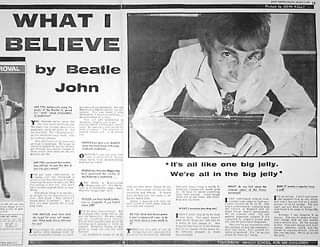
What I Believe - by Beatle John

In 1967 John Lennon gave an exclusive interview to The Daily Sketch which was published in their October 9th edition.

Entitled 'What I Believe - by Beatle John,' the interview focused on the changing attitudes of the late-sixties, flower power and the Beatles' spiritual endeavors with the Maharishi. The paper's conservative slant can be gently felt in the tone of the questions as Lennon is asked about the religious implications of their new eastern interests, and what role it all plays in context with LSD, fame, and Christianity.

Following this interview, after spending time with the Maharishi in Rishikesh in 1968, the group began to denounce, specifically, following the Yogi. What had NOT changed however was that the Beatles still believed strongly that meditation and eastern spiritualism were both beneficial and life-transforming.

The Daily Sketch newspaper was founded in 1909 and was considered Britain's oldest tabloid when its final issue hit the streets in 1971.

John Lennon is interviewed by Daily Sketch columnist Anne Nightingale. The photographer for the interview is John Kelly. 


Q: "Are you deliberately using the power of the Beatles to spread the word about transcendental meditation?"

JOHN: "Yes, because we've never felt like this about anything else. We want the younger generation, especially, to know about it. It's for everyone. For 'householders' as the Maharishi calls them. Just for ordinary people. You don't have to be some sort of freak to meditate. We've got to convince people we are not mystic... get through our million images to show people that what we can do, anyone can do."

Q: "Are you convinced that meditation will last your life, that it won't be just a phase?"

JOHN: "I've got some reservations, of course, but I'm convinced it works in the way they say it works. There's a lot more to learn yet. But I'm willing to find out. You don't have to have a great faith or anything. The whole thing is so simple - as though it's too marvelous to be true. You think: 'Why haven't I heard about it before?' But in fact, it's been around for a long, long time."

Q: "The Beatles must have been the target for every cult imaginable. What made this so different for you?"

JOHN: "It was always the same package before - Billy Graham stuff. Of course everyone's trying to reach the same thing ultimately. But the Maharishi's way is natural, not unnatural. You can make it with meditation if you're a Christian, a Mohammedan or a Jew. You just add meditation to whatever religion you've got. It runs alongside Christianity amazingly. Re-read it now, you know, what it's about. The kingdom of heaven within you. It IS within you."

Q: "People have been a bit doubtful about the moral issues with transcendental meditation..."

JOHN: "Obviously you put your own code of ethics into it. No one really wants to go around killing and having orgies."

Q: "People like Malcolm Muggeridge have questioned the validity of the Maharishi's meditation..."

JOHN: "And where is Malcolm Muggeridge at? The Maharishi is a completely happy man. Malcolm Muggeridge isn't."

Q: "Would you have found meditation so acceptable if you hadn't taken LSD?"
JOHN: "It's all been misconstrued. We dropped LSD weeks before we met the Maharishi. We were looking for something more natural. But all that has been said about us building gold palaces in India is rubbish. Everyone thinks we are going to freak out into the hills forever! All meditation means to us is that we have more output in our work. More energy for things like recording and filming. It would have worked just the same if we hadn't taken LSD."

Q: "Do you think that flower power is just a commercial craze, or do you think there is some worth to it?"

JOHN: "There will be a sort of core of things that will come out of it which will be worthwhile. Just the love and peace thing is worth it, whatever commercial muck goes on. At least it's about something nicer than normal. Good things came out of the beats, like (Allen) Ginsberg and all those things."

Q: "What if everyone drops out?"

JOHN: "I don't think they go for that over here (Britain). The slant doesn't seem to be 'drop-out,' but just do better or just change it. Not drop-out like they do in the States, but try to change what's going on, be different yourself in these surroundings."

Q: "What do you feel about the religious aspect of the flower movement?"

JOHN: "I can understand religion now. I might have come to that conclusion anyway at 25 or 26. But now I understand it - realizing that The Church Of England and all those things, they're government. We all rejected that. I'm not against organized religion if it's organized by religious people and not just by politicians disguised. But they've got themselves into the position of any big company - they lose touch. I've realized religion is personal. It's 'Do as you would be done by' really."

Q: "Does it involve a superior force, a God?"

JOHN: "It's an energy. I don't and never did imagine God as one thing. But now I can see God as a power source - or as an energy. But you can't see any kind of energy... only track it on radar or things like that. You can be aware of your own energy and all the energy that's around you. All the energy is God. Your own energy and their energy, whether doing god-like things or ungodly things. It's all like one big jelly. We're all in the big jelly."

Transcendental Meditation Cult, Patrick Ryan


PE PODCAST CULTS:
Transcendental Meditation Cult, Patrick Ryan


https://youtu.be/P7OqEkhmED8?si=kt3qY70h8NQuON8s

Apr 9, 2024

Kenyan suspect in religious cult deaths dies in custody after hunger strike

Reuters
June 21, 2023

A Kenyan accused of involvement in the deaths of hundreds of members of a starvation cult has died after a 10-day hunger strike in police custody, a prosecutor said on Wednesday.

Joseph Buyuka was among 30 people, including self-styled pastor Paul Mackenzie of Good News International Church, in custody over the deaths of 337 followers of the church.

"The police believe that these individuals... played significant roles in the offences leading to the deaths and illegal disposal of bodies in Shakahola (forest)," court papers said of Buyuka and four others arrested with him.

Authorities have exhumed most of the bodies from the forest in southeast Kenya since April.

Jami Yamina, senior prosecution counsel, said Buyuka had died two days ago at a hospital in Malindi, about 116 km (72 miles) from the port city of Mombasa where he had been taken from a nearby prison.

"He died ...(due to) ... complications from hunger strike and starvation, but we will await postmortem report," Yamina told a court in Mombasa.

"Two other suspects ... have also been taken ill. Police believe it is related to their hunger strike."

Mackenzie is accused of ordering his followers to starve their children and themselves to death so they could reach heaven before the end of the world.


He handed himself over to police in April and was denied bail last month. The other suspects were arrested later after authorities started the exhumations.

He and the others have not yet been required to enter a plea.

Interior Minister Kithure Kindiki had expressed concern in May that some of Mackenzie's rescued followers were refusing food. One of them had died, he said at the time.

(Writing by George Obulutsa; Editing by Bhargav Acharya and Andrew Cawthorne)

https://ca.movies.yahoo.com/movies/kenyan-suspect-religious-cult-deaths-124836117.html