Feb 24, 2017

House passes polygamy bill to strengthen punishments linked to child abuse, fraud, other crimes

Rep. Mike Noel, R-Kanab, presents his bill, HB99, Bigamy Offense Amendments, during a House Judiciary Committee hearing at the Utah State Capitol on Tuesday, Feb. 07, 2017.
Rep. Mike Noel, R-Kanab
Katie McKellar
Deseret News
February 23, 2017


SALT LAKE CITY — A bill that would strengthen penalties for bigamy whenever it's tied to child abuse, fraud, domestic abuse, sexual abuse or certain other crimes passed Thursday in Utah House of Representatives.

HB99 passed with a 48-25 vote and now heads to the Senate.

The vote comes after hours of testimony in a House committee earlier this month, when lawmakers heard often emotional stories about the abuses associated with polygamy and the fear otherwise law-abiding people practicing bigamy or polygamy have of being prosecuted.

Several lawmakers struggled with supporting the bill, worried that it might drive polygamous families deeper into the shadows and make prosecutions even more difficult.

But supporters said the bill would give prosecutors a stronger legal tool to hold perpetrators accountable by expanding the criteria for being prosecuted for bigamy.

Under the bill, the offender must live with the second spouse and "purport" to be married to an extra spouse.

A bigamy offense would remain a third-degree felony, if HB99 passes, but it would increase to a second-degree felony punishable to up to 15 years in prison if the crime is prosecuted along with other crimes such as abuse, fraud, domestic abuse, child abuse, sexual abuse or human trafficking.

A person leaving a polygamous marriage to report abuse or protect a child would be protected, the bill states.

"We are going to continue to outlaw the practice of polygamy and bigamy in our state, and we are going to tear down these evil organizations that are taking advantage of our children and what I call Utah's version of organized crime," said the bill's sponsor, Rep. Mike Noel, R-Kanab.

Noel, a Mormon, also decried any association between The Church of Jesus Christ of Latter-day Saints and polygamous groups, such as the Fundamentalist LDS Church.

"The fact that people come up here and testify that they are FLDS Mormons insults me and bothers me," he said. "They are an apostate group and no part of my religion."

Noel said Utah Attorney General Sean Reyes has told him this law would "strengthen" his ability to prosecute bigamy offenders.

While Rep. Merrill Nelson, R-Grantsville, said he recognized the "serious evils" of the crimes known to be associated with polygamy, he worried the bill wouldn't provide "equal protection" under the law. He noted that people who don't "purport" to be married but are cohabitating as polygamists would not be prosecuted.

House Minority Leader Rep. Brian King, D-Salt Lake City, said he was struggling to support the bill, wondering if it would create a chilling effect and cause families to hide even more heavily from law enforcement.

"Is it going to drive (polygamous families) even more deeply underground in a way that harms the lives of these women and children? This is such a difficult bill. It's so complex and difficult to figure out. I just don't think we have it quite right yet," King said.

The bill was forwarded to the Senate for consideration.

http://www.deseretnews.com/article/865674092/House-passes-polygamy-bill-to-strengthen-punishments-linked-to-child-abuse-fraud-other-crimes.html

'He said he could do what he wanted': the scandal that rocked Bikram yoga

Bikram Choudhury
Bikram Choudhury
Bikram Choudhury built hot yoga into a global brand, with trainees willing to pay him thousands. Then came the lawsuits – and a lawyer who now owns the business

Richard Godwin
The Guardian
February 18, 2017

We’re 15 minutes into the Monday morning class at Hot 8 Yoga in Beverly Hills. Francesca Asumah, one of the most sought-after instructors in California, is putting 48 perspiring humans through a sequence of 26 poses and two breathing exercises popularised by the celebrity yogi Bikram Choudhury. The temperature is a sapping 40C. Sweat slicks over yoga mats. Beautiful bodies melt into shapes that seem beyond the realm of ordinary human geometry.

Asumah’s class, titled A Dance With The Ancients, falls somewhere between gym session and sermon. “You must learn to love yourself, guys!” she encourages us in a northern English accent (she’s half-Ghanaian, half-English, and from Manchester). “If everyone loves themselves, then the whole world will be loved. And beware false gurus! Gurus are middlemen. We are all born in the temple. If anyone claims to be your guru, run a mile, people!”

The message has a special charge in this room. This is the home of what the yogis in my class call “the Bikram community-in-exile”: people who used to be at the heart of the movement, and who say they suffered horrendous abuse in their pursuit of yogic enlightenment. Sweating next to me is Minakshi “Micki” Jafa-Bodden, 48, former legal adviser for the Bikram yoga company. She wants me to appreciate the hold that these poses have before she will talk any further: “You can’t understand me unless you understand Bikram yoga.” And it’s just as well Jafa-Bodden remains devoted to the 26 poses: last month, Los Angeles county court gave her control of the entire global empire.

***

If you’re not up on your chakras and pranayamas, you could be forgiven for thinking that “Bikram” is a term for a kind of hot yoga performed by celebrities and Hollywood types in unsanitary conditions. It is that:
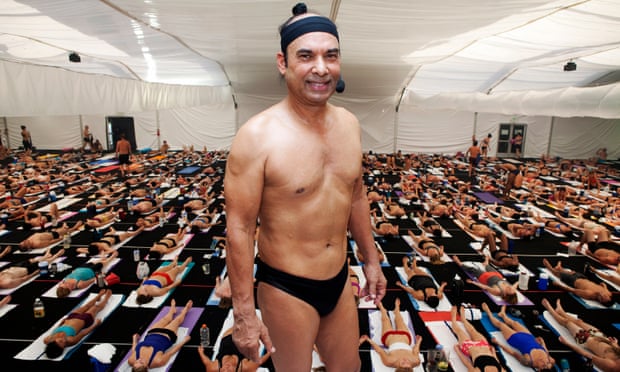
Andy Murray credits it with helping his “fitness and mental strength”; Serena Williams and David Beckham are said to be fans. But it is also a sequence of moves that takes its trademarked name from one man. At his early 2010s peak, the pony-tailed, waxed-chested image of Bikram Choudhury adorned the walls of around 650 licensed Bikram yoga studios across the world. For many, he was a spiritual leader as well as the inventor of an exercise class.

Little is known of Choudhury’s early life. Born in Kolkata in 1946, he claimed to have been invited to America by Richard Nixon, and to have taught yoga to the Beatles and Nasa astronauts. He once told a class that he invented the disco ball.

What is certain is that his yoga gave his students something they found life-changing. Asumah first went to a Bikram-affiliated studio in London in 2000. “I immediately saw the benefit of it,” she says. “At a normal yoga class, you do whatever poses the teacher feels like teaching you. Our form of yoga is different. I’m 64. My quality of life is so joyful and I know it’s because of the yoga.” She believes the 26 poses contain a “sacred geometry” that has been handed down from “the ancients”. Choudhury also claimed his form of yoga was more rigorous and authentic than westernised forms preaching peace and love.

Choudhury first set up a studio in a basement in Beverly Hills. From the mid-1970s onwards, he drew in a celebrity clientele, including Michael Jackson, Jeff Bridges, Shirley MacLaine, Barbra Streisand and Raquel Welch. His classes, heated to a regulation 40C (designed to mimic conditions in Kolkata), offered a combination of constructive hazing, cosmic wisdom and pantomime eccentricity. He would wear Speedos and issue bizarre commands; in 2011, a writer for GQ magazine went to a class
and reported him telling a student, “You, Miss Teeny-Weeny Bikini! Spread your legs!” He loathed the colour green and banned people from wearing it. He had never seen carpet until he arrived in America, and believing it represented the height of luxury had all his studios carpeted, hygiene be damned.

Initially, Choudhury asked for donations and slept on the floor of his studio; but as his celebrity grew, so did his material demands. He claimed he had trademarked his sequence and filed aggressive lawsuits to prevent former students from adapting his 26 moves (including a suit accusing Raquel Welch of stealing his sequence for her exercise book). In 2012, a California federal judge dismissed Choudhury’s attempt to trademark his sequence, ruling that a series of yoga poses cannot be copyrighted. As a New York studio owner, Greg Gumucio, whom Choudhury tried to shut down, told ABC news: “It’s kind of like if Arnold Schwarzenegger said, ‘I’m going to do five bench presses, six curls, seven squats, call it Arnold’s Work, and nobody can show that or teach that without my permission.’”

Choudhury’s most reliable stream of revenue was his twice-yearly teacher-training sessions, where up to 400 students would pay around £10,000 to undergo nine weeks of intensive yoga to become certified Bikram instructors. These earned Choudhury a personal fortune estimated at $75m, including a fleet of 43 luxury cars.

Benjamin Lorr, who wrote a book-length study of Choudhury called Hell-Bent in 2012, attended a training course in Las Vegas in 2009 and found himself drawn to Choudhury, despite describing him as “clearly a buffoon”. By the third evening, Choudhury had told the class that he launched Michael Jackson’s career, cured Janet Reno’s Parkinson’s disease, was once best friends with Elvis, and had experienced “72 hours of marathon sex, where my partner has 49 orgasms. I count.” (He married his wife Rajashree, herself a certified Bikram instructor, in 1984.)

But for Lorr, Choudhury’s ridiculousness only added to his charisma. He had the quality of being present in the moment. “You see it with Donald Trump, too – it’s this unscripted responsiveness,” Lorr tells me. “Bikram has an incredible ability to zoom in on specific people, combined with an ability to act as if he’s being true to himself.” And then there’s what Lorr calls the “volume game”. “When there are 380 people in a room cheering, you begin to wonder: ‘Why am I the only who’s sitting out of this?’ So you find yourself clapping and cheering, despite the fact that what he just said was moronic, or homophobic, or racist, or offensive.”

It was at these training camps – held in large hotel resorts – that Choudhury’s worst alleged abuses took place; there are now six separate suits working their way through the California courts, ranging from sexual harassment to rape. Jafa-Bodden is so far the only woman who has managed to defeat Choudhury in court: last month, a Los Angeles county jury awarded her a total of $6.8m in damages for a range of charges including unlawful dismissal and sexual harassment.

But recovering her damages has not been easy. Choudhury has since fled to India; his fleet of cars has vanished. When cornered by a TV journalist from HBO’s Real Sports at a teacher-training camp near Mumbai last October, Choudhury insulted his accusers and claimed that 5,000 women a day would line up to have sex with him: “Why do I have to harass women? People spend $1m for one drop of my sperm. Are you that dumb to believe those trash?” he said on camera. He also boasted that “this yoga is worse than cocaine. You can get rid of cocaine, but once you’re used to this yoga, you can’t stop.”

Back in March 2011, when Jafa-Bodden first stepped into Choudhury’s Beverly Hills HQ, she was convinced she had just landed her dream job. She was born in Assam, India, received her legal training in Britain, and had spent her career moving between Europe, India and the Caribbean, working in international litigation. She was introduced to Choudhury by his Indian lawyer, Som Mandal. Choudhury insisted that she start right away, and he and Rajashree helped her with her immigration papers, going so far as to choose (and furnish) a flat for her.

As a single mother with a six-year-old daughter, it seemed the perfect opportunity. “I saw it as my forever job,” Jafa-Bodden recalls. “It allowed me to combine my love of yoga and spirituality with the legal and business side of things. I was ready to take on a bigger role, and I also thought I was coming to work for a family-oriented company.”

Jafa-Bodden has the supple movements and clear complexion that comes from taking three or four hot yoga classes a week. She combines a disarming friendliness with a lawyer’s caution. She insists on meeting me twice before she will answer my questions: once for afternoon tea, once for yoga. When I am finally granted a formal interview at her attorneys’ offices in Santa Monica, she welcomes me wearing a camouflage jacket with the words “TRUST THE UNIVERSE” spelled in diamante on the back.

Her first inkling that something wasn’t right came when Choudhury and Rajashree invited her to their mansion in Beverly Hills a couple of days after she took up her position. “It was like the lair of a Bollywood villain. It was very showy and elaborate, not quite what I was expecting from a yoga guru.” Still, she says, he was on his best behaviour. “I’ve dealt with high-net-worth individuals in all sorts of countries, and my read on Bikram was just that he was eccentric.”

Meanwhile, in her day job, she found “operational dysfunction: a total co-mingling of personal and corporate assets”. Choudhury had a tendency not to settle his hotels bills, so her first task was to fight Marriott hotels over an unpaid sum of $1.8m. Choudhury also liked to use the company account as a personal credit card. But initially Jafa-Bodden saw this as an opportunity; she felt she had the necessary expertise to straighten out the business. It was only when a lawsuit from a former trainee named Pandhora Williams landed on her desk that she realised the extent of her problems.

***

The Bikram teacher-training courses centre on two mass 90-minute hot yoga sessions a day interspersed with anatomy seminars, spiritual lectures and rote learning of 45 pages of copyrighted Bikram dialogue. Choudhury likes to conduct the evening class from a throne with one attendant typically brushing his hair and another massaging his legs. Francesca Asumah attended a course in spring 2002. “He walked in and everybody started jumping around and cheering,” she recalls. “Because I’m English, and we don’t really do cults, I didn’t really understand what was going on. But everybody was worshipping him.”

Choudhury teaching in Beverly Hills, California in 1982. Photograph: Joan Adlen Photography/Getty Images

She was 49, and believes her “difficult” attitude led to her being shunned by Choudhury’s inner circle; the typical attendees were aged 22 to 35 and seemed more impressionable. “There were a lot of really beautiful bodies, all dressed in tight shorts and bikinis.”

In the evenings, Choudhury would invite his favourites to watch Bollywood movies with him. Anyone who fell asleep would be woken up; the ordeal would often go on until 3am. The first yoga session of the next day was 8am, and was often accompanied by vomiting, fainting and weeping. Nonetheless, despite the hardships, most students agreed it was worth it. “There were a few people who would exchange looks and raise their eyebrows,” Asumah says. “But you’d spent your £10,000. And the yoga’s good. And you’d just try to bear what you can.”

The case that landed on Jafa-Bodden’s desk in May 2011, the suit from Pandhora Williams, related to a training session at the Town and Country Resort in San Diego the previous autumn. Williams’ lawyers alleged that Choudhury had invited the class to lie down in savasana (corpse pose) whereupon he launched into a homophobic rant, announcing that all gay people should be put on an island and “left to die of Aids”. After the class, Williams had asked, “Bikram, why are you preaching hate? Yoga is supposed to be about love.”
She alleges that he replied, “We don’t sell love here, bitch,” then told an assistant, “Get that black bitch out of here. She’s a cancer.” Williams was ejected from the course – and Choudhury refused to refund her $10,900 fee. So she sued for racial discrimination.

“I realised that if half of this was true, we were facing a very serious situation,” Jafa-Bodden tells me now. She conducted internal investigations and challenged Choudhury on his behaviour. She found him unremorseful. “He would pick on someone in the crowd. If someone got up to go to the toilet, he would say, ‘Where are you going? To change your tampon?’ He uses profanities, he’s antisemitic, he’s homophobic. He’ll say things like, ‘Blacks don’t get my yoga.’ And once he starts on his tirade of profanity, he doesn’t stop. Once he’s picked on you, then you’ve had it for the entire class.”

Why did no one stand up to him? “There’s very little you can do. He’s up there on a podium, he’s miked up, and it’s really hot.” Many trainees feared losing the thousands of dollars they had already spent on the fees. “Their livelihood depends on putting up with it. The problem was that Bikram had set things up in such a way that, without his continued patronage, you can’t teach anywhere else. So some of his victims would come back to his training and just try to take precautions.”

Further allegations followed. Jafa-Bodden was required to read the manuscript of Lorr’s book Hell-Bent for libel, but found nothing actionable. The book’s allegations of sexual impropriety opened the floodgates. “Once people have bought into any cult, there’s no rational way you can change their minds – it has to be an emotional change,” Lorr tells me. “It was only when people started to see how much hurt he had caused that they began to change their minds.”

In 2013, a series of rape allegations were made. A former student, Sarah Baughn, claimed that Choudhury had sexually assaulted her at a 2008 training camp, pleading, “I am dying. I can feel myself dying. I will not be alive if someone doesn’t save me.” A Canadian student, Jill Lawler, sued Choudhury for a litany of charges, including sexual assault, gender discrimination, sexual harassment and sexual battery; she was 18 when the alleged crimes took place. Another student, Maggie Genthner, alleged that he raped her twice, forcing her legs into yoga postures and laughing at her.

Jafa-Bodden says she repeatedly challenged Choudhury on his behaviour, but he simply expected her to make the allegations go away. “At the outset, he expected me to be submissive,” she says. “He told me he was a god who could do whatever he wanted and that I was ‘stupid and too westernised’.”

Jafa-Bodden claims that, on one occasion, Choudhury held a meeting in his presidential suite and encouraged her to join him in bed. “He would tell me to go and ‘shut up’ the witnesses,” Jafa-Bodden says. “One woman sent a Facebook message saying that Bikram had tried to put his penis in her mouth – a horrific allegation. I went to Bikram and said, ‘What is this?’ And he said, ‘I thought we’d taken care of that bitch in Hawaii.’” After she told him he wasn’t allowed to bring trainees to his bedroom, he mocked her in front of a class: “He stood up on his podium and said: ‘My lawyer tells me I can’t have a girl in my room. So I’m now going to have two!’”

Jafa-Bodden became depressed, which she says has led to ongoing problems with anxiety. “My entire life revolved around Bikram and his yoga. It was like living in a parallel universe,” she says. She considered leaving the country, but was trapped. “I never received my pay cheque on time or for the full amount agreed. I was dependent on Bikram for everything, including my work visa, my apartment, my car. My cellphone was connected to his and my every move was monitored. It would have been very risky to flee without a well-thought-out exit strategy. He would say they’d revoke my green card, so I’d be deported back to India.”

Finally, in February 2013, she was subpoenaed to testify in the Williams case, which sent Choudhury “crazy”. “He said ominously, ‘Well, we’ll just tell them we don’t know where you are.’ I was so frightened.” The next month, he terminated her contract. With no car and little money, she moved with her daughter to a guesthouse until she was able to find a small one-bedroom apartment.

Jafa-Bodden eventually turned to her former adversary, Carla Minnard, the Californian attorney who had subpoenaed her in the Williams lawsuit. “My motto is, where there is darkness let there be light,” Jafa-Bodden says now. “I feel I have to show my daughter that you have to fight through the fear.” She sued Choudhury for unfair dismissal and sexual harassment.

An Irish former employee, Sharon Clerkin (herself allegedly dismissed for becoming pregnant), testified at Jafa-Bodden’s trial that Choudhury continued to demean women at teacher training, calling them “bitches” and boasting about allegations that were then surfacing on social media (“it’s good for business”).

The jury unanimously ruled that Jafa-Bodden had been subject to sexual harassment, nonpayment of wages, wrongful dismissal and a number of further charges. In December, with Choudhury refusing to return to the US, the judge ordered that the income from his studio franchises and his intellectual property be handed over to Jafa-Bodden. Last month, she filed a separate suit against Rajashree, who divorced Choudhury in 2016 and remains in the Beverly Hills mansion. (At the time of the divorce, it was ruled that she wasn’t required to pay damages in any pending or future cases; Jafa-Bodden and her lawyers are challenging that verdict.)

To date, there have been no criminal charges brought against Choudhury; all the women are pursuing civil cases. Choudhury denied all of Pandhora Williams’ claims before they settled out of court in May 2013, and has dismissed the other allegations as “lies lies lies”. However, he has repeatedly refused to return to the US; last month he violated a court order to complete a video deposition in the Clerkin case. A few weeks later, his attorney in that case quit, saying Choudhury was no longer cooperating or paying his bills.

Responding to a Guardian request for comment, Bikram’s Indian lawyer, Som Mandal, last week denied all the allegations. He said that Bikram had hired new lawyers and would be appealing the verdict in the Jafa-Bodden case.

For her part, Jafa-Bodden says she is less interested in the money than in seeing justice done: “It’s about accountability.” Meanwhile, many Bikram studio owners are removing photographs of Choudhury and distancing themselves from their former guru. There are around 30 yoga studios that carry the Bikram name in the UK, and many are rebranding: Bikram Yoga North, West, City and Primrose Hill in London now go under the name Fierce Grace.

Outside the US, Choudhury continues to advertise training camps: his next teacher-training session in Acapulco, Mexico, this April is again priced at about £10,000. “That’s so concerning for us,” Jafa-Bodden says. “Innocent and impressionable young trainees might be going to these camps in jurisdictions where there may not be as many protections.”

You’d understand it if Jafa-Bodden never wanted to step inside another yoga studio again, but she remains devoted to the series of 26 poses. “It must seem mystifying to someone who is not into Bikram yoga,” she laughs, “but I do actually think yoga is the answer.” She credits Asumah with seeing her through her worst moments.

Asumah herself has every reason to leave yoga behind. Her first husband died of a heart attack after taking a yoga class in Ibiza, and she blames Choudhury for the failure of her second marriage. Yet she has forgiven him. “If you spoke to me when I was in the depths of hurt, I’d have spoken differently. But he didn’t make me bitter. The highest form of love is forgiving the unforgivable.”

All of which leaves Jafa-Bodden with a dilemma. She is effectively president of Bikram Inc. But there is a serious issue with the name: in the process of de-Bikramisation, she wants to separate the yoga from the man who created it – not so easy when it’s a brand known the world over (most devotees don’t make the connection with the megalomaniac in Speedos). And she still remains devoted to the Bikram community. Can she rebuild the business as something new? As Asumah says, “Sometimes you get a rotten branch, and you have to cut it off, but it doesn’t mean the whole tree’s gone.”
https://www.theguardian.com/lifeandstyle/2017/feb/18/bikram-hot-yoga-scandal-choudhury-what-he-wanted

Supreme Court will not hear Amish bishop Sam Mullet's appeal in beard-cutting case

Eric Heisig
cleveland.com
February 22, 2017

CLEVELAND, Ohio -- The U.S. Supreme Court will not take up the case of imprisoned Amish bishop Sam Mullet, who was convicted of orchestrating a series of beard and hair-cutting attacks on his enemies.

Mullet, 71, is the only one of the 16 defendants federally prosecuted to remain in prison. A federal appeals court
rejected his appeal in May and the U.S. Supreme Court decided Tuesday to not review the lower court's decision.

Ed Bryan, Mullet's attorney, said he was disappointed in the high court's decision.

Mullet is the leader of a breakaway sect of an Amish community made up of 18 families in the village of Bergholz, located about 100 miles southeast of Cleveland. They were convicted of several crimes in September 2012 for carrying out five nighttime raids in 2011.

Members of the community rousted five victims out of bed and chopped off their beards and hair with horse mane shears and battery-powered clippers. The attackers documented the attacks with a disposable camera.

Men's beards and women's hair have spiritual significance to the Amish.

Prosecutors brought hate-crime and obstruction charges against 16 members of the Amish community. They said the attacks were carried out at the behest of Bishop Samuel Mullet against the bishop's enemies. Witnesses portrayed him as a fire-and-brimstone preacher who imposed strict, and often bizarre, discipline on his flock.

The 6th Circuit later overturned the hate-crime convictions, citing faulty jury instructions. Cleveland-based U.S. District Judge Dan Polster re-sentenced all of them to shorter sentences in March 2015, and noted that it was clear that the attacks were religiously motivated.

Bryan said his client has been jailed for longer than any other defendant, yet he was the only one who didn't cut anybody's hair or beard.

He noted that Mullet's wife died while he was in prison.

Mullet is serving his sentence in a prison camp in Lisbon. Bryan said Mullet recently underwent triple-bypass heart surgery.
http://www.cleveland.com/court-justice/index.ssf/2017/02/supreme_court_will_not_hear_am.html

Feb 23, 2017

Court of Appeal: Armenian man who claimed to be a Jehovah's Witness has deportation order reaffirmed

High Court
Seosamh Gráinséir
Irish Legal News
23 February 2017

The Minister for Justice and Law Reform has successfully appealed an Order of the High Court, which quashed the Minister’s decision to affirm an Armenian national’s deportation order. Delivering the judgment of the three-judge Court of Appeal, Mr Justice Michael Peart found that the trial judge had erred on both the issue of suicidal ideation, and the risk of assault as a Jehovah’s Witness.

Background

In December 2010, the Minister for Justice and Law Reform affirmed a 2003 deportation order in respect of RB, an Armenian national who came to this country in the year 2000, and whose application for a declaration of refugee status was refused.

RB made an application for judicial review in the High Court, seeking to have the Minister’s decision quashed on two grounds:

(a) that the Minister failed to properly consider certain country of origin information which had been submitted by RB which, he submitted, established a likelihood that he would, if refouled to Armenia, be exposed to the risk of assault as a Jehovah’s Witness; and
(b) that the Minister failed to have regard to RB’s mental health, and in particular to two medical reports of Dr Brian McCaffrey, Consultant Psychiatrist, which noted suicidal ideation resulting from his fear of being returned to Armenia, and which went on to state that RB “is a high risk person for suicide if he is deported”.

In December 2014, Justice Barr made an order quashing the Minister’s decision, finding that the decision had to be quashed on both grounds.

Court of Appeal

In the Court of Appeal, the Minister appealed the decision of Justice Barr, submitting that the trial judge erred by entering into a consideration of the merits or weight of the reports of Dr McCaffrey, and the Country of Origin Information (COI) that was referred to in relation to the Jehovah’s Witness issue.

In relation to the Jehovah’s Witness issue, Justice Peart found that the trial judge fell into error by failing to “apply the lower test appropriate to a review of a decision not to revoke a deportation order”.

By the time the Minister came to deal with RB’s application as a revocation application his claim for asylum based on his association with the Jehovah’s Witnesses and the risk of persecution thereby claimed to arise, had already been considered at the various stages of the process and rejected. Accepting the authorities outlined on behalf of the minister, Justice Peart agreed that the trial judge erred in failing to appreciate the limited scope of the review required in respect of a revocation decision (as per O(O) v. Minister for Justice [2008] IEHC 325; Kouyape v. Minister for Justice [2011] 2 IR 1; and P.O. v. Minister for Justice [2015] IESC 64).

Furthermore, it was reasonable for the Minister to conclude that even if there were such dangers disclosed in the COI, RB himself was not a person at such risk as he was not a Jehovah’s Witness even on his own case.

Accordingly, Justice Peart was satisfied that “the Minister considered the application appropriately, and in the exercise of his discretion was entitled to conclude as he did”.

In relation to the issue of suicidal ideation, Justice Peart explained that the Minister’s duty on the application being dealt with under s. 3(11) of the Immigration Act 1999 was “to consider all the medical evidence in his possession, and in particular the two reports from Dr McCaffrey which had not been available to him when he considered the s. 3 leave to remain application, and to form a view whether any new issue was raised in Dr McCaffrey’s two reports in 2005 which justified a revocation of the 2003 deportation order in 2010 or whether something of an exceptional nature arose in relation to RB’s personal circumstances that would merit a revocation”

Justice Peart was of the view that “the question whether the reports of Dr McCaffrey constituted credible evidence that RB was a suicide risk was not the correct question for the trial judge to consider”, and that the correct question was “whether those reports raised some new issue in 2010 for the Minister’s consideration which had not been previously considered when the deportation order was made”.

As such, Justice Peart was satisfied that t he trial judge erred in determining that these reports had to be considered in a more specific way than was done by the Minister because they constituted new evidence of suicide risk.

Allowing the Minister’s appeal, Justice Peart held that the High Court Order must be vacated and RB’s application for judicial review dismissed.
https://www.irishlegal.com/6681/court-of-appeal-armenian-man-who-claimed-to-be-a-jehovahs-witness-has-deportation-order-reaffirmed/

The Raid on Mount Carmel


St. John Barned-Smith
Houston Chronical
February 18, 2017

ATF agents keep Branch Davidian raid close to the vest

Bullet holes mark the vest’s dark blue fabric, still caked with red earth and sand. Blood has eaten through the nylon, leaving a spot of Kevlar visible through a small hole ringed by a maroon stain.    

Nearly 25 years after the standoff at the Branch Davidian compound near Waco, Eric Evers doesn’t know what to do with the armor he once wore. His wife can’t bear to see it. The government doesn’t want it. For now, he keeps it at the office, wrapped in gray plastic.

He might give it to a museum someday.

“What do you do with it?” said Evers, a special agent in Houston with the Bureau of Alcohol, Tobacco, Firearms and Explosives. “It’s not like I’m going to frame it and hang it on the wall.”

For Evers, the vest stirs memories both sacred and taboo: of four colleagues who died doing their jobs, of his own survival, and of a fateful encounter that began with the best intentions.

Agent Gary Orchowski keeps his helmet – visibly damaged by a hail of bullets – on a small coffee table in his office, next to the mangled radio that once broadcast his death.

The agents rarely talk about the raid that kicked off a seven-week siege at the cult’s compound, ending in a blaze that killed more than 70 people. They’ve kept quiet about the worst loss of life in ATF history and the challenges that followed.

But the government’s decision to return their gear last year brought it all back. Now, more than two decades later, the agents say they’re ready to share the experiences that have largely gone untold amid a slew of documentaries, books and news coverage.

“I’ve decided I’m never going to forget, and I owe it to the guys who were killed to tell their story,” Orchowski said. “We owe it to the people who made the ultimate sacrifice to be honest with each other. … I want everybody at the end of day to go home alive, to go home to their families.”

It was Feb. 28, 1993, a cold and drizzly Sunday morning just outside of Waco.

Evers lay bleeding in a ditch as bullets whizzed by.

He’d already been shot five times, but his armored vest had stopped three rounds. A rifle round smashed through the webbing, however, boring deep into his shoulder; another bullet struck his forearm.

“This isn’t a game,” the special agent thought. “They’re putting real bullets down. They’re going to drop one in your head.”

Just yards away, Orchowski lay sprawled in cold, muddy water, with his radio crackling from its perch on his back. He heard reports of his own death, but before he could respond, another round zipped past his ear and hit the radio head-on.

The gunfire bombarded the agents so heavily that branches on nearby trees began to fall.

“I’ve learned the meaning of sheer terror,” said Evers, now 52.

Evers, Orchowski and more than 130 other ATF special agents and support staff had traveled from Houston, Dallas and New Orleans to execute search warrants on the Branch Davidians for illegal stockpiles of automatic weapons and explosives.

They had also been ordered to arrest the group’s leader, David Koresh, a 33-year-old from Houston who stood accused of having sex with his followers’ children, some as young as 11 years old.

The agents had heard stories that the youngest of Koresh’s followers had never been allowed to leave the compound.

“We were more or less looking at it like a humanitarian mission,” said Orchowski, 55, a former police officer in Georgia who is now the assistant special agent in charge of the ATF’s Houston field office. “That meant they had never had a candy bar. A bunch of us had gone to Walmart ... In our vests, there were candy bars we planned on giving to the kids.”

The plan had been to drive up to the compound in two cattle trailers, to surprise the Davidians, fan out, search for illegal firearms and arrest Koresh.

But that plan went stale before the agents ever drove up to the compound; Koresh and his followers had been tipped off they were coming.

Even after learning they’d lost the element of surprise, however, the agents’ superiors pressed forward.

They approached the compound expecting to find workers outdoors; instead, they saw only curtains fluttering at the windows.

Then the air filled with bullets, as cult members opened fire with automatic weapons from dozens of posts.

“It was Fallujah before Fallujah,” said Robert Elder, 56, a now-retired ATF agent who also participated in the raid, comparing it to Iraq.

Elder looked up and saw a man atop a water tower, training an AR-15 at him.

“I remember looking up and thinking, ‘He’s got me,’” Elder said. “The next thing I recall, I see the rifle fall and I see him fall back into the water tower because one of our snipers took him out.”

For hours, the agents and the Branch Davidians traded fire, broken up by ceasefires.

Orchowski remembers the surreal sounds of chirping birds when the gunfire halted.

“I almost wanted to start shooting at the birds,” he said. “Like, ‘Shut up, this is not funny.’ It was like they were almost laughing at you.”

During the third and final ceasefire, ATF agent David Opperman moved in to pull Evers from the ditch, just feet from the man who’d shot him.

“Dave never stopped,” Evers said, choking up slightly. “He kept coming on: ‘I’m just coming to get my guy, I’m just coming to get my guy, I’m just going to get him. It’s a ceasefire.’ ... I thought for sure he’d smoke us in the back but he didn’t.”

Four ATF agents did not survive: Steven D. Willis, from the Houston field office, and three New Orleans-based agents: Conway C. LeBleu, Todd W. McKeehan, and Robert J. Williams. Six Branch Davidians also died in the firefight.

“Knowing what we were up against, there was no way we were going to succeed,” Orchowski said. “As long as someone makes up their mind they’re going to go down in a blaze of glory, there’s not much you can do about it.”

The ensuing stand-off and fiery conclusion to the siege on April 19, 1993 became a lightning rod for controversy over religious liberty, personal freedom and federal overreach.

It followed the Ruby Ridge shooting in 1992 that galvanized paramilitary activists, and stirred Timothy McVeigh as he planned the bombing that came two years later at the Alfred P. Murrah Federal Building in Oklahoma City.

But as the public watched lawmakers hold hearings and prosecutors win convictions of some Branch Davidians on manslaughter and weapons charges, Orchowski, Evers, and their colleagues quietly recuperated and went back to work.

ATF agent Roland Ballesteros, 54, who was shot in the thumb that day by Koresh as he confronted the cult leader at the compound’s front door, defends the agency’s preparation for the raid.

“I’m associated with something that is being called a debacle,” Ballesteros said. “There was no flaw in the plan. My only thing is, when we were compromised ... maybe we shouldn’t [have gone through with it] ... But there was a momentum going on this thing, and I don’t know if it was easy to push back at that point in time. It just created a life of its own.”

The incident and internal scrutiny that followed the incident prompted the ATF to retool its intelligence gathering, beef up training and re-assess how it conducts its operations. Ballesteros said decisions might be different today.

“Nowadays, I see things, and we do things, and it’s more like: “Ok, let’s just check ourselves ... Everybody goes home tonight,” he said.

Some of the details still remain fuzzy for many of the agents.

“Every time we hear somebody speak, we learn something new,” Orchowski said. “Because so many moving parts were involved.”

Today, a shrine to the fallen agents marks the entryway of the ATF’s Houston field office.

A large, 3-D model of the compound shows where the men died that day, and their portraits line the wall.

Every year, current and retired agents travel from across the region for a special memorial to remember them and their deaths.

“It’s the biggest personal tragedy our agency has ever suffered,” said Special Agent Nicole Strong, spokeswoman for the Houston field office.

For the agents, the return of their gear – which was almost destroyed by the federal government before being handed back – has provided a different kind of insight.

“They didn’t want to make this part of our history,” Elder said. “It is part of our history, but there are people who want it to go away, and they think if you don’t talk about it, it’s going to go away.”

***
After the bullet-ridden gear was returned, memories of the deadliest — and still-controversial — day in agency history came flooding back to the agents. Here are the moments they'll never forget.

Evers had been with the bureau for two years before the raid. Prior to joining ATF, he had worked as a firefighter in El Paso.

He was shot five times during the raid. His vest stopped three bullets, but he lost 40 to 60 percent of his blood from two other wounds.

“Everything was a blur. My hearing was muffled. It was like those movies. It was just ... ‘surreal’ is the only word I can come up with.”

While agents who participated in the raid sometimes discussed it amongst themselves, he believes the response to the incident would be much different if it happened today.

“I think all these guys would have been sent to peer support groups, and maybe to psychologists we have on retainer would have been brought out to meet with these guys and whole discussion aspect would have been in play to help minimize some of those stressful emotions after the fact,” Evers said. “First responders, EMS, firefighters all have things in place now for critical incidents they experience. I think it would be the same for us.”

Gary Orchowski’s helmet deflected two bullets. His radio also got destroyed in the firefight.

Orchowski worked at the Gwinnett County Police Department before joining ATF and had been with the agency for five years at the time of the raid. He’s now the Assistant Special Agent-in-Charge in the Houston Field Office. He and his colleagues said their superiors ordered the agents on the ground to proceed with the raid even after discovering they had lost the element of surprise - then denied knowing the Davidians had known they were coming.

That incident stuck with him the rest of his career, he said.

“I made a promise to myself I would be honest. ... If it’s going to hurt your feelings, guess what, it’s a feeling, but it’ll pass. We owe it to the people who made the ultimate sacrifice to be honest with each other.”

When the final ceasefire was called, just before noon, none of the agents were quite willing to move at first, he said.

“We all thought as soon as we got up they were going to start executing us,” he said.

Rob Elder, now 56, was former Special Agent in Charge of the Houston field office before retiring last year. He worked as a cop in St. Louis before joining the bureau. By the time of the raid, he had been an ATF agent for about six years. He remembers looking up and seeing a man training an AR-15 at him from the water tower in the middle of the Branch Davidian compound.

His mission had been to subdue cult members who were working in “the pit.”

When he tried to pull out his pistol, he inadvertently hit his magazine release.

“I hit my magazine release and my magazine fell out into the mud,” he said. “I have one round in my gun now and I remember looking up and thinking, ‘He’s got me.”

He had me, and the next thing I recall, I see the rifle fall and I see him fall back into the water tower because one of our snipers took him out.”

Roland Ballesteros, 54, was tasked with charging the compound’s main entrance. As he ran up the steps leading to the door into the compound, he saw David Koresh and one of his followers. He remembers Koresh yelling and asking him what was happening.

Ballesteros yelled back that they were executing a search warrant and ordered him to lie down.

Instead, Koresh stepped back through the compound’s door, shut it, and he and others began shooting through the door at Ballesteros, blowing half his thumb off.

“You see holes coming, popping through the door,” he recalled. “And part of my thumb, just hanging over my glove.”

These photos occurred during the ATF’s initial siege of the Branch Davidian compound. The conflict the cult members and federal agents kicked off a seven-week siege which ended in a fiery conflagration in April, 51 days later.
Explore our newspaper coverage

These newspaper clippings come from the Chronicle’s coverage of the deadly raid 24 years ago. Explore them in greater detail to see how the events unfolded in real time.
Read the report

After the raid and inferno at the Mount Carmel Center, federal agents came under criticism for their handling of the raid, with critical news coverage, federal hearings, and testimony in trial. The event also prompted the federal government to commission an exhaustive investigation into the agents’ actions and how it all played out.

Read the report to get an even more in-depth understanding of the ATF’s raid and what investigators concluded. Scroll down for maps and charts highlighted in the report.

https://houstonchronicle.atavist.com/wacoraid

Pity the satanic abuse police - they have to be 120 per cent gullible

That evil bastard Edward Heath fooled us with his organ playing and yachting when he really liked Satan and killing children

Rod Liddle
Spectator.co.uk
25 February 2017

I got lost in the forest near my house while walking the dog the other week. The path I was on, and which I thought I knew, narrowed until it was scarcely a path at all. The trees closed in and brambles tore at my legs. Somewhere, high above, I could hear the importuning mew of a buzzard. And then I reached a small clearing where the tall grass and the broom had been flattened. There were signs that a fire had been lit in the centre, and there were the shadows of human footprints in the hard earth.

I immediately felt sick inside — for I knew exactly and without question what this was. It had been the site of a satanic paedo-phile orgy involving our former prime minister Sir Edward Heath. Heaven knows how many children had lost their lives in this tiny glade in Kent during a foul and emetic bacchanal. I saw, with sudden clarity, Heath stripped naked and — in a voice familiar to millions of unsuspecting decent, Christian British people — invoking the Dark One as he dangled some poor child over the fire after he and his deranged, shrieking cabal had had their wicked way with it.

You evil bastard, Heath, I thought to myself. You evil, evil man. We thought of you as a statesman and an organist who quite liked yachting. Now, after all this time, we at last know what you really liked. Satan and killing children.

I had read about these goings-on in one of our daily newspapers. A group of women have made allegations that a paedophile ring linked to Heath had murdered at least 16 children during satanic orgies in forests in the south east of England. The children were abused and then slaughtered, after which the devilish celebrants would gorge themselves on the bodies of these poor mites — a case of waste not, want not, I suppose. We know that Heath must have been involved because one of the women reported having heard mention of a mysterious but very important man known only as ‘Ed’ — well, you don’t fool us with that cunning alias, Heath. And now the police are on his trail, the Wiltshire Police, because this stuff has all surfaced as a consequence of their brave investigation, Operation Conifer.

If Heath were still alive I daresay he would attempt to rebut the allegations with some laughable excuse, which would be swallowed whole only by the Establishment — who are probably themselves in a wood near you right now, murdering still more kiddies and prostrating themselves before Lucifer — and the supremely gullible. Luckily the Wiltshire police force is not remotely gullible. The copper in charge of Operation Conifer has said that the allegations of child sexual abuse levelled at Heath are ‘120 per cent genuine’. So you can see that the investigation is being led by a man with a brilliant and penetrating mind. If these allegations really are 120 per cent genuine, that means they are more genuine even than things which are entirely genuine. Bloody genuine, then. The police are especially delighted because some of the evidence has come from people who don’t know each other —that’s the clincher, isn’t it? Whatever way you look at it.

I’m particularly interested in the testimony of these women who, when they first told the police about having been abused as girls and all the devil sacrifice murder stuff, were told, unaccountably, that they sounded doolally. That was back in 1989. I’m interested in their testimonies because of all the things I ever wondered about the evil Heath — and I did suspect, during those power cuts of the 1970s when the tv went off, that he was an agent of Beelzebub — it never remotely occurred to me that he might be sexually interested in women. How little we know.

Gullibility. I wonder if Det. Insp. 120 per cent has asked two straightforward questions of the people who have come before the police with these interesting testimonies. First: are they certifiably insane? That is, are they — as the Americans put it — crazier than a shithouse rat? And second: do they have anything to gain, financially, from making these assertions? My guess is that neither of those questions have been asked. And they have not been asked because those are not the sort of question the filth is allowed to ask any more. The rozzers must take everything at face value these days. They must not exercise their judgment — or, as the social justice warriors and the liberal reformers would put it, their prejudices. If someone comes forward to say that 16 kids were killed in a forest by a satanically-minded paedo ring involving half the British Establishment, you must not ask if they are on medication for being mental. Because if they were abused as kids, they’re going to be mental, aren’t they? That’s what it does to you, being abused by Sir Edward Heath in a glade in Kent; it sends you round the bend. And so you have a force which is, to misappropriate the quote from Sir William Macpherson, institutionally gullible.

Not just in the area of paedophilia, either. If someone comes before the police to complain that he has been the subject of a racist insult or attack, then according to the guidance before the police, he has been, and that’s an end to it. No latitude for judgment. He has been racially abused, end of (as Det. Insp. 120 per cent might say). Similarly, if a woman claims she was raped then the police are enjoined not simply to take her word for it, but to make sure a prosecution is brought — no matter what doubts might linger in their minds. This is perhaps one reason why conviction rates for rape are so low: the juries, the British public, are not institutionally gullible. But still, lives are ruined along the way. Lives and the reputations of people who cannot defend themselves, because they’re dead.

http://www.spectator.co.uk/2017/02/pity-the-satanic-abuse-police-they-have-to-be-120-per-cent-gullible/

Documentary - The Devil's Trap


Mitchell Stafiej (Canada). World premiere.

CPH:DOX, Copenhagen International Documentary Film Festival,

When he was 18, the now 25-year-old Lane was kicked out of the fundamentalist Christian cult that his family is still a member of, and they haven’t spoken to him since. ‘The Exclusive Brethren’ is a powerful, rich and extremely sealed off cult that rejects everything – and by that we mean everything! – except themselves as being satanic. Now, Lane decides to visit them on a road trip through fanaticism’s USA and Canada. A dark and nightmarish world of neon crosses, militantly organised sects, deadly alcoholism and drug abuse. And a journey where the outwardly strong and re-socialised Lane confronts the demons of his past with the director Mitchell Stafiej on the passenger seat of his car. But when he finally manages to meet his brother, it is till far from a happy ending. ‘The Devil’s Trap’ is the first film about the notoriously secretive but extensive and extremely well-organised ‘Exclusive Brethren’, but also tells a frightening and far more universal story about how radical parallel societies can dominate their members. Lane’s story about how he as a teenager for the first time saw a film in a cinema is nothing less than a staggering image of the clash between two realities.

Aussie survivor tells: 4 warning signs of being in a cult

Allison Yee
Yahoo
February 23, 2017

After escaping one of Australia's most infamous cults with her eight children, Claire Ashman doesn't want others to make the same mistake.

For most of us, the idea of being trapped in a controlling, manipulative cult seems so outrageous it doesn't even cross your mind. It happens in books, or in movies, or in articles like this that you read on the train while thinking ‘That’s never ever going to happen to me’.”

But according to ex-cult member Claire Ashman, these organisations are much more widespread than we think, with estimates there are over 3000 active cults in Australia.

Claire should know. Having spent decades of her life in not one, but two separate ultra religious and suppressive cults, the Brisbane mum-of-eight was forced to plot her escape when she realised she was putting her young family in danger of a paedophile.

Brisbane mum Claire is passionate about increasing awareness about cults after her own years of personal experience. Photo: Facebook/mark.ashman.739
Brisbane mum Claire is passionate about increasing awareness
about cults after her own years of personal experience.
Photo: Facebook/mark.ashman.739

“My parents brought me up in The Society of St Pius X, an ultra religious Catholic sect that had started off with good intentions but has become an open cult,” Claire explains to Be.

“I left home when I was 18 and got married to a much older man – he was 31. I was feeling lost, insecure and directionless. I was very socially naïve.”

Eight years into her marriage and five children later, Claire was horrified to learn her husband Tony wanted to move to the NSW suburb of Nowra to live in a community run by the infamous William “Little Pebble” Kamm.

 
Claire, pictured here in religious garb, hated her time in Little Pebble's cult and became increasingly outspoken against it.
Claire, pictured here in religious garb, hated her time in
Little Pebble's cult and became increasingly outspoken against it.

Claiming he was able to communicate with God and the Virgin Mary, Little Pebble believed it was his purpose to take 12 queens and 72 princesses to repopulate the Earth with his "holy seed".

Little Pebble would also later go on to be convicted of having sex with two 15-year-old girls, and jailed for nine years.

"I didn’t know it was a cult because I’d never heard that word [but] I didn’t have a good feeling about it, and I didn’t want to go. It was an absolute dump and I hated it on sight,” says Claire, who would go on to live in the community, known as The Order of Saint Charbel, for nearly 10 years.

“Kamm had his favourites, he’d have his arms around certain girls. One of the young girls was only 17 and had a baby. I noticed how he worded it in the community notice board, and thought ‘Holy s**t, that’s his baby’. I didn’t realise at the time he was grooming them when they were much younger."

“I wanted to move, but others in the cult said ‘No, he’s got special permission from the Virgin Mary to keep doing this.’”

Disgusted, horrified and terrified for the safety of her children, Claire – whose children now range in age from 26 to 12 - knew she had no choice but to leave when her husband became even more firmly entrenched in the order and decided to become a priest.
 
William Kamm was convicted of paedophilia in 2005 and served nine years in jail.


“That’s when I knew that the marriage was over,” says Claire. “I spent the next two and a bit years playing along, it was really hard.”

When Tony began to work away from home in 2004, Claire seized her chance. She began purging the family of possessions Tony had collected for the “apocalypse” Little Pebble had told his followers was coming.

“We’d been told that when the apocalypse came, the Earth was going to be burnt and there would be survivors from communities who had obeyed William Kamm, so we had to store food, clothes and farm implements,” she explains.

 
Claire, pictured here with her new husband Mark, had nine kids with her ex Tony, however one child passed away before she entered Little Pebble's community. Source: Facebook/claire.mcauliffe.37
Claire, pictured here with her new husband Mark, had nine 
kids with her ex Tony, however one child passed away before
 she entered Little Pebble's community. 
Source: Facebook/claire.mcauliffe.37
In 2006, despite having very little experience in the outside world, Claire took the plunge and opened a bank account and changed Centrelink payments so the money went into her account.

She began to scour the rental columns in the local newspaper, and when a Nowra sheriff knocked on her door in August to evict the family from their home, Claire knew this was her chance.

“My kids come first, their stability, their security comes before anything or anyone else,” says Claire. “It didn’t matter about me being on my own, I thought come hell or high water, I’ll make it somehow.”

Now remarried to her British husband Mark and working as a cleaner while pursuing her passion to raise awareness on the issue, Claire has dedicated her life to telling her story and warning others about how easy it is to become influenced and manipulated into joining a cult.

Here are Claire’s tell-tale signs to look out for:

Secrecy


If your loved one has becoming increasingly withdrawn or cagey about who they’re seeing and what they are doing, it could be a warning sign. “If the group is very secretive and tells you that other people won’t understand and you have to keep it a secret, you’ll notice they will be secretive,” says Claire.

Excitement


“People can get drawn in through a personal development group, a yoga group, or it can be religious. People are curious and everybody has certain beliefs or likes and dislikes, and you hear about a group and you just go and join it,” says Claire. “Sometimes [your loved one] will talk a lot about them. It depends. They will also be excited about meeting other like-minded people.”

Financial involvement


If you’ve noticed some suspicious payments your friend or family member is making, it could be sign they are being manipulated by someone else.

“A lot of people think that when William Kamm went to jail for paedophilia, the cult closed down, it didn’t,” explains Claire. “There’s other cults connected to him, and he is getting money from all of that. There is money coming from somewhere and that is how they flourish.”

Vulnerability


“People need to understand that you don’t willingly join a cult,” says Claire. For some people, feeling lost or searching for some sort of meaning can lead them to meet someone who can see and exploit that.

“The thing is, it’s easy to join but you’ve got to remember cult leaders are the masters of manipulation, and you’re manipulated against your will but without knowing it,” says Claire.

Claire and her kids no longer has contact with her ex, and remarried her current husband Mark (pictured) in 2015. Photo: Facebook/claire.mcauliffe.37
For anyone who worries someone they love might be involved in a cult, Claire’s advice is simple.

“The biggest thing is don’t judge. Don’t tell them ‘You’re in a cult, you need to get out of it’ because that’s the worst thing you can say,” says Claire.

“It’s very important you still need to be in contact and let them trust you. They may not tell you very much, but at least you’re there because that’s very important.

“Often times people get drawn into these cults and they don’t realise and sometimes a light bulb can go on one day and they think, ‘Holy shit, I don’t have any contact with any family members or friends, who can I call on?’ and they feel so alone and afraid they can’t take that step out.”

If you are concerned about the mental health of yourself or a loved one, seek support and information by calling Lifeline 13 11 14, or Kids Helpline 1800 551 800


https://au.be.yahoo.com/lifestyle/real-life/a/34477940/aussie-survivor-tells-4-warning-signs-of-being-in-a-cult/#page1

Shame and Silence: Recognizing Spiritual Abuse

Mackenzi Kingdon, MA, LMHCA
goodtherapy.org
February 1, 2017

Spiritual abuse, a type of abuse that results from a spiritual leader, system, or indoctrinated individual’s attempts to control and/or manipulate another individual, can be difficult to recognize, and many people are entirely unaware that this type of abuse even exists.

Those who are aware of spiritual abuse may understand this concept as the oppression or domination of individuals within a particular religious organization, leading these people to follow the leaders without dissent or question. While this is one manifestation, any abuse—committed intentionally or otherwise–that occurs in a religious context and negatively impacts a person’s spirituality, effectively diminishing or breaking their spirit, can be described as spiritual abuse.

Spiritual Abuse in Intimate Relationships


Spiritual abuse may occur in relationships, though some may not recognize they are experiencing abuse. A key feeling to look for, if you believe spiritual abuse may be present in your relationship, is shame. Shame, obvious at times but less apparent at others, can be experienced in many ways, all of which are likely to lead to hurt and pain.

Spiritual abuse can be recognized in many of the following situations but is not limited to these:

Do you feel ashamed when you and your partner have different thoughts about religion? If your partner adheres to a particular religion and you feel it is not safe to challenge their ideas about religion, spiritual abuse may be present.
Have you ever been silenced by your partner when challenging a common ideology in their religion? Have they called your thoughts and opinions silly, wrong, or stupid, leading you to feel ashamed of having the audacity to think differently?

Has your partner ever forced you to attend religious gatherings?

Find a Therapist


Have you ever been shamed or punished by a partner for not obeying a particular religious rule or set of rules?
Does your partner use scriptures, religious texts, or beliefs to justify harmful or abusive behaviors?

Does your partner insist children be raised according to a certain faith, even if you do not follow that faith?

Many churches teach that in a heterosexual relationship, the male has supremacy over the female: the man is the head; the woman is the help-meet. This was true in the church I attended in my late teen years. I, and other young women, were given multiple reasons why God had arranged it thus. “Ladies, you should be so lucky to find a man to help and support!” we were told. As much as I hoped at the time to fit into this box, I—strong, opinionated, and stubborn as I was, and still am—simply didn’t. I push back. I make decisions. I desire to be involved in all aspects of a relationship, as an equal member, not a lesser part.

My partner, another member of the church, did not support these aspects of my nature. On more than one occasion we had disagreements in which he told me, jokingly at first, to “submit,” persisting until I stopped talking. His “joke” response continued, silencing me again and again until I lost the energy and willpower to defend myself further. To avoid that word, “submit,” I forfeited my voice and my opinions.

In this way, messages from religious organizations trickle down, affecting relationships, shattering the spirits of many, often leading to religious trauma syndrome or another lasting negative impact on mental health and well-being.

Spiritual Abuse in Parent-Child Relationships


Parent-child spiritual abuse, while common, may be tricky to recognize, as the line between abuse and influence can at times be blurry one. When does the attempt to influence and shape a child’s moral outlook through religious upbringing cross the line into abuse?

I imagine many individuals, when considering the topic of spiritual abuse, think of the movie Carrie. In this film, Carrie suffers extreme physical and spiritual abuse at the hands of her mother, all in the name of God.

Spiritual abuse perpetuated by parents, not always obvious or blatant, can be seen when parents:

Encourage single-minded thinking. When parents discourage questions or shut a child down for challenging what they learn, they are teaching the child that critical thinking is not valuable.

Use exclusive language or “us vs. them” mentality when referring to those who do not adhere to the same religious group. This language serves to give children a pointed message about the organization of social relationships and can encourage both an elitist mentality or a savior complex.

Stifle a child’s interest in learning about other religious practices. This often furthers exclusive language by sending the message that others might be dangerous, evil, etc.

Force a child to participate in certain rituals such as prayer, worship, communion, bowing, group participation, repentance, public displays of adherence, etc. A child who does not wish to participate likely has a reason, and parents who ignore the child’s choices send the message that children do not have the freedom to make their own choices.

Force a child to remain in an environment where a traumatic event occurred. Children who have an extreme reaction to a religious environment typically do so for a reason. Parents may be unaware a traumatic event has taken place, but to ignore the child’s reaction instead of attempting to discover the reason for it is likely to teach the child they cannot expect to be protected from harm, even by their parents.

The parent-child dynamic of spiritual abuse should not be equated with a parent’s attempt to raise a child in a religious household. Parents who follow a particular faith may read their child stories from a religious text, explain why certain morals are important or why they hold certain beliefs, and bring their child to church events. These are not examples of abuse when they are not forced on a child.

Further, parents who encourage their child to ask questions and provide the child with explanations instead of simply saying, “Because God says so,” can help their child learn, grow, and think critically. It is often worth it for a parent to take the time to explain to a child why they chose to follow a particular faith, as this serves to introduce the child to that unique and important aspect of the parent’s life.

Abuse in Small Cults


Society as a whole has become more aware of cult practices in recent years. Cults might exist as small branches of major religions or are large organizations in their own right, and they may be difficult to recognize or define. People who have left them, however, often report abusive practices, though many share that they did not recognize these tactics as abuse until they had a chance to step away from them.

Some of the following may be questions to consider:

  • Am I in danger?
  • Physical danger? 
  • Danger of a destroyed reputation?
  • Am I being forced to pay money in order to become spiritually enlightened
  • Have I been shamed for thinking differently?
  • Have I been equipped with the tools to research my beliefs on my own, or are there only a chosen few individuals who are authorized to give me information?
  • Is there a ranking system?
  • Am I being taught that I am somehow lesser than other individuals?
  • Is my individuality unappreciated or unwelcomed?
If you answered yes to any of these questions, you may wish to carefully consider the religious group to which you belong. It may be a good idea to seek the support of a trusted friend or family member along with professional help from a counselor, particularly one trained to provide help with spiritual and religious issues. A person should not have to worry that sharing their worries or opinions will lead to judgment or recrimination.

Abuse in Large Organizations


Spiritual abuse typically becomes more insidious as the size of the organization grows. In large organizations, however, the most common forms of abuse may be more difficult to identify.

One way of identifying whether you have been, or currently are, in a spiritually abusive relationship is to look at the leadership in your organization.

  • Do the leaders hold all authority?
  • Do they discourage free thinking or opinions about their messages?
  • Do they inform followers they are less valuable because of things they cannot change (gender, sexuality, ethnicity, age, and so on)?
  • Do they demonize other religions and belief systems?
  • Do they catch you in the “loop”?
Spiritual abuse is sneaky. It hides in the fact that it is not commonly discussed and thus is often overlooked. But know that if you have experienced spiritual abuse or oppression, you are not alone, and compassionate help and support can help you overcome its effects.

The “loop” is an idea I have been developing as I continue my own spiritual exploration. Recently, the pastor giving a Christian church service I attended shared information I disagreed with. As I picked apart the message in my head, I experienced doubt about my own religious beliefs. As if the pastor had read my thoughts, he exclaimed, “And if you have doubt, that is because you are ensnared by sin.”

“Oh, that explains it,” I thought. “Now I need to do whatever he says I should to wipe out my sin, and that will ease my doubt. Wait. What?!”

This thought ran through my head as I processed what he told me. I was so quick to believe I was being manipulated by evil that my ability to think critically about his message was compromised by a loop he had created. He stated a “truth,” pinpointed doubt and critical thinking, and then he blamed it on outside forces like sin. My ability to deconstruct his message was inherently sinful, I interpreted.

Now, this was not a direct situation of spiritual abuse. That pastor was not intending to abuse his congregation. However, I can tell you that I did feel oppressed. My spirit felt crushed.

If you have felt similar oppression from this type of preaching, teaching, or reading, you may have felt abused. You may have experienced guilt, shame, or fear. Your emotional well-being may have been affected.

So what to do? How can you find an organization that affirms you and allows your spiritual self to thrive?

Look for organizations with leadership that is horizontal, not vertical. True leaders pool the voices of those they represent. They do not stifle the voices of their congregation to remain in the role of “truth holder.”

Find a community that celebrates your differences. It is oppressive to be told that because you are female, you cannot lead; because you are LGBTQ+, you cannot participate; because you are black, you belong in a black congregation. Avoid homogeneous congregations and find one that celebrates you and all aspects of your identity.

Surround yourself with people who encourage you to form and process your own opinions about spirituality and your beliefs. Avoid communities, friends, and partners who confine you to one way of thinking and silence your opinions.
Find a safe person/people to talk to and process, if necessary. This could be a counselor/therapist, friend, family member, or a support group.
Spiritual abuse is sneaky. It hides in the fact that it is not commonly discussed and thus is often overlooked. But know that if you have experienced spiritual abuse or oppression, you are not alone, and compassionate help and support can help you overcome its effects.

References:

Kinsley, M. (2013, January 17). Eyes wide shut: ‘Going Clear,’ Lawrence Wright’s book on Scientology. The New York Times. Retrieved from http://www.nytimes.com/2013/01/20/books/review/going-clear-lawrence-wrights-book-on-scientology.html
Tamm, J. (2011, April 14). What is a cult? Recognizing and avoiding unhealthy groups. The Huffington Post. Retrieved from http://www.huffingtonpost.com/jayanti-tamm/the-c-word_2_b_848340.html

http://www.goodtherapy.org/blog/shame-and-silence-recognizing-spiritual-abuse-0201175

Feb 22, 2017

Catholic church dismisses cult-like abuser

Catholic church
Sky News
February 22, 2017

An Australian priest who set up a cult-like group based on the Peanuts comic strip to groom convent school girls has been dismissed from the clergy.

The Pope has agreed to Brisbane Archbishop Mark Coleridge's petition to dismiss Francis Edward Derriman, nearly two decades after his conviction for indecently assaulting a teenage girl in the 1960s.

The child sex abuse royal commission has previously criticised the Catholic Church for doing nothing for years about Derriman, only starting the canonical process for his dismissal 15 years after the 1998 conviction.

Archbishop Coleridge has been pushing for the Holy See to dismiss Derriman, twice meeting with Congregation for the Doctrine of Faith personnel in Rome in an attempt to expedite the 2014 petition.

Archbishop Coleridge said his concerns about the delays in the Vatican processes increased when five of his petitions to dismiss priests convicted of child sex abuse were refused.

He was informed in October last year that the Pope had decided to dismiss Derriman from the clerical state, the archbishop revealed in a statement to the royal commission released on Tuesday.

Derriman's victim Joan Isaacs told the commission in 2013 that Derriman created a cult-like group that included herself and three other children, using the Peanuts comic as a platform and referring to himself and the children with the 'Brown' surname.

Derriman, who was the chaplain of Brisbane's Sacred Heart Convent at the time of the abuse, was not able to function as a priest after being excommunicated in 1970 when he married. He then moved to Victoria.

But he remained an ordained Catholic priest until Pope Francis agreed to his dismissal, the most severe disciplinary measure in canon law that can be sought by a Catholic Church authority.

Archbishop Coleridge has made eight petitions to the Holy See to dismiss priests convicted of child sex abuse or possessing child exploitation material.

One of those priests has since died.

Archbishop Coleridge said the CDF refused his petitions in five cases.

One application remains pending.

Archbishop Coleridge will again appear before the royal commission on Thursday, joining Australia's four other metropolitan archbishops on a panel as part of inquiry's final hearing into the Catholic Church.

AAP

http://www.skynews.com.au/news/national/qld/2017/02/22/catholic-church-dismisses--cult-like--abuser.html

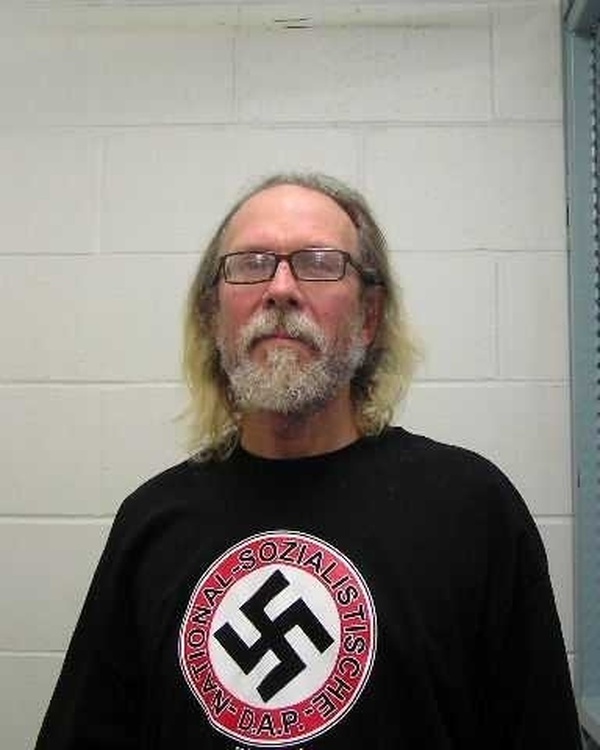
White supremacist Cobb is co-owner of former Nome, ND church

Craig Cobb
Craig Cobb
Jim Monk
February 21, 2017

VALLEY CITY, ND (KFGO) - Craig Cobb, the white supremacist convicted of terrorizing residents in Leith, ND, is now the co-owner of an abandoned church in Barnes County.

The Barnes County Recorder's office says a deed was filed Tuesday that lists Cobb as one of two people who own the former Nome Zion Evangelical Free Church.  The Barnes County Treasurer's office also confirms that Cobb submitted a check for his share of the property tax bill.

City leaders in Nome have expressed concern about what Cobb plans to do with the church. In 2013, Cobb tried to establish an all-white community in Leith, ND.

Cobb is now living in Sherwood, ND. He’s serving four years of probation for terrorizing and menacing Leith residents.

http://kfgo.com/news/articles/2017/feb/21/white-supremacist-cobb-is-co-owner-of-former-nome-nd-church/

Thousands attend Vrindavan temple's anniversary celebrations

IANS
February 23, 2017

Vrindavan: The anniversary celebrations of one of the largest temples here -- the land of Lord Krishna -- saw thousands of devotees performing aarti on Wednesday.

The Prem Mandir, established by the fifth Jagadguru, Shri Kripalu Ji Maharaj, is part of a sprawling 54-acre complex on the outskirts of this holy town and is run by the philanthropic Jagadguru Kripalu Parishat (JKP).

The fifth anniversary celebration, attended by JKP President Vishakha Tripathi, was marked by a grand "abhishek", singing of devotional songs and a bhoj for devotees.

JKP Secretary Raam Puri said the temple, whose foundation stone was laid in January 2001, took about 12 years to complete and employed over 1,000 artisans.

The uniquely designed two-storey temple, which stands 125 feet tall, used both traditional chisels and hammers for intricate carvings, as well as computerised robotic machines that gave shape to its structure, made entirely of Italian marble.