
Subscribe to the CultNEWS101 Newsletter.
We invite you to receive our Cult News newsletter - cult recovery -
resources about cults, cultic groups, abusive relationships, movements, religions, political organizations, events and related topics.



October 23, 2023
TOKYO (Kyodo) -- The Unification Church's headquarters in South Korea has told its branches worldwide to manage their assets in accordance with the laws of their respective countries amid speculation the Japan branch may transfer its assets overseas to avoid liquidation when it is issued a dissolution order, a church source said Monday.
Japanese lawmakers are stepping up efforts to ensure the assets of the Japan affiliate will be used to help victims of the group's aggressive donation solicitation tactics after the government filed a request with a court this month for an order to dissolve the branch, a move that would deprive the group of its tax-exempt status.
The notification from the church, formally called the Family Federation for World Peace and Unification, said their assets "need to be managed according to respective country's laws" and that each branch is run "independently and with self-reliance," according to the source.
The notification also backed remarks by the Japanese branch of the church at a press conference on Oct. 16 that it would not transfer its assets abroad.
Lawmakers from the ruling Liberal Democratic Party said they are considering ways to ensure that church assets stay in Japan to provide relief to victims, while some opposition parties have proposed bills to give the court authority to safeguard assets of a religious group that has been given a dissolution order.
The church came under scrutiny after the assassination of former Prime Minister Shinzo Abe last year. The shooter has said he was upset with perceived connections with the religious group and Abe.
The government filed the request with the court on Oct. 13, saying its nearly yearlong investigation into the organization found repeated malicious and illegal acts at an organizational level, including soliciting large donations from its followers.
If the court accepts the government's request, the Unification Church, which earned its religious corporation status in Japan in 1964, would lose its status and tax advantages. However, the organization could continue its activities in Japan.
https://mainichi.jp/english/articles/20231023/p2g/00m/0na/040000c
An Australian cult linked to controversial preacher Paul Mackenzie had been taken to task over questionable kidney donations, according to reports seen by the Nation.
Mr Mackenzie and his wife, who are leaders of the "Jesus Christians" group, have been accused by a Senate committee of inciting religious extremism in the country that led to the deaths of over 400 people in Shakahola, Kilifi County.
An independent search by the Nation established that Dave and Sherry Mackay had been accused of brainwashing their believers into donating their kidneys to complete strangers under suspicious circumstances.
They also drained their followers' bank accounts and separated them from their families.
The Senate ad hoc committee that is investigating the Shakahola deaths and is chaired by Tana River Senator Danson Mungatana mentioned the Mackays in its report, claiming that Mr Mackenzie was indoctrinated by their teachings.
According to the committee, Mr Mackenzie used virtual links and social media to reach out to the foreigners and their cult dubbed,"Voice in The Desert".
Furthermore, it is alleged that he hosted their associate in Makongeni, Nairobi City County, who delivered anti-government [sermons], particularly stating that the Huduma Namba was "the mark of the beast".
Additionally, the associate allegedly urged followers to abandon earthly possessions and follow Mr Mackenzie to the "promised land", which was later established to be located in Malindi.
Reports show that, in the early 2000s, the Mackays and their followers hit headlines across Australia and the UK over questionable organ donations, particularly kidneys.
According to media reports at the time, the group's members from Kenya, Britain, the US and Australia had donated their kidneys as part of their desire to "live selflessly", following teachings by the cult. These occurrences led the group to be referred to as the "kidney cult".
The believers donated their organs secretly as their kin, who were interviewed by journalists, said they suspected that they had been brainwashed.
"Information [made available] to the committee established that Paul Mackenzie was influenced by Dave Mackay and Sherry Mackay from Australia, who are founders of a cult movement known as Voice in the Desert. The teachings of this cult include forsaking all private ownership of property, surrendering earthly possessions and relocating to an isolated communal place where members serve one master," the committee report states.
In May this year, documents filed at the Milimani Law Courts in Nairobi indicated that some of the Shakahola victims may have had their organs harvested before they were buried in mass graves.
The documents filed by Chief Inspector Martin Munene, in an application seeking to freeze bank accounts belonging to New Life Centre and Church leader Ezekiel Odero, who was linked by detectives to Mr Mackenzie, alluded to a wide network of organ traffickers in the country that is under investigation.
"Post-mortem reports have established missing organs in some of the bodies of the victims so far exhumed. It is believed that trade on human body organs has been well-coordinated involving several players," said the officer.
Associates of the two Australian preachers had also been accused of kidnap across different countries, including Kenya and the UK.
In Kenya, records show that Roland and Susan Gianstefani, who are members of the "Jesus Christians", were arrested in 2005 over the disappearance of a woman and her seven-year-old son.
The church later released a video of the woman and her son on their website and YouTube channel, with the woman defending the two suspects while claiming that she was in hiding from her father who wanted to take custody of her son. It later emerged that Roland and Susan had encountered a similar case in the UK in 2000 when a British judge handed them suspended six-month jail sentences for refusing to reveal the whereabouts of a teenage boy who had left home to join their group.
In their report, the Senate committee expressed frustrations in their bid to expose the truth about the Shakahola massacre.
They accused Interior Cabinet Secretary Kithure Kindiki and his Health counterpart Susan Nakhumicha of blocking government representatives summoned to appear before the committee from testifying.
"Despite extending invitations and issuing summonses, the committee was unable to procure the attendance of key witnesses. These included former Kilifi County Security Committee members, who were transferred following the discovery of the tragedy in Shakahola forest," the report reads in part.
Prof Kindiki informed the committee that some of the transferred officers were witnesses and others suspects in the ongoing investigations.
The committee recommended that "the Attorney-General declares Mackenzie's Good News International Ministries a society dangerous to the good government of the Republic of Kenya pursuant to section 4 (1) (ii) of the Societies Act (Cap 108) within thirty (30) days of adoption of the report by the Senate."
It also accused the country's justice and security systems of failing to take appropriate action early enough despite the matter having been extensively publicised in the media and by human rights organisations, victims' families and political leaders.
- Additional reporting by Farhiya Hussein


Standard
October 20, 2023
A Senate report has accused Paul Makenzi of being the mastermind of the Shakkahola massacre and recommended he be charged for the death of at least 429 people.
The report by the Tana River Senator Danson Mungatana-led committee ad hoc committee has revealed how Makenzi lured hundreds of gullible followers to their deaths, including killing those who defied his starvation orders.
The team established that Makenzi intensified his recruitment during the uncertainty and anxiety occasioned by the Covid-19 pandemic.He recruited hundreds of vulnerable people through agents in different parts of the country who systematically lured followers to their deaths through deceptive recruitment tactics, states the report.
The report released yesterday claims that Makenzi manipulated his followers by promising them land in Shakahola. Firstly, it says, he financially exploited them by requiring them to sell their assets and hand over the proceeds to him.
The committee established that Makenzi systematically concealed properties and money that he fraudulently and unlawfully acquired from his victims.
Other than using the agents, the report states that Makenzi also lured people to the forest through preaching, using a variety of media channels to disseminate his harmful doctrines, including social media platforms such as YouTube.
"He used virtual links and social media to foster foreign links with "Voice in the Desert", an Australian cult founded by Dave and Sherry Mackay and hosted their associate in Makongeni area, Nairobi County, who delivered summons echoing anti-government sentiments, particularly stating that Huduma Namba was "the mark of the beast", It states.
"He intentionally isolated his followers by moving into Shakahola Forest, a remote and inaccessible area with no access to social services, and caused his followers to cut links with family members, thus leaving them dependent and without protection. He strategically and systematically targeted and isolated extended families, and as a result of his atrocious actions, entire families perished, leaving relatives devastated. In some instances, entire lineages were wiped out," it says.
Inside the over 800-acre Shakahola forest, Makenzi established an armed gangthat violently enforced his starvation doctrine by attacking and killing followers who changed their minds about willingly starving themselves to death.
But the "deserters", according to the report, were first arraigned before a makeshift court where mock trials were conducted and were sentenced.
"He set up a makeshift court where he held mock trials of followers who had refused to comply with starvation orders. The orders from this makeshift court would be enforced by the armed gang," states the report
The Mungatana-led committee established that Makenzi exploited the vulnerability and subjected children to painful and slow death by starvation;
The children were denied access to health care, basic education, basic nutrition, shelter, and the right to be protected from abuse and neglect in clear violation of Article 53 of the Constitution of Kenya, the Children's Act, 2022, and the Basic Education Act, 2013, states the report.
"While his followers faced a slow and painful death through starvation, Makenzi and his gang of violent enforcers enjoyed elaborate meals as evidenced by menus and cooking apparatus found at his house in Shakahola Forest," it says.
Makenzi was first linked to the death of his followers in March this year after he was arrested on allegations of the murder of two children who had succumbed to starvation and suffocation.
Following arraignment in court, Makenzi was granted bail of Sh10,000 by a Malindi Magistrate's Court.
But the Mungatana committee reports that after he left protective custody, Makenzi intensified the starvation orders that caused the deaths and concealment of hundreds of bodies of his deceased followers.
"As part of concealing the mass graves where his followers had been buried, Makenzi planted vegetables on the graves," states the findings of the report.
It adds; "After his arrest without any iota of remorse and in full knowledge of the impact of his heinous acts further intimidated the public in his now infamous brazen remark, "kitawaramba" loosely translated to mean "it will catch up with you".
During the rescue process by security agencies, some of the survivors were found locked in their houses emaciated and frail, naked and their legs and hands tied with either turbans or ropes.
But the committee now claims that Makenzi also buried victims who were still living but near death as a result of starvation to terminate their lives.
"Acting in concert with his goons, savagely and sadistically forced starvation of his followers. He radicalized and indoctrinated his followers, causing them long-term psychological, physical, and emotional harm which will require long-term care and rehabilitation," said the report.
It concludes that Makenzi's gruesome actions caused a long-term negative social, cultural, ecological, and environmental impact on the local community in the Shakahola area.
https://webcache.googleusercontent.com/search?q=cache:xta4-Vg8nKwJ:https://www.standardmedia.co.ke/national/article/2001483828/report-reveals-how-makenzis-deceptive-tactics-lured-followers&hl=en&gl=us


Humanists UK
October 19, 2023
The All-Party Parliamentary Humanist Group (APPHG) met on 17 October to hear testimonies from people who have left high-control religious groups, often referred to as ‘apostates.’ The group discussed the urgent need for the introduction of government funding for programmes such as Humanists UK’s own Faith to Faithless to support those leaving high-control religious groups.
The meeting was chaired by Baroness Bakewell DBE, Co-Chair of the APPHG. Attending parliamentarians heard from the following individuals: Yehudis Fletcher, Humanists UK’s Faith to Faithless Policy Officer and Charedi campaigner, author, and founder of Nahamu; Terri O’Sullivan, Faith to Faithless Apostate Services Development Officer and ex-Jehovah’s Witness; Jawad Anjum, ex-Muslim and Faith to Faithless volunteer; Dr. Joy Cranham, ex-member of the Plymouth Exclusive Brethren and an academic researcher focusing on preventative safeguarding strategies; and Hari Parekh, ex-Hindu and academic specializing in the abuse of apostates within religious households.
Terri O’Sullivan discussed her experience leaving the Jehovah’s Witness community and how she felt completely isolated from her friends and family after leaving. She explained that her work at Faith to Faithless, where she started as a volunteer before becoming a staff member, focuses on helping apostates connect and build new support networks. This is achieved by organising peer support groups, apostate social events, and other activities to reassure them that they are not alone. Terri also highlighted the enduring impact of high-control religions on individuals who leave, noting that they are often left without a safety net during times of crisis. She emphasised that the trauma experienced by individuals within these groups is not erased simply by leaving.
Yehudis Fletcher shared her personal experiences of living within a high-control religious community. She mentioned that educational neglect is widespread, ranging from a near-total denial of modern education for school-age children to the dissuasion of pursuing higher education. For those who decide to leave these high-control religious groups, many face shunning by their friends and family. Consequently, they often find themselves without employment, education, or secure housing, leading to homelessness. Yehudis also emphasised the work of Faith to Faithless, a program of Humanists UK, which supports individuals leaving high-control religious groups and amplifies their voices. She highlighted that the Bloom Review recommended the introduction of government funding to assist those leaving high-control religions and called for the support of parliamentarians in ensuring its implementation.
Jawad Anjum delivered an emotional speech about his personal experience of leaving Islam. He spoke about how the question of whether his friends would go to heaven had worried him throughout his childhood, and ultimately, it was his compassion for his friends that guided his chosen path. Despite the difficulties he encountered and the ostracism he faced from his family, he also shared a message of hope. Jawad has been able to find new friends and family who love him unconditionally. Through his volunteering for Faith to Faithless, he has also helped others discover their own paths to support and understanding.
Dr. Joy Cranham spoke about her research and her personal experience leaving a high-control religion. Her research has shown that leaving high-control religions can result in deep emotional and psychological scars, with instances of mental health problems and suicide being over-represented within these groups. She emphasised the need for services, better societal understanding, and increased research funding to address this issue. Joy also mentioned how the impacts of leaving a high-control religious group can last a lifetime, stressing the importance of understanding this for people to begin the process of recovery.
Hari Parekh presented a concerning picture of how clinical psychology often overlooks the harm caused by high-control religion. He emphasised that clinical psychology tends to overemphasise the safety of family and religion, leading to situations in social care where individuals leaving these high-control religions are often returned to their families. Hari highlighted the importance of mental health services and clinicians gaining a better understanding of apostasy to effectively safeguard and support the people they serve.
After a fruitful discussion Q&A session, Baroness Bakewell drew the meeting to a close by adding that there is a need for support services like Faith to Faithless to receive funding and called on parliamentarians to strengthen this call.
Notes
For further comment or information, media should contact Humanists UK Director of Public Affairs and Policy Kathy Riddick at press@humanists.uk or phone 07534 248 596.
The APPHG is a cross-party group of parliamentarians from both Houses of Parliament. The Group is co-chaired by Tommy Sheppard MP and Baroness Bakewell, and has 115 members. Humanists UK provides the secretariat.
Read more about the All-Party Parliamentary Humanist Group
Faith to Faithless is Humanists UK’s support programme for so-called ‘apostates’ and those who leave high-control religions. The service is led by apostates themselves, who have knowledge and experiences of apostate communities facing serious and systemic issues.


Nippon.com
October 19, 2023
Tokyo, Oct. 19 (Jiji Press)--Japan's ruling parties have agreed to study the need for a law to preserve the assets of the controversial religious group Unification Church, after the government asked a court last week to order the group's dissolution.
"We should do something about the issue," Toshimitsu Motegi, secretary-general of the Liberal Democratic Party, told his counterpart from Komeito, Keiichi Ishii, at their meeting in Tokyo on Wednesday. Ishii responded that his party will consider its response and inform the LDP of the outcome.
In the opposition camp, the Constitutional Democratic Party of Japan and Nippon Ishin no Kai (Japan Innovation Party) have drafted their own bills to preserve the Unification Church's assets.
These moves come amid concerns that if the group, formally called the Family Federation for World Peace and Unification, transfers assets overseas before facing a dissolution order, there could be a shortage of funds to provide relief to victims of its problematic practices, such as the collection of massive donations.
Within the LDP, there was initially a strong sense of caution about an asset preservation law, as such a law might violate the Constitution, which stipulates property rights.
https://www.nippon.com/en/news/yjj2023101801160/


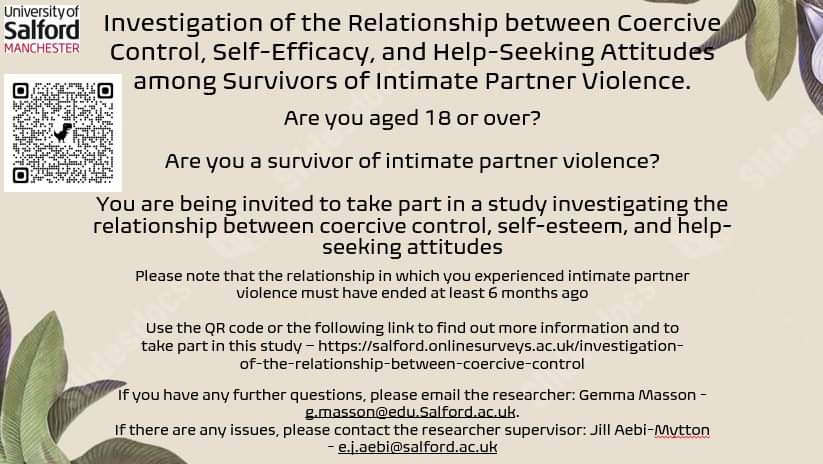
https://salford.onlinesurveys.ac.uk/investigation-of-the-relationship-between-coercive-control
Title of study: Investigation of the Relationship between Coercive Control, Self-Efficacy, and Help-Seeking Attitudes among Survivors of Intimate Partner Violence.
Name of researcher: Gemma Masson
Invitation paragraph
You are invited to take part in the current study which aims to look at the relationship between coercive control, self-efficacy, and help-seeking attitudes. Before you take part, please carefully read this participation information sheet because it gives information on the purpose of this study, as well as notifying you on the activities you will be taking part in. It is encouraged that you read this sheet carefully, and then take sufficient time to decide whether you want to participate (24 hours is recommended).
What is intimate partner violence?
Intimate partner violence refers to abuse that happens within an intimate relationship; this could be with a partner or a former partner. Examples of the types of abuse that may occur are acts of physical violence, sexual violence, emotional or psychological abuse, or coercive and controlling behaviours.
What is coercive control?
Coercive control is the repeated pattern of threats, humiliation, assault, and intimidation used to gain power and control over another person. Coercive control is a form of abuse that is now criminalised in the United Kingdom under Section 76 of the Serious Crime Act 2015. Coercive control is widely considered to be a component within intimate partner violence, yet there is still much research to be done regarding specific components of coercive control.
What is the purpose of the study?
The aim of this study is to investigate how coercive control may relate to self-efficacy and help-seeking attitudes in individuals who have experienced intimate partner violence. Furthermore, the project aims to investigate whether coercive control moderates the relationship between self-efficacy and help-seeking attitudes. An analysis on differences in coercive control in different types of relationship will also take place.
The questionnaires used will allow us to gain a greater insight into the impact of coercive control on different individuals. The results from this study could allow for a better understanding as to why some individuals seek professional help and others do not. Should you feel any distress in taking part in the study, you can contact the support services listed at the bottom of this information sheet.
Why have I been invited to take part?
If you are aged 18 or above and have experienced intimate partner violence you can take part. It would also be greatly appreciated if you could share the poster that contains the link to this study on your social media platforms. If you are younger than 18 or have not experienced intimate partner violence, please do not continue with this study. Furthermore, the relationship in which you experienced intimate partner violence must have ended at least 6 months ago.
Do I have to take part?
This study is completely voluntary so if you do not wish to take part, you do not have to. You can also withdraw at any point up until 2 weeks after submitting your answers. If you wish to withdraw, please contact the researcher to do so and quote your unique personal identifier. If you have any questions about the research, please use the email provided at the bottom of the participation information sheet to contact the researcher. Alternatively, contact information is provided for the supervisor of the project and co-chair of the ethics committee should you have any further queries.
What will happen to me if I take part?
You will be asked to complete a series of questionnaires which involve questions that are related to coercive control, self-efficacy, help-seeking attitudes, and some questions to determine the demographic of the sample. The statements on the questionnaires allow you to rate how much you agree with them, or how much the statement describes you. It should take around 30 minutes to complete the whole set of questions.
Expenses and payments?
There will be no payment to those who take part, however, participation will be greatly appreciated.
What are the possible disadvantages and risks of taking part?
Completing questionnaires on past experiences of abuse could lead to negative feelings arising towards oneself or others. You have the right to withdraw at any time, and you do not have to answer any questions which you do not want to. If this study should trigger any distress, support services are listed at the bottom of this information sheet and in the debrief form.
What are the possible benefits of taking part?
The study is not guaranteed to help you; however, the research findings could allow psychologists to have an increased understanding on what contributes to attitudes towards help-seeking and how coercive control may impact an individual.
What if there is a problem?
If you have a concern about any aspect of this study, you should ask to speak to the researcher Gemma Masson by email (g.masson@edu.salford.ac.uk) who will do their best to answer your questions.
Following this, if you have any issues or complaints, you may contact the research supervisor Jill Aebi-Mytton by email (e.j.aebi@salford.ac.uk).
If the matter is still not resolved, please forward your concerns to one of the Co-Chairs of the Health Taught Ethics Panel:
Dr Linda Dubrow-Marshall - l.dubrow-marshall@salford.ac.uk
Dr Anna Cooper-Ryan - a.m.cooper-ryan@salford.ac.uk
Will my taking part in the study be kept confidential?
Participants will be given a random unique number for their data to be referred to which is only known by the researcher, therefore upholding anonymity and confidentiality. All collected data will be kept on a password protected computer and only be accessed by the researcher. Data will be kept for a minimum of 3 years, after the graduate award has been made, for possible validation of the data and possibly used in further research. However, your identity will remain protected. Efforts have been made to ensure that your data is handled correctly and in accordance with General Data Protection Regulations.
What will happen if I do not carry on with the study?
If you do not wish to continue and instead want to withdraw now, you can leave the current page. If you start to fill in answers and decide you do not wish to continue, you can leave the page and your answers will not be submitted; this will be considered as a withdrawal from the study. If you want to withdraw at a later date, please quote your unique personal identifier when contacting the researcher about withdrawal. Withdrawal will be allowed up until 2 weeks after participation.
The results of the study will be used as part of a dissertation report. If you wish to know the results of the study, please contact the researcher and the results will be made available to you once the study has concluded. The data may also be used in presentations, publications, and future research. Any personal information will not be used, and data will be kept confidential and secure.
Who is organising or sponsoring the research?
There is no funding or organisational support for this research.
Further information and contact details:
Researcher, Gemma Masson – g.masson@edu.salford.ac.uk
Research supervisor, Jill Aebi-Mytton – e.j.aebi@salford.ac.uk
Support services:
National domestic abuse helpline – 0808 200 0247
Victim Support helpline – 0808 168 9111
Women’s Aid – helpline@womensaid.org.uk
If you are a student at the University of Salford, you can also access Student Wellbeing Services – Call 0161 295 0023 or email: wellbeing@salford.ac.uk
Nippon.com
Oct 19, 2023
In July 2022, former Prime Minister Abe Shinzō was shot to death by a man whose family had ties to the former Unification Church. Journalist Suzuki Eito talks about his investigations of this church, its shady activities, and its ties to the political world.
A Forced Dissolution?
According to the journalist Suzuki Eito, while it may seem that efforts toward forcing the dissolution of the Family Federation for World Peace and Unification (formerly known as the "Unification Church") are currently in a lull, they remain as strong as ever and are likely to even ramp up sometime this year.
"The Ministry of Education, Culture, Sports, Science, and Technology, or MEXT, continues in its efforts," says Suzuki. "Now it is up to Prime Minister Kishida Fumio to make a decision."
MEXT has asserted its right to question the organization under the Religious Corporations Act a total of seven times, and it has compelled the former Unification Church to provide relevant documents and materials in response to these inquiries. It has not yet, however, filed with any court an Order for Dissolution by Judicial Decision.
"Since it was assumed that the former Unification Church would not provide any documents or materials that would put it in an unfavorable position," says Suzuki, "MEXT carefully compared what the former Unification Church submitted with documents that it had already obtained independently. The Ministry is expected to file an Order for Dissolution by Judicial Decision this fall, indicating that the government may be prepared to take the next step."
If the order is filed, the former Unification Church will be stripped of its status as a religious organization and lose the favorable treatment it currently enjoys under tax law.
A week after the July 8, 2022, assassination of former Prime Minister Abe Shinzō, members of the media began to focus on the existence of a certain document: a list of over 100 Diet members who had attended or sent telegrams of congratulations to events organized by groups with ties to the former Unification Church. Although some of these politicians were in the opposition, the majority were in the ruling Liberal Democratic Party.
Suzuki Eito was the author of this list. Other members of the media then began pursuing Diet members whose names appeared on the list. These Diet members all parroted the same responses to reporters' questions: "I did not know that organization [the sponsor of the event they had been linked to] was associated with the former Unification Church" or, more simply, "I cannot recall." This in turn provoked the ire of the Japanese public. At this very same time it was being reported that the mother of Yamagami Tetsuya, the accused assassin of former Prime Minister Abe, had donated over ¥100 million to the former Unification Church, which led to irreparable rifts in the Yamagami family. This led to further scrutiny of LDP politicians who acted as mouthpieces for the former Unification Church.
Releasing the List
The news website Almost Daily Cult News, which is Suzuki Eito's main writing vehicle, did not publish the list of names itself.
"We thought it would be more efficient," Suzuki explains, "to distribute the list to major media outlets rather than putting it up on our own site. I had no ambition to scoop other journalists with stories about the former Unification Church. I still feel that way. My stance is that information should be as open as possible so that everyone has a chance to investigate the issues themselves."
The effect of this distribution exceeded even his own expectations. According to a survey conducted by the daily Asahi Shimbun, support for the Kishida administration—which stood at 57% immediately following Abe's assassination—suffered a drop of 10 points after just one month and has continued to fall ever since. The criticism-plagued LDP initiated an investigation of politicians with links to the former Unification Church, and on September 8, 2022, it announced that 179 LDP Diet members had some type of association with it. However, this investigation consisted of a questionnaire that LDP politicians completed on a voluntary basis, and thus it is generally believed that the number with links to the church is higher than the 179 who chose to respond positively to the questionnaire.
"Other reporters," observes Suzuki, "managed to uncover aspects of the issue that I myself was unable to. This is another reason why I think it was the right decision to share our list with everyone."
In fact, Suzuki has been investigating this issue without much fanfare for a long time. He began with a survey of the former Unification Church in 2002. While a university student he had a part-time job and was involved in a band, which took up most of his time. After graduation, he worked for a building maintenance company on a limited contract basis. It was around this time that he first saw with his own eyes that church members would speak to passers-by under false pretenses, as they did not disclose the true name of the organization on whose behalf they were recruiting.
"One time, I had just passed through the turnstile at JR Shibuya Station," he recalls. "There were a lot of church recruiters inviting passers-by to study 'palm reading' or claiming that they could tell by looking at their faces that they were experiencing problems. When they came across someone who seemed anxious, they would tell them that they were at 'a major turning point' in their lives. In this way the recruiters would attempt to hook people and eventually bring them to facilities associated with the former Unification Church."
Enthusiastic Followers
In addition to the "palm reading study" approach, the recruiters would also sometimes use something called an "attitude survey." The ultimate goal in either case was to entice people who showed any interest at all into going with them to "video centers" run by former Unification Church members. There, the targets would be shown videos designed to arouse interest in the organization's doctrines.
"From that point onward," explains Suzuki, "the enticements would continue non-stop and gradually shift to mind control techniques. In the end, the targets would be made to go to training camps run by the former Unification Church so that they could be turned into followers."
Sensing that this was problematic behavior, Suzuki began efforts to put an end to false solicitation. Essentially working alone, he at times suffered violence and was trailed by church members whom he tried to stop from falsely soliciting people. He also made a new discovery during this period, which was that if you engage in a normal conversation with church members, many of them turn out to be pleasant people.
"Those who were soliciting people to join in palm reading studies had good intentions and were not bad people," he said. "In fact, it was indeed people who had good intentions who became followers and who then became enthusiastic about recruiting people. This was something that I first learned through conversations with followers."
The reality is that people of good will tend to become caught up in new religious movements. The largely unknown technique used to entice these people to new religious movements is mind control, and influential politicians were deployed by the church to present a convincing face to followers and prevent targets from getting away. Suzuki made proposals to write articles on the issue on numerous occasions, but his results were mixed at best.
"Most publications completely ignored me," recalls Suzuki. "The editors would say things like 'that politician has no name value' or 'the former Unification Church isn't a hot topic.' I had to endure that kind of treatment for a very long time."
The only media outlet that expressed any interest was Shūkan Asahi, which ran "Abe teikoku vs. shūkyō" (The Abe Empire vs. Religion) in its April 11, 2014, edition. This story went into details regarding then Prime Minister Abe, LDP members, and the former Unification Church.
"That was the start of a run of stories at a pace of about one per year," said Suzuki. "But in addition to complaints about the articles that were sent to the editors of the magazine, there were also those who insisted that the magazine shouldn't run what they referred to as the 'fake news' that I had written."
The Media Backs Down
But there was another reason why the media stopped covering new religious movements as problems in society.
"Other religious organizations, just like the former Unification Church, would quickly file complaints any time they were portrayed negatively in the news media," recalls Suzuki. "There were a lot of lawsuits, and the media outlets began to think that it was too much trouble to cover the issue."
Most new religious movements used their plentiful funds to bolster their media strategies. For example, they would send reporters mid-year and year-end gifts and invite members of the Japanese media to events being held abroad. It was due to these practices that the Japanese media stopped covering issues related to the former Unification Church.
In spite of this media environment, Suzuki continued his investigative reporting at Almost Daily Cult News, which was founded by the journalist Fujikura Yoshirō in 2009.
As a result, the intrepid Suzuki sometimes received anonymous mail. One bore the title "Suzuki Eito: Predatory Journalist."
It stated, "What is your real job, a carpenter? Most of the time you don't even look like a journalist. You wear work clothes and you drive an old-fashioned pickup truck to work in the early morning hours. When you 'report,' you change into a suit, but still . . ." It went on to say, "You're forcing your mother—a woman in her eighties—to work in order to support you."
Naturally, none of this was true.
"The reason I drove a pickup truck in the morning," Suzuki explained, "is that I also worked in the real estate industry and had to travel to the properties I handled. I was in the process of doing renovations on the properties, and so I suppose this person saw me hauling lumber in my truck. My mother was working because she likes to work. She never gave me any of the money she earned."
Suzuki states that he knows who wrote this letter, and what the writer's objectives were.
"The letter was written about three years ago," says Suzuki. "After Abe's assassination, I began to appear on television, and for a time I was working in and around the National Diet building and the Kantei, the prime minister's official office and residence in Nagatachō, Tokyo. I suppose the letter-writer was attempting to suggest that I was an untrustworthy person."
The Need for a Formal Investigation
In response to the former Unification Church issue, the Kishida administration got a new law passed that was intended to provide support to people who had been victimized by unscrupulous religious organizations. But Suzuki claims the new law does nothing to solve the underlying problem. He also says that the Japanese government needs to conduct a formal investigation into the issues that formed the background of Abe's slaying.
When asked what his next step would be, Suzuki replies: "There are several politicians in the LDP who have attempted to escape any personal responsibility by laying all the blame on Abe. I'd like to next turn my attention to them."
Regarding the responsibilities of the media, Suzuki goes on: "If the media once again stops covering this issue, it's clear that things will return to 'business as usual,' and that the politicians who facilitate the activities of these religious organizations will fall out of the public eye. I think that both the religious organizations and the politicians who support them will simply go back to their old ways as soon as the media stops paying attention to them. It's therefore the media's responsibility to make sure that coverage of this issue does not end."
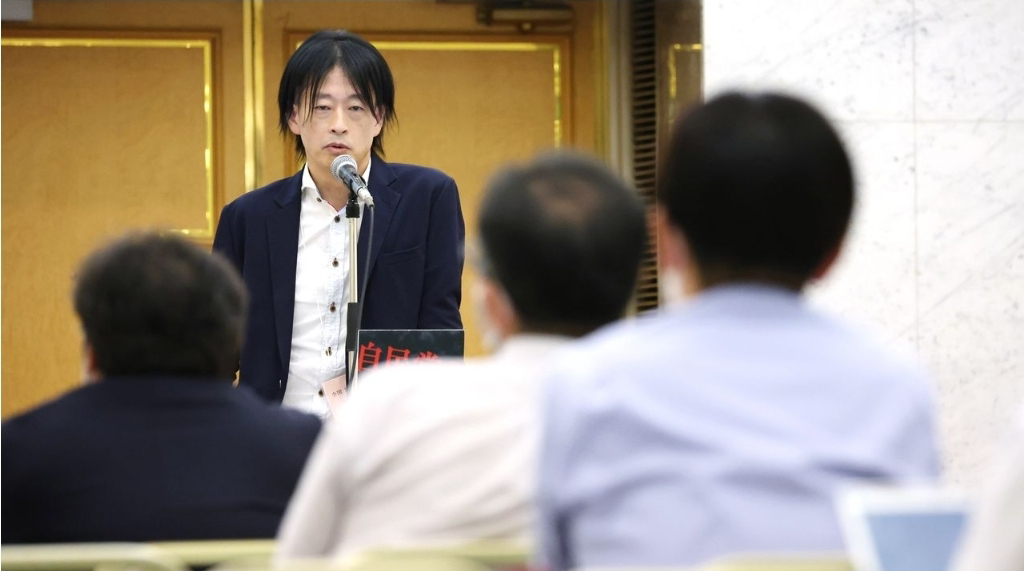
(Originally published in Japanese. Reporting and text by Mikata Kyū, Nishioka Yukifumi, and Power News. Banner photo: Journalist Suzuki Eito at a press conference in Tokyo in September 2022. © Mikata Kyū.)