Showing posts with label Rishikesh. Show all posts

Dec 14, 2024

John Lennon wrote a song full of expletives called ‘Maharishi’. Then he had to tone it down

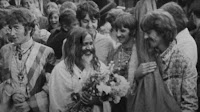
The Beatles with Maharishi Mahesh Yogi
At the screening of his documentary, ‘The Beatles and India’, Ajoy Bose showed how the band’s visit to Maharishi Mahesh Yogi’s ashram helped export Indian classical music to the West.

Ashutosh Anil Gudi
The Print
14 December, 2024

New Delhi: John Lennon was so distraught by Maharishi Mahesh Yogi’s betrayal that he wrote a song full of expletives directed at his former spiritual guru who introduced the West to ‘transcendental meditation’.

He wanted to call it ‘Maharishi’.

“The rest of The Beatles convinced him to rename the song to Sexy Sadie and tone it down,” said filmmaker Ajoy Bose at the screening of his 2021 documentary, The Beatles and India earlier this month at New Delhi’s India International Centre. “It had to be re-written, but it still carries the same sentiments; the lament that the Maharishi had everyone fooled.”

Bose, in his documentary, explores the cultural bridge between India and the West, which The Beatles along with Pandit Ravi Shankar and Maharishi Mahesh Yogi built together. They even visited the Maharishi’s Rishikesh ashram in 1968—but soon had a falling out over allegations that the Maharishi molested multiple women devotees including Mia Farrow.

The Maharishi also attempted to exploit The Beatles, referring to himself as their ‘spiritual teacher’ in a recording of his lectures. He also made a promise to the American Broadcasting Corporation that the group would be appearing in a television special without their consent.

The documentary shows how The Beatles’ visit to the ashram helped export not just Indian spirituality and yoga to the West, but also classical music. George Harrison incorporated the sitar in his music, in turn inspiring many artists and bands such as Donovan and The Mamas & The Papas.

“The Beatles were a very important part of my growing up in the ’60s. I was even commissioned to write a book on them by Penguin Random House because they wanted a fan account of them instead of an expert account. Writing my book and making this film had me really rediscover my favourite band,” Bose said. It’s a fascination he shares with the rest of the world.

The Beatles will never go out of style—and as Bose put it, “It goes beyond their music.”

Maharishi’s curse

The Maharishi’s cult status and the adulation from the West became a hotbed of intrigue. In Parliament, the Opposition alleged that the godman and his guests were in cahoots with the CIA to destabilise India. There was another rumour doing the rounds–that the Maharishi had cursed The Beatles, warning them that they would break up if they did not practice transcendental meditation.

Two years later, this came true. Bose, however, dismissed an audience member’s question on whether there was any truth to it.

“I think, for The Beatles, the time had already come before the curse. They were really all not together, and they had started fading away fast, and after 1967, everyone wanted to get out while only Paul wanted to stay,” he said.

He was impressed by their professionalism and commitment to their fans.

“They didn’t let their internal dynamics compromise their music.”

The infamous fallout between the godman and the idols made headlines all over the world. But it didn’t end there. French author Come Carpentier, who attended the screening, pointed out that over the years, there were attempts to mend the bridge, which Bose’s documentary also captures.

“There was a greater reconciliation because there was something higher than whatever transpired between The Beatles and the Maharishi,” he said.

“The Beatles essentially said that even though we made a mistake, this is what changed our lives and that is much better than whatever may have been said about the Maharishi.”

“This is the nature of India, and that is reflected very well in this film,” said Carpentier. “The legend of India remains no matter what is said about any guru, because there is something much higher about India than any individual’s behaviour, which is always affected by weaknesses such as those of the Maharishi,” he added.

Past and present, superimposed
The documentary is not rooted in the past. Through the film, Bose juxtaposes archival footage of The Beatles during their 1968 visit with present-day images of the locations.

A black–and–white scene shows the ‘Beatles Ashram’ in Rishikesh in ruins, followed by footage of John Lenon walking in the same landscape.

Bose explained that it was a superimposition of archival footage with recent images.


“We, in fact, had a special guy to do that. He had drawn this whole thing out, how exactly to do it. The editing team’s magic is behind this execution,” Bose said.

Incidentally, the ashram is slated for an overhaul to make it a tourist attraction.

Although The Beatles may have left the Maharishi and his ashram behind, Bose’s documentary shows that their romance with India ensured the country’s spiritual legacy found its rhythm in the global consciousness.

(Edited by Prasanna Bachchhav)

https://theprint.in/feature/around-town/john-lennon-wrote-song-expletives-maharishi/2402941/

Dec 8, 2024

Finding lost Beatles Ashram in Rishikesh woods

Raju Gusain
First Post
December 8, 2024
Maharishi Mahesh Yogi Ashram in Rishikesh
Six years back, when a forest ranger was walking with an American author inside the Maharishi Mahesh Yogi Ashram in Rishikesh, they found the bungalow where the world-famous musical band, the Beatles, stayed during their 1968 Rishikesh.

The building where the world-famous musical band, the Beatles, stayed during their 1968 Rishikesh tour remained in complete neglect and unidentified for many decades. It was in 2018; the bungalow was traced, and now it has turned into a major attraction for tourists and Beatles fans.


George Harrison, John Lennon, Paul McCartney, and Ringo Starr travelled to Rishikesh to learn meditation from their guru, Maharishi Mahesh Yogi, in 1968. They stayed in the spiritual camp of Maharishi, and there was little information about the bungalow where the music stars dwelled and composed many of their iconic songs. Mahesh Yogi took 15 acres of land on lease for setting up his camp from the forest department in 1961, but he had to abandon the campus and hand it over to the government after a court order in 1999. Now the former ashram of Maharishi is managed by the Rajaji Tiger Reserve of the Uttarakhand forest department.

The incident took place some six years back when a forest ranger was walking with an American author inside the Maharishi Mahesh Yogi Ashram in Rishikesh. The American was meditation teacher and film producer Prudence Anne Villiers Farrow, who had stayed with the Beatles in the Ashram in 1968. The forest staff casually asked, “Do you remember the house where you had stayed with the Beatles?”

The reply of the guest made forest ranger Rajendra Nautiyal jump with joy. Prudence Farrow plainly said, “The building was located near the back gate, and it was U-shaped.” These two clues were good enough to identify the building. Prudence and Nautiyal hurriedly walked toward the back gate. Carefully walking through the wild bushes as they reached the spot, Prudence Farrow verified, “Yes, this is the building!” Had Prudence not toured India in 2018, the landmark building would have remained unidentified forever.

Beatles Bungalow
The scene must have shocked Prudence. The seven-room bungalow with a veranda was covered with wild bushes. The building, which was a hub of vibrant activities with the Fab Four’s arrival, was vandalised, like the other 200-odd structures at the Chaurasi Kutiya Ashram. With broken doors and windows narrating a sad story! Miscreants had taken away all the valuables and bathroom fittings. The building was in a dilapidated condition.Ringo stayed in the Maharishi Ashram for 10 days, Paul McCartney for five weeks, and John Lennon and George Harrison each for eight weeks. They stayed in the bungalow and composed 48 songs. The stay was one of the most creative periods of their career! Many of their compositions featured in their famous ‘The White Album’ and ‘Let it be.’

A happy Rajendra Nautiya says, “With the tour of Prudence Farrow, the mystery over the place where the Fab Four had stayed during their 1968 tour got solved. Now this building is known as the Beatles Bungalow.”

After the identification, the bushes were cleared and garbage/waste removed. Now, everyday tourists in large numbers go there to have a look at the building that was named as ‘Rishikesh Hilton’ in 1968 by the western media. A building that remained forgotten for a long time. Two rooms are linked to two famous Beatles songs. To tease Prudence Farrow, who used to meditate for long hours, John Lennon composed the song ‘Dear Prudence’ song. Lennon suffered from insomnia in the Ashram, and this inspired him to write, ‘I’m So Tired.’

The Maharishi Mahesh Yogi Ashram takes the visitors on an epic journey highlighting the legacy of Maharishi Mahesh Yogi and the famous trip of the Beatles. As the forest department took control in 1999, they put a ban on public movement in the campus. Miscreants found a golden opportunity and looted all the valuables from the campus. They vandalised all the buildings, and presently Chaurasi Kutiya is a hub of about 200 damaged buildings.

From 1999, the bad days of the Chaurasi Kutiya started. It continued till 2015, when the Uttarakhand government decided to reopen the former spiritual camp of Maharishi for the tourists. The move evoked a warm response from the tourists, and last year 1.19 lakh Indians and over eleven thousand foreign tourists visited the place now famous as the Beatles Ashram. Local guide Alok Upreti says, “The foreign tourists are thrilled by seeing the Beatles bungalow. They are surprised to find that the famous band member stayed in ordinary rooms.”

Now the Uttarakhand government is planning a major redevelopment plan at the Ashram. In a cabinet decision, held last year in August, the Uttarakhand government announced hiring a Gujarat-based firm to draft a master plan to develop Chaurasi Kutiya as an international destination.

After the Beatles tour, major infrastructure development activities took place on the front side of the Chaurasi Kutiya. The construction of 121 igloo-type structures was one of them. Least development work took place on the back side of the Ashram. The bungalow where the Beatles stayed was first used as staff rooms and later as a school. Blackboards still exist in the rooms where George, John, Paul, and Ringo had stayed.

The Uttarakhand forest department should be thankful to Prudence Farrow for adding a major attraction to Chaurasi Kutiya.

https://www.firstpost.com/opinion/finding-lost-beatles-ashram-in-rishikesh-woods-13842706.html#goog_rewarded

Oct 27, 2024

Gujarat architecture firm to spruce up Beatles ashram in Rishikesh

Beena Parmar
The Economic Times

"AHMEDABAD: The iconic Chaurasi Kutiya (84 huts) Ashram, where the British band 'The Beatles' practised yoga, wrote and composed songs, in Rishikesh, is set to be renovated by a Gujarat-based architecture firm. The Beatles' fab four, John Lennon, Paul McCartney, George Harrison and Ringo Starr, stayed at the ashram inside Rajaji National Park near Rishikesh town in 1968.

The Uttarakhand government has awarded HCP Design, Planning and Management Pvt Ltd to renovate the ashram, originally established by Maharishi Mahesh Yogi in 1961 on 7.5 hectares of forest land as a meditation centre.

HCP Design, Planning and Management Pvt. Ltd has its head office in Ahmedabad city.

Notably, the firm led by architect Bimal Patel has undertaken some big-ticket projects in the recent past, including the Central Vista, the new parliament complex and the Kashi Vishwanath Corridor.

The firm is presently working on the redevelopment of Gandhi Ashram in Ahmedabad city.

The Chaurasi Kutiya Ashram gained popularity after the British band spent nearly three months practising yoga and meditation at the facility in 1968. The band's stay was said to be the most productive period for their songwriting, and they penned more than 30 songs.

Anand Patel, project head at the firm, said the renovation, with an estimated cost of Rs 90 crore, would commence by the end of 2024 and may take a year and a half to be completed.

Talking to PTI, Patel said, "This is a Uttarakhand government project. As far as we know, the Centre came up with this idea of redevelopment after several foreign delegates who attended a G20 meeting in Rishikesh last year inquired about this place and expressed their desire to visit it. The Centre then requested the Uttarakhand government to see if it can be developed."

As the ashram is inside a forest, it will remain a "low-impact tourism spot" with minimal noise or other activities that can adversely impact the environment, he said.

The place is sought after by foreign and Indian tourists, mainly because of its connection with The Beatles, he said.

"The place is over 50 years old, and we will be repairing it without changing its original character so that visitors get an idea about its original form," Patel said.

He said the renovation will be done in such a way that tourists get an idea about its key features and characters through exhibitions on The Beatles, Maharishi Mahesh Yogi, ecology, yoga and music.

"Of nearly 25 small and medium structures which are part of the Ashram, we will renovate 12 and leave the other 13 as they are so that people get an idea about how it looked when it was established over five decades ago," Patel said."

https://economictimes.indiatimes.com/industry/indl-goods/svs/construction/gujarat-architecture-firm-to-spruce-up-beatles-ashram-in-rishikesh/articleshow/114583287.cms

Oct 21, 2024

55 Years Ago: A Self-Titled LP Signals Beginning of Beatles' End

Ultimate Classic Rock
November 2023

The name of the album may have signified a unified front, but it was really the beginning of the end. On Nov. 22, 1968, the Beatles released their self-titled two-LP set, which would soon be known as the White Album.

Perhaps its title was a way of showing the world that the tumultuous year they had endured could only strengthen them. After all, the Beatles should have celebrated a victory lap following the release of Sgt. Pepper’s Lonely Hearts Club Band.

Instead, they appeared to be in a free-fall. The Beatles had suffered the death of manager Brian Epstein, created their first critical disaster (the Magical Mystery Tour film), fallen out with Maharishi Mahesh Yogi, and seen Apple, their new business venture, get off to an inauspicious beginning.

Unknown to the public at the time, the recording sessions for The Beatles were incredibly fractious, with the songwriters working on their tracks in separate studios and bringing in the others when needed. It didn’t help that John Lennon insisted on having Yoko Ono, his new girlfriend, in the studio with him.

Animosity Leads to Double Album Concept

Drummer Ringo Starr even quit the band for a few weeks during the White Album sessions, frustrated by escalating tensions in the studio. So, a little bit of defensive overcompensation from the group could perhaps be forgiven.

In fact, The Beatles only became a double album because of mutual animosity, as way to appease all parties involved. Most agree that the project might have been better served by paring it down to a single disc – except Paul McCartney, who defended its length in Anthology by saying, “It’s great, it sold, it’s the bloody Beatles’ White Album. Shut up!” – but there’s no consensus on which songs should have been omitted.

The record’s chief selling point is the command with which the group handled its sprawling diversity. McCartney filtered the previous 50 years of American music through his own perspective. He tries his hand at folk (“Blackbird,” “Mother Nature’s Son”), country (“Rocky Raccoon”), Tin Pan Alley-style balladry (“I Will”), vaudeville (“Honey Pie”), Fats Domino (“Why Don’t We Do It in the Road?”) and the Beach Boys via Chuck Berry (“Back in the U.S.S.R.”).

Lennon, for his part, was looking toward the future with more abstract songs like “Happiness Is a Warm Gun,” “The Continuing Story of Bungalow Bill,” “Everybody’s Got Something to Hide Except Me and My Monkey” and the avant-garde sound collage “Revolution 9.” Conversely, he also wrote some of his most overtly autobiographical material to date in “Julia” and “Sexy Sadie,” his parting shot at the Maharishi.

George Harrison Comes Into His Own
Meanwhile, George Harrison was very quickly coming into his own as a songwriter, penning “Piggies,” “Long Long Long,” “Savoy Truffle” and one of his most beloved cuts, “While My Guitar Gently Weeps,” which featured a guest solo from his good friend Eric Clapton. Even Starr got in on the act with his first composition, offering a honky-tonk arrangement on “Don’t Pass Me By” that is charmingly clunky. (Years later, the Georgia Satellites’ slamming cover gave it the treatment it needed.)

Even if the music didn’t reflect the disharmony within the group, the packaging provided hints. For the only time in the Beatles’ history, the LP cover didn’t feature a photograph or drawing of the band. Instead, pop artist Richard Hamilton envisioned an all-white sleeve with “The Beatles” embossed slightly off-center and with a serial number stamped below it. The only visual representation of the four men came in the individual photographs by John Kelly that were included inside the album.

The Beatles would continue to make music that met their incredibly high standards, but damage done during the sessions for the White Album would prove to be irreparable. In an attempt to fix the situation, McCartney suggested that the group return to their roots as a rock band without all the added distractions.

As the original Let it Be movie shows, however, by then it was too late. Within a year and a half of the release of the The Beatles, the group would be dissolved in a series of acrimonious lawsuits.

https://www.msn.com/en-us/music/news/55-years-ago-a-self-titled-lp-signals-beginning-of-beatles-end/ar-AA1kmuPS

Jun 14, 2023

Meeting the Beatles in India

"Paul Saltzman shares an extraordinary life experience in a new feature documentary, Meeting the Beatles in India. With new and vivid first-hand details and over 40 personal photos never-before-seen."


To a lifelong Beatles fan like me, Paul Saltzman is one of the luckiest Beatles fans who’s ever lived.

In the late 1960s, as a young adult, the future Canadian film and TV producer and director was feeling a bit adrift and decided to pack his bags for a trip to the other side of the world — specifically, to study transcendental meditation in India with the Maharishi Mahesh Yogi.

He was hoping it would help him find some measure of fulfillment and inner peace. He didn’t count on also finding the four most famous celebrities on Earth at the time, The Beatles. They’d come to the Maharishi’s ashram in Rishikesh, India, at the same time and for the same purpose. Saltzman’s documentary includes fascinating, intimate photos from that brief period of them all studying meditation — as well as anecdotes from his time spent with The Beatles in the camp at the foot of the Ganges. Suffice it to say, this is a must-watch for Beatles fans."