Feb 3, 2018

The True Story of 'Waco' Is Still One of Contention

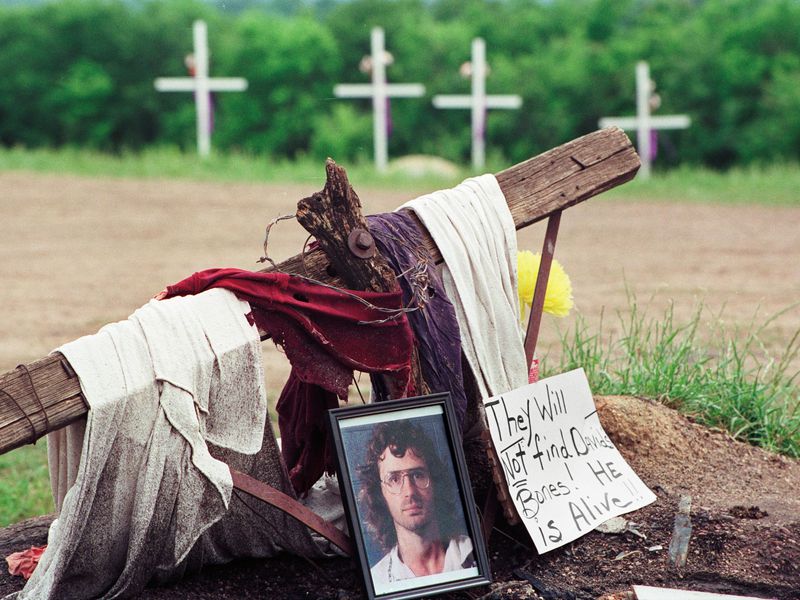
A photo of David Koresh rests beside a wooden cross as part of a monument erected in Waco, Texas, by supporters of the Branch Davidian leader and founder, Friday, April 30, 1993. (AP Photo/NewsBase) Read more: https://www.smithsonianmag.com/history/true-story-waco-still-one-contention-180968002/#Y7OBbhH61PI6iXuX.99 Give the gift of Smithsonian magazine for only $12! http://bit.ly/1cGUiGv Follow us: @SmithsonianMag on Twitter
Branch Davidians
A new mini-series hopes to humanize those in and outside the doomed compound

Roger Catlin
SMITHSONIAN.COM
January 31, 2018

It was 25 years ago this spring when the skies 13 miles northeast of Waco, Texas, filled with roaring fire in a government siege gone wrong. When the smoke cleared, more than 70 were dead.

Charges and countercharges followed the incident, from Congressional hearings to court cases. There were also a handful of TV movies about David Koresh, the leader of the religious cult called the Branch Davidians and the siege by the Bureau of Alcohol, Tobacco, Firearms and Explosives (ATF) and the FBI.

The most detailed filmed version may be the miniseries that premiered last week on the Paramount Network, the cable outlet that up to recently had been Spike TV.

“Waco” boasts an impressive cast that includes Taylor Kitsch of “Friday Night Lights” sporting aviator frames and a mullet as Koresh. Opposite him is two-time Oscar nominee Michael Shannon as Gary Noesner, the head of the FBI’s Crisis Negotiation Unit Gary Noesner. Other cast members include “Supergirl” Melissa Benoit as one of Koresh’s wives and Camryn Mannheim of “The Practice” as the mother of a compound member.

The premiere garnered 1.11 million viewers — a success for a smaller cable network in the first week of its new name. In the target 18-49 demo, it tied the episode of the much more publicized “The Assassination of Gianni Versace: American Crime Story” the same night.

Early reviews of the miniseries have played up its historical accuracy - almost to a fault. The Guardian called it “re-enactment rather than dramatization, presenting these characters and images without developing them beyond their factual bullet points.” A writer for Forbes said it “ultimately suffers from feeling more like a history lesson than a drama.” And The New York Times said it was “a workmanlike summary of events that paints a largely, some say excessively, sympathetic portrait of Koresh and his followers.”

The filmmakers based the series on a pair of books by participants from inside and out of the siege — Noesner’s 2010 Stalling for Time: My Life as an FBI Hostage Negotiator and the 1999 A Place Called Waco: A Survivor’s Story by David Thibodeau, one of nine Branch Davidian survivors. Thibodeau is portrayed in the series by Rory Culkin.

Together the books, and other interviews done in preparation, were meant to show more of what was going on among those living inside the compound, as well as the squabbles between the ATF and FBI leading up to the tragedy.

“People talk about ‘David Koresh did all these horrible things, David Koresh kind of had this coming to him,’” says John Erick Dowdle, who created the miniseries with his brother Drew Dowdle. (Koresh was believed to have committed multiple accounts of child abuse and statuary rape within the compound, not to mention the illegal arms cache that ostensibly brought the compound under siege in the first place.) “But it never occurred to us to think, ‘Well, what about the other people in there, who were innocent of anything, who were good people trying to live a life they thought was positive and the correct way?’”

The Dowdle brothers, who previously made such big screen thrillers as No Escape, As Above/So Below and Devil, began by looking into Koresh’s backstory. And there was a lot to tell there.

Born Vernon Howell to a 14-year-old single mother, Koresh was severely abused as a child, had a learning disability and was bullied at school. His father abandoned the family for another teenage girl before Koresh was born; his mother began living with a violent alcoholic.

Howell became a born-again Christian and joined his mother’s Seventh-Day Adventist church, before being expelled for wanting to marry the pastor’s young daughter.

He ended up with the Branch Davidian group, a Waco separatist cult that grew out of the Davidian Seventh-Day Adventists , which he eventually took over after a series of violent incidents. He changed his name to David Koresh in 1990 to refer not only to King David, but Koresh is the Biblical name for Cyrus the Great.

Rather than deal with Koresh’s backstory, however, the Dowdles focus on that of his followers, including Thibodeau. “What we read [in Thibodeau’s book] was so completely different than what we expected to read,” John Erick Dowdle told reporters this month at the TV Critics Association winter press tour.

“I just want the people inside to be humanized,” said Thibodeau, who was also at the press conference, in describing his book. “They died for what they believed in, whether you believe that or not. To me, they’re martyrs, and they shouldn’t just be demonized and hated.”

In “Waco,” in addition to empathy for those caught inside the compound, there is also an understanding for the FBI negotiator’s role, and how Noesner fought the militarization of law enforcement, a debate still raging today. Noesner bumps up against his colleagues who wanted to make a show of the siege, as a make-up of sorts for the bad headlines that came out of a similar standoff in Ruby Ridge, Idaho, six months earlier.

In that incident, Randy Weaver, his family and a friend wouldn’t come out of their remote cabin to answer firearms charges. An initial shootout left a U.S. Marshal, and Weaver’s wife and son dead. Negotiations led to a peaceful surrender came 11 days later. (The miniseries places Noesner at Ruby Ridge as a dramatic embellishment; the actual negotiator was not there in 1992.)

Both botched incidents caused death, inflamed the far-right and were cited by Timothy McVeigh in inspiring the 1995 bombing of the Oklahoma City Federal Building, which occurred on the second anniversary of the Waco fire.

“It’s hard not to read both of these books and not have empathy for both sides, no matter what your preconceptions might be,” Drew Dowdle says. “Reading [Thibodeau’s] book, it was just learning who these people really were and putting names and faces to a lot of the people who perished, that was very eye-opening to us.”

But, he added, “You read [Noesner’s] book, too; you just realize how difficult their challenge was in this situation as well.”

The Branch Davidians believed they were living in a time when Biblical prophesies and divine judgement was coming were imminent ahead of Christ’s second coming. A headquarters was first established near Waco in 1935 and at its height, 900 people moved there awaiting a sign from God. Koresh rose to power as a young man in the 1980s, in part by taking its leader, a woman in her 60s, as a lover. When she died in 1986 at 70, there was a power struggle between her son and Koresh.

Upon ascending to the leadership position, Koresh never claimed to be Jesus, but did refer to himself as “the Son of God, the Lamb” and unlike his predecessors, began stockpiling arms, a departure from its pacifist belief system. About 130 people were living at the compound when the ATF first approached in early 1993. They had been tipped off after a UPS package of grenade casings en route to the compound had accidentally broken open.

The ATF tried to execute a search warrant relating to weapons violations and the sexual abuse allegations.

The miniseries begins with ATF closing in on Mount Carmel on Feb. 28, 1993. Then it flashes back nine months earlier to establish Thibodeau’s entry to the group — because Koresh’s rock group needed a drummer.

Unlike what is depicted in “Waco,” the two did not meet at a local bar sound check, where they hit it off and played “My Sharona.”

“I went to L.A. to be a drummer in a band,” said Thibodeau, who, unlike the smaller figure portrayed by Culkin in the film, is a big hulking man 25 years later.

He said he met Koresh “at Guitar Center” and he gave him a business card with some scripture on it and the drummer replied, “I’m not looking to be in a Christian band.”

“The way that they described it was that they had some insights to Scripture that was kind of deeper than Christianity,” Thibodeau said. “To my surprise, about a week later, I ended up calling them. It just kept pressing on me for some reason.”

Early that Sunday morning, 78 ATF agents approached in an 80-vehicle convoy to the compound. The raid was not called off when thought it was clear the Branch Davidians had been tipped off by a news vehicle asking for direction. The cultists prepared for the raid.

The question of who fired the first shot has long been in contention. Some ATF agents said they heard shots from within the compound. Another suggested an agent’s gun accidentally went off. But the miniseries runs with the assertion that the first shots were those fired at the compound dogs by the agents.

What began at 9:45 a.m. ended at 11:30 a.m. with four ATF agents dead and 16 wounded; a fifth was killed later in the day. Five Branch Davidians were killed. It was the longest gun battle in U.S. law enforcement history. And the ceasefire came only because federal agents were running out of ammunition.

The siege consumes much of the third episode of the miniseries. The tense, 51-day standoff with the FBI, which took over government operations, culminates in a tear gas attack on April 19 and the apocalyptic fire that killed 76 at the compound including Koresh.

An internal Justice Department investigation concluded in 2000 that the fire was started from within; other interpretations, including a 2000 film by then little-known conspiracy mongerer Alex Jones, America Wake Up (Or Waco) contend it was the government.

How “Waco” deals with the aftermath of the fire, who caused it and whether it was set by the cultists as part of a violent, Biblical-inspired endgames, remains to be seen -- just three episodes were made available to the press in advance. But based on the source material, Thibodeau has maintained that the Branch Davidians did not start the fire itself, as the resulting Justice Department report in 2000 claimed. And Noesner has little to add to that debate, having left Waco three weeks before the raid, after freeing 35 people, mostly children, from the compound.

Many of the main characters of “Waco” are based on real people, including Koresh’s lieutenant Steve Schneider (Paul Sparks), local radio personality Ron Engleman (Eric Lange) and the compound lawyer Wayne Martin (Demore Barnes). But John Leguizamo’s character — an ATF agent that got close to the compound by moving next door — is named Jacob Vazquez instead of Robert Rodriguez, who was the actual undercover ATF agent.

As to whether the tragedy could have been avoided, Thibodeau says he thinks Koresh “could have been reasoned with.”

“He was always a reasonable individual the entire time that I’ve known him,” Thibodeau says of Koresh. “I think that what happened was the ATF messed up horribly bad on the first day. And then the FBI came in, and the miscommunication was so profound that both sides felt they were being lied to. And over the course of the 51 days, every day there was a news conference, and every day they were calling us a cult, demonizing us.”

Controlling the message on the outside, Thibodeau says, meant “the people inside were forgotten about, and they were just crazy cult leaders that deserved what they got. And that’s really too bad.”

As a negotiator, Noesner expected Koresh to renege on some of his promises as a normal part of the process. But “at Waco, our on-scene commander and the tactical commander took those behaviors in a very negative way,” he says. “Then they would take actions that would the only ratchet up things with David. So it was a very complex tragedy.”

For Kitsch, portraying Koresh “was kind of a hard-learning experience, to be honest. I’ve never kind of played anybody like this or remotely close.”

But even after all the research he did, studying audio tapes, recruitment materials and literature, Kitsch says. “There are still things that I’ll never have answers to, and I don’t think any of us will.”

“Waco” runs Wednesdays at 10 p.m. on the Paramount Network (formerly Spike TV).

https://www.smithsonianmag.com/history/true-story-waco-still-one-contention-180968002/

The myth of the new you: Why you shouldn't buy what self-help gurus are peddling

Why you shouldn't buy what self-help gurus are peddling

Richard Whittall: While the New Cult’s mode of delivery and the variety of channels has changed in recent years, the dubious scientism remains the same

Richard Whittall
Special to National Post
February 1, 2018

You’ve seen the headlines. Maybe they were on a friend’s Facebook feed or, as is more likely, on a colleague’s LinkedIn page. Perhaps you dismissed them as silly self-help clickbait, but if you’re like most of us, you found it impossible to resist their siren song: “5 Incredibly Effective Ways to Work Smarter, Not Harder.” “Most productive people: 6 things they do every day.” “3 Questions that Will Free Your Mind and Turn Your Life Around.”

Chances are you read a few of these articles in the lead-up to New Year’s Day and made a flurry of resolutions which, by now of course, you have quietly dropped. They usually appear on a handful of familiar websites: inc.com, hbr.org, entrepreneur.com, businessinsider.com and the motherlode of self-improvement propaganda with armies of life coaches and “marketing ninjas,” medium.com.

Each post carries the promise of a New You – a well-rested, effortlessly creative person who goes to the gym five times a week, reads 100 books a year, completes a day’s work in two hours, meditates and journals every morning and launches startup business in their spare time in between raising gritty, grateful offspring – all while somehow remaining “stress-free.”

And don’t worry; achieving these ambitious life goals requires nothing more than a few easy-to-implement tips and tricks supposedly “backed up by the latest behavioural psychology and neuroscience.” These tips might even make you unbelievably rich – though the authors of these posts go to painful lengths to stress that money can’t buy happiness. They also just happen to pepper their articles with anecdotes from the lives of ultra-rich business people and investors including Ray Dalio, Elon Musk, Sheryl Sandberg, Jeff Bezos, Ariana Huffington, Warren Buffett and others.

Welcome to the New Cult of Self-Improvement.


The inescapable truth the gurus never tell you is that self-improvement never ends.

Once the purview of slap-happy motivational speakers like Tony Robbins and corporate productivity writers such as The 7 Habits of Highly Effective People author Stephen Covey, the New Cult of Self-Improvement has adapted to the disruptive paradigm favoured by Silicon Valley, eschewing airport hotel convention centre seminars and dime store self-help books for email newsletters and ebooks filled with “life hacks.” And where there were once a handful of self-improvement superstars, the literature today is spread across an online army of authors and bloggers, with only a few standing out (Tim Ferriss, Cal Newport and Mark Manson) while many others clamber to get a piece of the action.

But while the New Cult’s mode of delivery and the variety of channels has changed in recent years, the dubious scientism remains the same, including the reliance on questionable interpretations of neurological research and anecdotes from the rich and famous to back up claims.

Despite the greater number of voices in the choir, the chorus is very much in unison – most of the new self-improvement advice on offer is more or less the same with minor variations, and it’s not exactly groundbreaking. The advice tends toward setting time aside to do focused work, taking regular breaks, avoiding multitasking, shutting out online distractions, breaking down large tasks into detailed to-do lists, focusing on process instead of results, reading books instead of wasting time on the internet, using spare time for personal learning, sleeping eight hours a day, skipping lunch twice a week, doing push-ups whenever you go to the bathroom and so on and so on.

When it comes to the thornier issues of our psychological and emotional well-being, the New Cult borrows heavily from both Buddhism and the ancient Greek philosophy known as Stoicism, with calls to be mindful of the present moment, focus on what’s in your control and ignore the rest, accept your present circumstances with magnanimity, realize you are not your thoughts, etc.

Of course, none of this advice is objectionable on its own; despite its promoters’ tendency to push quick fixes, much of what they suggest is still both practical and useful. But the sheer volume of blogs, online seminars and podcasts all selling the same story raises the question: why does such a simple, largely uniform message require so many voices to propagate it in slightly different ways, over and over and over again?

The answer relates in part to the ephemeral nature of self-improvement, and our inability to take advice, stick with it and move on with our lives. For example, after the initial high that comes with making healthy or productive changes – perhaps setting up a to-do list or starting a new workout routine – we can’t help but wonder: what if there is a slightly better workout we’re missing out on, or a marginally more effective productivity system we could be using?

The inescapable truth the gurus never tell you is that self-improvement never ends. Even after we’ve made changes to improve our lives, we can’t help but think we could be running faster, or taking more time to ourselves, or being more productive at work, all the while ignoring or discounting the positive changes we’ve already put into place over the years. And of course, legions of self-improvement writers are poised to take advantage of our restless need to tweak, with new and slightly different listicles on how to eat better, or work faster, or lose weight.

The flip side of the self-improvement industry's emphasis on personal agency is, of course, that we are also primarily to blame for our failure to flourish.


So why do so many of us struggle to break this cycle – fully aware we will never be satisfied with ourselves? The answer is the irresistible idea peddled by the self-improvement industry: that our ability to flourish as human beings is entirely in our control.

While news media presents us with an increasingly populated world under the sway of vast, faceless and unseen forces – economic market cycles, demographic shifts, geopolitical tensions, climate change – the self-improvement industry pushes the reassuring notion that our personal choices determine the quality of our lives. If we can learn to be more productive, we will get a decent, well-paying job. If we stick to a regular workout routine, we will stave off death for a few more years and maybe attract an ideal partner along the way. If we can stay mindful of the present moment, we will avoid unpleasant feelings of anxiety or depression.

The flip side of the self-improvement industry’s emphasis on personal agency is, of course, that we are also primarily to blame for our failure to flourish. Personal setbacks or a loss of resolve are not the result of bad luck, but a reflection of individual weakness. And this is where the self-improvement industry can do far more harm than good.

Consider, for example, a person at the peak of their career who is objectively considered to be very good at their job. They might ascribe their success to their ability to work smarter not harder, to delegate tasks, to set ambitious but achievable goals. But one day, due to economic forces beyond their control, they are let go as part of a restructuring plan.

Worse, because they are middle-aged with experience in a shrinking industry, they will likely have to take a lower position for less pay. A lifetime of industrious self-improvement has failed to save them from disaster. Though this person tries to accept the situation with equanimity, they can’t help but feeling as though they should have seen this coming, that they took the wrong self-improvement advice, that this unfortunate situation is fundamentally their fault.

This dark side of the self-improvement cult has not gone unnoticed by critics, some of whom compare its focus on personal salvation – the manic need to produce and strive and improve as much as we can in the short time we have on earth – to the old Protestant work ethic, which still permeates much of our culture to this day.

In a recent post, The Outline’s Vincent Bevins makes this link explicit: “(The Protestant work ethic is) what’s behind the perverted impulse to self-flagellate and ask, ‘What did I accomplish this year?’ and it’s why we get jealous every time we find out that some accomplished famous person is younger than us. In the U.S., for example, it doesn’t matter if you’re Catholic or Jewish or Buddhist, we are all still basically Calvinists deep down. And to the extent that American-style capitalism has spread around the world, so has this basic outlook, to every corner of the globe. This has got to be what’s behind those fanatical posts on LinkedIn and Medium.”


Real self-improvement is arguably impossible in a social vacuum.

Others, such as Danish psychology professor Svend Brinkmann, have pointed out that while at one time, the individualist program of the self-improvement industry was a useful counterweight to a conformist society, today it has led to a society of insular, self-obsessed navel-gazers in constant fear of failing to keep up with the Joneses. “Nowadays,” Brinkmann writes for The Guardian,“real resistance to the system would consist not of turning inward in search of some authentic self, but in rejecting the whole concept and finding out how to live responsibly with yourself and others instead.”

Brinkmann hints here at the major drawback of the current craze for productivity hacks and happiness gambits: it omits entirely the social element of the good life. Self-improvement – at least the way it is depicted by the mass of Silicon Valley-obsessed online hucksters today – is, in practice, a lonely pursuit. It is a list of personal choices to be made by you and you alone. The role of other people, when mentioned at all, is either as a means to “boost personal happiness” or to delegate boring work.

This is particularly ironic as the purpose of being more productive, or more mindful, or more physically fit is inherently social. We want to be better workers in order to gain recognition from our colleagues and employers. We want to be physically fit in order to appear more attractive to others. We read books and meditate in order to be more socially present and aware.

Moreover, real self-improvement is arguably impossible in a social vacuum. All the productivity systems in the world won’t save you from a fundamentally toxic work environment, while an effectively collaborative office can make even the most disorganized worker more productive. Similarly, experience shows that social support has a major influence on factors like diet and fitness, both when it comes to our close circle of friends and in a larger, more political context involving everything from mass agriculture to city planning.

Of course, it is much harder for self-improvement writers to sell us on the idea that our lives depend on a larger social whole that we cannot control. After all, while you can pick your own to-do list and workout schedule, you can’t necessarily pick your co-workers or your gym buddies or your elected government.

But this is perhaps the core message the New Cult of Self-Improvement needs to embrace: that our ability to flourish, whatever that means in practice, depends a lot on other people beyond our sphere of influence – and that all that can be asked of us is to do the best we can in whatever given circumstance we find ourselves in, while hoping for (but not expecting or demanding) an ideal outcome. It may be far healthier, and nicer, to stop focusing intensely on our own self-improvement regimens and to focus more on developing genuine connections with others.

Ironically, this is the core message of one of the self-improvement cult’s favourite philosophies: Stoicism. But where self-improvement bloggers have latched on to Stoicism’s themes of overcoming negative emotions and preparing oneself for the worst, they have largely skipped over its core message – that the key to happiness is to accept your present circumstances with equanimity, and to prize above all acting virtuously at all times for the sake of the common good.

This means focusing less on getting the right productivity app, eating all the right foods and picking the right cardio-to-weight-work ratio, and more on being an engaged person no matter the circumstances, which are almost entirely outside of your control.

It may not be the sexiest life hack out there, but simply living a virtuous life is probably the most effective.

http://nationalpost.com/entertainment/the-myth-of-the-new-you-why-you-shouldnt-buy-what-self-help-gurus-are-peddling

'I broke away from a strict homeschooling community cult'

'Judy' studied hard and managed to go overseas to carry out missionary work
BBC News
February 2, 2018

When you're very young, your parents or guardians are responsible for nurturing and teaching you as you grow up, but how do you know if you are getting a good upbringing?

The news that a teenager escaped from her home in California, where she and her 12 siblings were held in shackles by their parents, sent shockwaves across the world.

But what happens to children who are brought up under such restricted conditions?

Judy (not her real name) told the BBC about what life was like for her living in a "homeschool community" in Oregon, USA.

'His word was law'


"I was raised in a homeschool religious cult which encouraged parents to set up their own little schools and renew their marriage vows, just like the Turpin family. I recognise some of their behaviours.

"When my parents got together they were disenchanted by the overly free and 'hippy' style of living that was sweeping across the country. They wanted children to live a different life instead of one with no morals or rules.

"They had heard about Bill Gothard, founder of the Institute in Basic Life Principles (IBLP), who was a really big deal in Oregon. They attended his seminars and embraced the IBLP homeschooling curriculum wholeheartedly.

"He was an icon, kind of like a prophet. The seminars involved a week of intensive brainwashing. He was the authority. His word was the law.

"My parents started homeschooling in the late 1980s and for over 30 years our family became part of this closed community with similar values."

'Strict and abusive'


"There was a lot of heavy-handed smacking from our parents. To disobey them, was to disobey God. The system was especially awful for the little ones. At Bill Gothard's seminars he used to talk about 'breaking their will'.

"They were quite abusive, but we knew other families who had it worse than us. When I was little, we lived in a mobile home. It was really inadequate - there were four or five of us in a room.

"Under the IBLP system, adults were not allowed to get into debt or have a mortgage, so my parents built a house. While it was being constructed we lived in a garage. I lived in a proper house at 15 and shared a bedroom with one or two sisters. It seemed fine at the time but as I grew up, it was more and more difficult having no space to myself."

Judy believes there is a connection between the Turpin family and Bill Gothard and the IBLP:

"He's very big in Texas. I met the Duggar family (who have 19 children) at one of the seminars. The real emphasis is on families, big ones."

'You don't know what's normal'


"The world outside our community was presented to us as an evil, bad place that we were protected from.

"We were required to memorise a lot of scriptures - chapters and chapters of the bible, to the point at which we could quote them off by heart.

"I got on with my siblings. You had to - that's one of the commands. I might not have in normal circumstances. There was definitely a pecking order and a lot of bullying in the family.

"Abuse in homeschool communities is often normalised or well-hidden and all too common.

"You don't know what's normal. There was no TV and no communication with anyone outside our circle. We watched movies once a week at our grandparents' house.

"We would have been seen and heard as there was a park and playgrounds near our house where we could play. But we didn't integrate outside the family."

'I was a second mum'


"We were fed well. All of us had braces on our teeth and we were healthy.

"I am the second eldest of nine siblings and when my mother gave birth I had childcare responsibilities.

"Girls weren't encouraged to pursue careers. They were expected to stay at home and help out with the family, and I was kept busy with lots of domestic work.

"I did pretty much everything. I was like a second mum, especially while my mum suffered from depression after she miscarried child number 10.

"My dad was away a lot on business during the spring and summer. But when he was around, he was most definitely in charge."
The outside world

"Under Bill Gothard's teachings, I was sent to Taiwan aged 21 to teach English for six months.

"After a year back in Oregon, I went to mainland China. In a sense, I didn't really leave my family. I was still very much connected by phone calls and emails.

"Living in China, I got to know 'normal' Americans who hadn't been homeschooled. That was a bit of a culture shock.

"I met a British man there and soon realised how different my life was back in Oregon. We decided to get married in the US."
Cutting ties

"I didn't realise how much of a hold the cult had on me. My husband and I stayed in the US for a while, but soon realised it was better for us to remove ourselves from the community completely. My family didn't really like my husband although he was really good with them.

"My husband encouraged me to stay in touch with my family. It took a lot for him to see that they were never going to change. But I have not seen my family since I left. I'm now in my 30s.

"A lot of people ask if it's hard to cut yourself off from your family. It was an upheaval but I was lucky to have the support of my husband who helped me to find the strength to leave my community and country. I couldn't have done it alone.

"It's taken me a long time to realise the extent of the abuse I encountered. Now that I have three lovely children of my own and am part of a real community and church, I realise my upbringing was not normal."

The Washington Post reported that Bill Gothard resigned from the IBLP ministry in 2014 amid allegations of sexual abuse, which he denied, and in 2016 there were further details of a lawsuit filed by 10 women.


Interview by Sherie Ryder, UGC and Social News team

http://www.bbc.com/news/world-us-canada-42701297

BBC: Searching for a cult leader in the jungles of Costa Rica (documentary)


"In the jungles of Costa Rica alternative communities have removed themselves from Western life in an attempt to create their own version of paradise."

"Ben Zand heads to meet some of these groups and to search for a controversial cult leader called Nature Boy. Nature Boy runs a group called Melanation and has convinced thousands of people online to follow his message. But, is paradise really as good as it sounds?"

http://www.bbc.com/news/av/stories-42879776/searching-for-a-cult-leader-in-the-jungles-of-costa-rica

First Woman To Accuse Nassar Says Church Can Be One Of ‘Worst Places’ To Go For Help

Survivor Rachael Denhollander speaks at the sentencing hearing on Jan. 24 for Larry Nassar, a former team USA Gymnastics doctor who pleaded guilty in November 2017 to sexual assault charges.
Survivor Rachael Denhollander
People who work with victims of sexual assault say the evangelical church should re-evaluate how it treats survivors.

Carol Kuruvilla
Huffington Post
February 2, 2018

Survivor Rachael Denhollander speaks at the sentencing hearing on Jan. 24 for Larry Nassar, a former team USA Gymnastics doctor who pleaded guilty in November 2017 to sexual assault charges.

Rachael Denhollander was the first woman to publicly accuse former USA Gymnastics team doctor Larry Nassar of sexual abuse. As she worked to find justice for herself and the doctor’s other victims, Denhollander began to turn a critical eye on a community that she depended on dearly for support ― her church.

Denhollander, an evangelical Christian, saw that Biblical teachings about grace and repentance were being weaponized against victims, pressuring them into offering an easy forgiveness to their abusers. At the same time, churches lacked accountability structures that treated victims with compassion and respect.

It soon became clear to her that when it comes to properly caring for survivors of sexual abuse, the church has a long way to go ― and experts HuffPost spoke to agree.

Denhollander opened up about her disappointment with the American evangelical church in an interview Wednesday with Christianity Today’s Morgan Lee.

“Church is one of the least safe places to acknowledge abuse because the way it is counseled is, more often than not, damaging to the victim,” said Denhollander, who now works as a lawyer in Kentucky. “There is an abhorrent lack of knowledge for the damage and devastation that sexual assault brings. It is with deep regret that I say the church is one of the worst places to go for help.”

Nassar pleaded guilty in November to 10 counts of first-degree criminal sexual contact for abusing young athletes under the guise of medical treatment. He was sentenced last week to up to 175 years in jail.

Denhollander was one of more than 150 survivors who shared statements in court during Nassar’s sentencing hearing. In her statement, Denhollander spoke about how her advocacy for sexual assault victims “cost me my church and our closest friends.”

Denhollander said one of the biggest struggles she faced was trying to come to terms with what happened to her from a spiritual perspective. She told Christianity Today that she initially wondered why God didn’t prevent the abuse, and if she was “stained” by it. Over the years, she came to realize that church teachings sometimes can be used to “mitigate and to minimize” victims’ suffering.

″[Christians] can tend to gloss over the devastation of any kind of suffering but especially sexual assault, with Christian platitudes like God works all things together for good or God is sovereign,” she told Christianity Today. “Those are very good and glorious biblical truths, but when they are misapplied in a way to dampen the horror of evil, they ultimately dampen the goodness of God.”

Ashley Easter, an advocate for abuse victims, told HuffPost she agrees the church is not always a safe place for victims to disclose abuse.

“Many churches hold poor interpretations of Scripture that imply the victim is somehow at fault for dressing or acting a certain way ‘immodestly,’ that speaking up about abuse is ‘gossip’ or ‘slander,’ and that forgiveness is moving on without demanding justice for the victims,” Easter told HuffPost. “These stances are a stark contrast from Jesus’ ministry to the marginalized.”

Many of these views about women are steeped in patriarchal biases. Christa Brown, an expert on church abuse scandals, told HuffPost that in evangelical communities, patriarchy is often seen as part of God’s plan. Some churches emphasize female submissiveness and male “headship,” the idea that men have final authority over women in the church, community and home.

These teachings aren’t always inherently destructive. But they can create an unequal power dynamic ― such as when a female survivor of assault brings her case to the male elders of a local church.

Meanwhile, other aspects of evangelical Christian theology, such as the emphasis on forgiveness of sin, can enable covering up sexual abuse. And often, Brown said, evangelical churches lack adequate accountability structures that would keep all of these problematic forces in check.

“The toxicity of this combination ― a lack of accountability structures and a patriarchal theology ― taints evangelical culture at its very core,” Brown told HuffPost.

Denhollander first went public with her accusations in The Indianapolis Star in September 2016. At the time, she and her husband were attending a church in Louisville, Kentucky. She claimed the church was “directly” involved in supporting a local pastor who had been accused of covering up child sex abuse. When Denhollander spoke up on behalf of survivors, it caused a rift between her and the leaders of her church. She said some elders even used her personal story of sexual abuse as a weapon against her, claiming that the assault had clouded her judgment as an advocate.

In the interview with Christianity Today, Denhollander made it clear that she feels the problem is bigger than one individual congregation. She believes the American evangelical church as a whole has to work much harder to appropriately respond to abuse allegations from survivors.

“The only reason I am able to have the support of these leaders now is because I am speaking out against an organization not within their community,” Denhollander said. “Had I been so unfortunate so as to have been victimized by someone in their community ... I would be massively shunned. That’s the reality.”

Easter told HuffPost she’s seen this pattern before in evangelical churches. Church leaders are more likely to support specific victims if the abuser has no ties to their own ministry. But when victims come forward about abuse by one of the church’s pastors or a popular ministry leader, the church’s first response is often to fully support the abuser and reject the victim, she said.

“This duplicitous double standard is an exercise in image management and not reflective of the heart of Jesus,” Easter told HuffPost in an email.

In January, an evangelical church in Tennessee was criticized after it appeared to stand by a pastor accused of sexual abuse. Highpoint Church in Memphis initially indicated it had “total confidence in the redemptive process” that accused pastor Andy Savage had gone through after he allegedly assaulted a young woman years ago. After the pastor read out an apology during a church service, some members gave Savage a standing ovation.

It wasn’t until the church received backlash in the national media that leaders decided to put Savage on leave, and take other steps to re-evaluate the church’s policies on child safety.

Brown agrees that church leaders tend to respond poorly to abuse in their own communities.

“Having communicated with hundreds of clergy sex abuse survivors over the past decade, and based on my personal experience as well, I can say that Rachael’s statement is absolutely true in its assessment of how abysmally evangelical leaders would react if she had been victimized by someone within their own community,” Brown told HuffPost. “Rachael’s statement should serve as a challenge to evangelical faith groups to at least come up to speed with the basic norms of accountability structures.”

For Brown, this includes setting up centralized safe spaces within denominational bodies where survivors can take their complaints.

“What most evangelical groups now have is a system that tells abuse survivors to take their complaint to the local church ― i.e., the church of the accused pastor,” Brown said. “This is akin to telling bloody sheep that they should go to the den of the wolf who savaged them.”

Easter said that when victims come forward, churches need to open their doors and get outside professionals involved ― law enforcement, licensed counselors, justice attorneys for victims, and unbiased investigators.

“For the church to become a safe place for abuse survivors, it must repent of its sin of shielding perpetrators in their ranks,” she said. “The church needs to reevaluate its patriarchal shaming and silencing of victims and create an environment where abuse disclosure is encouraged and met with belief and compassion.”

https://www.huffingtonpost.com/entry/rachael-denhollander-the-church-isnt-safe-for-sexual-abuse-victims_us_5a73264ce4b06fa61b4e1574

Gallows finally loom for Japan’s killer cult leaders

Japanese protest against the Aum Shinrikyo cult in 2009. Photo: Wikipedia
Japanese protest against the Aum Shinrikyo
Aum Shinrikyo's leader is at last facing capital punishment, but the motive for the 1995 gas attack on Tokyo's subway remains obscure

TODD CROWELL
Asia Times
FEBRUARY 3, 2018

Kazumasu Takahashi, an assistant stationmaster on the Chiyoda subway line in central Tokyo, was on duty when the 8:10am train pulled in on Monday morning, March 20, 1995. Many of the passengers were civil servants working in the government ministries in the Kasumigaseki district close by Tokyo’s Imperial Palace.

Before the doors shut, Takahashi noticed that some liquid had spilled on to the train floor. He mopped it up and waved the train on. Then he keeled over on the platform and died. Within minutes thousands of commuters were staggering out of the subway exits gasping for air, coughing, rubbing their eyes or foaming at the mouth.

It was sarin nerve gas. Urban terrorists had planted it at five widely scattered locations along three central city subway lines in the world’s first – and so far, only – use of a weapon of mass destruction delivered in a lunchbox. Twelve died in the attack; 5,000 were injured. More than two decades later, some survivors are still bedridden with little or no prospect of recovery.

Suspicion quickly fell on a cult called Aum Shinrikyo (Supreme Truth). For a while, the menacing portrait of its hirsute guru Chizuo Matsumoto alias Shoko Asahara was as common as portraits of Osama bin Laden. Police arrested dozens of members, including Asahara.

Only now, 23 years later, does it appear that the “guru” and his lieutenants will have to pay the ultimate price.

The wheels of justice have moved slowly. Asahara, along with another 12 cult leaders, was sentenced to death in 2006 after a trial that lasted more then eight years. By way of comparison, the Oklahoma City bombing in the US took place in the same week as the Tokyo nerve-gas attack. However, the perpetrator of that atrocity, Timothy McVeigh, was swiftly convicted and executed. He has been dead for 16 years.

The Aum trials were unprecedented in Japan’s judicial history in terms of their sheer number (190 indictments) and the extraordinary length of the deliberations.

Japan’s Supreme Court finally cleared the path to the gallows when it upheld the life sentence for one Katsuya Takahashi, an Aum cultist who had been on the lam for 16 years. Under Japanese law, a person cannot be executed while courts are considering an accomplice, on the theory that he or she might be needed to testify.
Asahara has never tried to explain or justify his actions, or express any remorse for the victims. When he was found guilty of mass murder, he accepted his sentence without a word. He has never made an apology or admitted guilt

Amid this legal firestorm, one might think that the vast number of trials (Asahara alone made 257 court appearances) would have shed light on the cult’s motives for its murderous attack on the Tokyo subway system.

Yet aside from one brief statement at the beginning of his trial to the effect that he had ordered his associates not to poison the system, Asahara clammed up. He never addressed the core issues; never tried to explain or justify his actions, nor express any remorse for the victims. When he was found guilty of mass murder, he accepted his sentence without a word. He has never made an apology or admitted guilt.

It not clear how the Justice Ministry will handle the 13 executions. If it follows current procedure, Asahara will not know his execution is to take place until the morning guards show up to escort him to the gallows chamber. The general public will learn of the execution with a terse announcement after the deed is done.

Public opinion polls show that the Japanese public approves of capital punishment by very large margins. But much of that is because the government takes pains to keep executions as low-key as possible – no vigils outside the prison, no dramatic calls to the state governor for clemency.

That an obscure doomsday cult with no known track record of international terrorism was able to manufacture sarin gas in quantities large enough, theoretically, to kill millions so easily, and to spray it indiscriminately in the middle of the world’s largest city, is a timely – and terrifying – reminder of what terrorists can do with chemical weapons.

It is also worth remembering that not all ideologies of doomsday or apocalyptic terror are incubated in Muslim madrassas – former Aum spokesman Fumihiro Joyu was a graduate of Waseda University, one of Japan’s most prestigious institutions of higher learning. Nor did these dedicated terrorists have to brew their deadly chemicals in caves in remote border areas. They lived in the suburbs.

Remarkably, Aum Shinrikyo has never been outlawed and still has perhaps 1,500 followers. It is said that the guru is gaining new respect among followers, now in their late teens, or early 20s, who were only 10 or so when the gas attacks occurred and have no real personal memories of the attack.

Cults still flourish in Japan and continue to draw in more young people. They seem to fill a spiritual void at the heart of Japan’s consumer society. For the overwhelming majority of Japanese, traditional religions such as Shinto and Buddhism are only practiced for rites of passage, such as marriages and funerals. Otherwise, they are largely ignored.

Much ink has been expended on how terrorism can be traced to rootless young people trapped in poverty and oppressed by the heavy hand of dictatorships. Given this, it is worth remembering that the world’s first and only terrorist attack with a WMD was perpetrated in a functioning democracy by indigenous young people with good educations and prospects.

Japan’s most famous contemporary novelist, Haruki Murakami, turned his attention to the cult in a book called Underground: The Tokyo Gas Attacks and the Japanese Psyche, published in 1997. During his research he asked if any of young followers regretted joining the cult. Almost all said no. “They found a purity of purpose they never experienced before,” he wrote.

http://www.atimes.com/article/gallows-finally-loom-japans-killer-cult-leaders/

Feb 2, 2018

From Waco to Charles Manson: what TV gets wrong about cults

There have been a slew of big-budget shows about the world of cult leaders, but many have fallen flat and missed the point of what makes a God complex tick.

Charles Bramesco
The Guardian
February 1, 2018

Underground film-maker Carey Burtt had satirical intentions in mind when he released his absurdist short film Mind Control Made Easy, or: How I Became a Cult Leader in 2006. Its opening narration still makes for a persuasive sales pitch: “Don’t you want devoted followers who will leave their families for you? … And will kill for you? Don’t you want to become a cult leader?”

Little annoyances such as moral imperatives pale in comparison to cash, power and a panoply of sexual partners. The followers don’t have it so bad either, as far as they can tell. Vulnerable, wayward types find the solace of purpose, or at least reorienting their messy lives in a single direction under strict rules.

Waco review – cult drama series retells violent history with little finesse

Waco, the US miniseries dramatising David Koresh and his Branch Davidian cult’s 51-day standoff with federal agents in rural Texas, frames this unit as something closer to a family. In Waco, Koresh has a familiar modus operandi: rough-hewn but charismatic, he gently preys on the lonely and confused, offering them community and support while explaining that the outside world can never understand the “beautiful, special” paradise that they’ve built for themselves. He fashions himself as the new Messiah, and speaks his every word as if it’s gospel. Anybody with a passing knowledge of recent history can tell that he’s concealing sinister intentions, but for his disciples living through the situation, they see the best in Koresh because Koresh sees the best in them.

Taylor Kitsch’s take on the leader of Waco’s Branch Davidian sect falls in line with a long succession of Svengali-type men using their magnetic charm to capitalise on the trust and kindness of others. Cal Roberts, the de facto leader of the fictitious Meyerist faith that Hugh Dancy plays on Hulu’s The Path, fits this mold. Handsome and self-assured, he casts his spell on the hard-living Eddie (Aaron Paul) by promising him redemption, assuring him that the superior self he so badly wants to be is perfectly attainable. Both Cal and this dramatised Koresh take most of their cues from Charles Manson, the original self-styled hippie god-king, whose dark story for the screen not too long ago with the short-lived procedural series Aquarius.

All of the aforementioned shows have struggled to find acclaim and an audience for a variety of the usual reasons: stilted dialogue, facile characterisation, and in the instance of Aquarius, hilariously on-the-nose period accoutrement. But they also miss a fundamental truth about Manson and his methods. Just beneath the surface of Manson’s rhetoric about enlightenment and the dawning of a new age for humanity laid a bedrock of hysterical rage and common bigotry. Manson fancied himself as a man of radical new ideas, but the paranoid fear of black power in the US that drove him to the “Helter Skelter” murders dates back to slavery. The fuel for his movement wasn’t perverted love, but rather hate operating properly.

Pop culture’s dark obsession with Charles Manson – from Guns N’ Roses to Mad Men

To this effect, the show landing closest to the mark just might be the latest season of American Horror Story, subtitled “Cult” and revolving around a murderous cell terrorising smalltown America. Proudly all over the place as the episodes might be, their observation that false prophets can gain a foothold through the public’s worst instincts rings true. Evan Peters portrays Kai, a rabid misogynist who twirls a faceless neighbourhood around his finger by indulging its residents’ most repressed ugliness. He grants them the relief that the things they’ve always been afraid to say out loud – mostly, that they despise women – are actually good and noble.

American Horror Story creator Ryan Murphy likens Kai to Donald Trump, and indeed, they share a certain willingness to do or say whatever might benefit them in a given situation. (The most effective cult leaders are the ones who know better than to believe their own words.) But viewers can find his closest analogue in Rev Richard Wayne Gary Wayne, the Jon Hamm-played huckster that traps a small group of women underground for about a decade-and-a-half to lend The Unbreakable Kimmy Schmidt its premise.

Ever the natural comic actor, Hamm gets plenty of laughs, but exposes a frightening inner layer when challenged. The first-season finale sees Wayne taken to court for his crimes and he can feel himself losing ground, he exposes a curdled chauvinist petulance. Absurd, pathetic and disturbing all at once, he dispenses an immortal soundbite we may one day soon hear on Fox News: “Shut your mouth, Kimmy Schmidt! If God wanted women to talk, he wouldn’t have made their mouths look so much like their privates!”

Fringe Sect Proselytizes on Campus


Ethan Starr
The Torch | Boston College's Catholic Newspaper
January 31, 2018

In the past few days, Boston College students have been approached by college-aged individuals asking if they would be willing to take part in a Bible study with them, with some students agreeing to do so. Those who accepted were introduced to the core beliefs of the World Mission Society Church of God (WMSCOG).

Within minutes, two individuals that the author met with delivered a well-planned lesson—complete with three scriptural extracts—demonstrating the unquestionable existence of “God the Mother.” This female deity, was not an alternative manifestation of God or a representation of the Church, but a separate, contemporary deity. The missionaries claimed that God the Mother and God the Father have a spousal relationship, from which the familial structure of humans on earth was derived.

Several representatives from the WMSCOG proselytized on and around campus throughout the month of January. This, however, is not the first time they have attempted to convert BC students. Representatives from the group have been visiting campus since the beginning of the decade. Equipped with biblical quotations, they preach their message in pairs, emphasizing “proof” that the Bible refers to the existence of multiple deities.

What exactly does the WMSCOG believe? Where did it come from? The group’s founder, Ahn Sahng-hong, cultivated a devoted, international following after he was excommunicated from the Seventh Day Adventist Church in 1962. His followers claim that he was the second coming of Jesus.

Ahn died in 1985 in South Korea, but his organization did not perish with him, nor did it dissipate in 1988, 1999, or 2012, when the WMSCOG claimed the world was coming to an end. Still referring to itself as a Christian organization, despite its doctrine of bi-theism and rejection of the cross as an idol.

The first “unquestionable” proof for a second deity stems from Genesis 1:26, “Let us make human beings in our image,” demonstrating a multiplicity of gods. Disregarding the subsequent confirmation in Genesis that “God created human beings in his own image,” the missionaries questioned students as to how one should interpret the confusing plurality of pronoun usage. The “our” could be easily interpreted as referring to the Holy Trinity rather than God in the singular. From a linguistic approach, the original Hebrew expresses the pronoun using the ‘Royal We.’ The phrase is meant to express a hierarchical separation.

Missionaries also emphasized Galatians 4:26 in their argument for the Mother God: “The Jerusalem that is above is free, and she is our mother.” This section is taken out of its context, where St. Paul differentiates Jerusalem from the Heavenly Kingdom. The so-called “Woman of Revelation 12” provides another reference to a female on which WMSCOG rests its bi-theistic teaching. While no one in the academy claims to have a perfectly consistent interpretation of the entire Book of Revelation, the female pronouns are most commonly associated with Jerusalem, Mary, or the Church Herself.

There is every indication that the WMSCOG could frequent Boston College’s campus for some time to come. Their beliefs can be found on their website, though their primary arguments have been listed above.

https://www.thetorchbc.com/2018/01/31/fringe-sect-proselytizes-on-campus/

Jehovah's Witness note-taking challenged at EU's top court

Jehovah's Witnesses

Deutsche Welle
February 1, 2018


Notes on door-to-door visits made by members of Jehovah's Witnesses breach EU data privacy law, according to the advocate general of the EU's top court. His finding backs the view of Finland's data protection commission.

The Luxembourg-based Advocate General Paolo Mengozzi on Thursday rejected a lawsuit filed by the Jehovah's Witness movement that asserts its members' notes are gathered only individually and do not breach the EU's privacy directive.

Instead, the report by the advocate general, whose findings often carry weight in the European Court of Justice, concluded that the Jehovah's Witnesses (JW) are centrally organized and the people visited by the group must give permission for note-taking.

As evidence, Mengozzi said that prior to the legal dispute the movement had provided printed forms for note-taking to its members.

Lawsuit origin in Finland

JW brought the case after a Finnish data protection commission ruled that the religious group could only record and process information on people its members spoke to within the confines of EU and Finnish privacy laws.

Finnish authorities found that JW members took notes on family members and the religious orientations of those visited without the individuals' permission for use in later visits.

Based in the US state of New York, the movement formed in the 19th century and has more than 8 million members worldwide. It preaches door-to-door, seeking to convert "outsiders" to its literal view of the Bible and belief that the end of the world is near.

Followers object to military service. During World War Two, members were widely persecuted.

Privacy cases frequent

Advocate general reports typically provide the basis for rulings by the Luxembourg court. Its verdict on the Finnish case is likely in several months.

The court has made a string of rulings on privacy issues, including its dismissal last week of a bid by an Austrian activist to bring a class action against Facebook.

In a related 2015 ruling, the court forced the EU and the United States to replace their "Safe Harbor" data sharing arrangement with a new system supposed to better safeguard personal data that firms in the US hold about Europeans.

http://www.dw.com/en/jehovahs-witness-note-taking-challenged-at-eus-top-court/a-42408206

Utah to launch its own investigation into FLDS food stamp fraud

FBI surveillance video obtained by FOX 13 inside an FLDS Church-run store in what prosecutors allege shows the food stamp fraud scheme.
BEN WINSLOW
FOX 13 News
FEBRUARY 1, 2018


SALT LAKE CITY -- The state of Utah will launch its own investigation into members of the Fundamentalist LDS Church and whether they violated rules on food stamps, FOX 13 has learned.

The Utah Department of Workforce Services said it would conduct a review into individual members of the polygamous church who are recipients of Supplemental Nutrition Assistance Program (SNAP) benefits following the federal prosecution of FLDS leaders, including Lyle Jeffs.

"We expect them to use those properly, but if we find out they’re not using whether it be this particular community or anybody, any citizen in Utah, we will pursue disqualification," said Dale Ownby, the director of eligibility for Utah's Department of Workforce Services.

The state will review evidence the FBI gathered last year, including hundreds of hours of surveillance video showing FLDS faithful using their SNAP benefits cards at church-run stores. Welfare recipients may also be questioned.

FLDS towns don’t use the most food stamps — but they get a lot of money

"We’ll need to look at each one of those individuals, case by case," Ownby said in a recent interview with FOX 13.

The state uses a "clear and convincing" standard to determine violations. If anyone challenges their determinations, an administrative law judge gets involved.

Federal prosecutors indicted 11 FLDS church members and leaders in what became the nation's food stamp fraud case. Church leaders were accused of ordering members to hand over their SNAP benefits to the Bishop's Storehouse to do with what they wished. The U.S. Attorney's Office at one point claimed taxpayers were bilked out of more than $11 million (a judge reduced that amount significantly to about $1.5 million). FLDS leader Lyle Jeffs, the brother of imprisoned polygamous leader Warren Jeffs, is currently serving a 5-year prison sentence for his role in the scheme.

The state, which administers the federal government's SNAP program, can now conduct its own review since the case has been adjudicated. But some who work with those in the FLDS Church fear the state may be persecuting rank-and-file members.

"Don’t paint every FLDS person that you see with the crimes of the bad guys," said Christine Marie Katas of Voices for Dignity, a group in Hildale that works with FLDS members on everything from jobs and education to evictions.

Katas said she feared the DWS review would harm families who legitimately need assistance and cause a reclusive community to retreat further from help.

"I work hard to try to convince them the outside world loves them and try to reduce the stigma against them," she told FOX 13 on Friday. "But every time there’s an investigation and it’s associated with the word FLDS, the entire population and you paint them all with the crimes of a few."

The FLDS claimed a religious right to consecrate all they have to their church. The judge handling the federal case allowed that to be raised as a defense, should the case go to trial. But the defendants took plea deals (a case was dismissed against one).

Esther, an FLDS woman who asked FOX 13 not to use her last name, said she did not believe rules were broken.

"I don’t know how they can prove it. You purchase food for your family and make a pot of soup for your family and share it with your neighbors, there’s nothing wrong with that," she said.

Ownby said the religious claim would be evaluated as they conducted the review, which could wrap up in a few months. Potential punishments would mean the head of household could see individual benefits cut off. (For example, a family of four would have the benefits reduced to three.)

He insisted the Utah Department of Workforce Services would not let children go hungry.

"You'll feel a sting, but the parents will still have the resources to feed their kids," he said.

http://fox13now.com/2018/02/01/utah-to-launch-its-own-investigation-into-flds-food-stamp-fraud/

Man leaves the Jehovah's Witnesses after 12 years (Story)


This is the story of growing up as a Jehovah's Witness and how I got out, and how I'm doing now.

University Of Memphis Bans Korean Mind Control Cult From Campus


JOSHUA GILL
Daily Caller
February 1, 2018

The University of Memphis banned a Korean mind control cult from campus after police said they were “aggressively discussing religion” and handing out literature.

The university announced via their emergency alert message system that authorities placed several members of the cult on criminal trespass following their attempts to aggressively proselytize students, according to WREG. The individuals belong to the Southaven cell of a cult known as the World Mission Society of God, which began in South Korea, professes belief in God the Mother as necessary for salvation.

“I just think it was a little awkward because I didn’t know them and they were, like, shoving their beliefs down my throat,” university student Jailyn Washington told WREG.

“They believe in some entity called God the Mother, and they tell you that in order to reach salvation you have to believe in God the Mother,” Washington added.

The cult asserts that God the Mother is incarnate in their elderly South Korean leader, Zang Gil-Jah, and that their founder, Ahnsahnghong, is an incarnation of the Holy Spirit that fulfilled the prophecy of Jesus’ second coming. Members of the cult, therefore, use their preach in their founder’s name and consider it one of the personal names of God.

Several ex-members of the cult alleged in 2015 that the organization was more nefarious than its public face belied. They claimed that the church is, in reality, a money making scheme and that the leaders isolate followers from their friends and family members, brainwash them, and use “a number of psychological control tactics…to prevent its members from exposing its criminal and tortious behavior.”

Former congregants alleged that the cult leadership would expect followers to spend all of their free time at one of the cult’s churches, deprive them of sleep, and actively work to dissolve marriages so that new members could then create marriages between Americans and South Koreans. They also alleged that leaders would shame women into getting abortions since birthing a child was, in their view, “pointless and selfish” given their belief that the world will soon end.

The Southaven cell of the cult is also connected with an official student club on campus called Elohist, named for the title by which they refer to the joined God the Father and God the Mother – the Hebrew name Elohim. The university administration instructed students to call the police in the event that they see members of the cult on campus.

http://dailycaller.com/2018/02/01/university-of-memphis-bans-korean-mind-control-cult-from-campus/

Feb 1, 2018

Jehovah's Witnesses cover-up

Canadian survivors of childhood sexual abuse are coming forward to reveal how their church failed them — and protected their predators


Kristy Woudstra
United Church Observer
January 2018

This article original was published in The United Church Observer.

“I’ve given a lot of thought into how I should start this. I don’t really know if there is a good way to start it. So I’m just going to come out and say the toughest part to begin with, and that is: My name is Melissa*, and I am a survivor of childhood sexual abuse from the ages of six, possibly younger, to 14, and during that time, I was being raised a Jehovah’s Witness.”

This is how Melissa begins her first video blog divulging some of the horrific abuse she endured at the hands of her father while her family was living in Ontario and British Columbia. Her voice trembling but filled with conviction, she talks for 23 minutes from her living room in Edmonton in November 2016. “I will say my earliest memory is coming home from school sick,” she confides. “[My dad] went out and got me McDonald’s. He said I would get it after we cuddled for a bit. Well, we didn’t cuddle.”

At this point in the video, Melissa pauses as the weight of her words settles on viewers. She doesn’t share “the nitty-gritty,” as she calls it, because “nobody needs to hear that.” Instead, she explains how the rules and structure of the Jehovah’s Witnesses allowed the abuse to continue despite her mother reporting the situation to elders in multiple Kingdom Halls (their place of worship).

“My anger is more at the church than him,” the now 34-year-old said in a recent phone interview. “I know that might sound ridiculous, but I’ve only ever known my dad to have a severe brain injury, and that resulted in his lack of impulse control. I don’t forgive him, but I do hold the organization more accountable.”

Melissa remembers how, at age 12, she disclosed to an elder what was happening at home. His response? She should keep quiet and respect her parents, or else she’d bring shame on Jehovah (God). This scared Melissa because, like all Witnesses, she believed in Armageddon, an imminent battle between God and worldly enemies that only God’s true servants will survive. Melissa thought that if she mentioned the abuse again, Jehovah would literally kill her. So the preteen didn’t reach out to anyone, even though she suffered from depression, experienced learning delays and felt isolated.

“I’m hoping that it will at least let others know that they’re not alone,” says Melissa on why she finally shared her story so publicly 20 years later. (Her video has been viewed more than 17,000 times.) “This is an issue that needs to be taken seriously. . . . It’s very, very damaging.”

Around the world, lawmakers are starting to pay attention to this insular religious organization. The British government, via its Charity Commission, is conducting an investigation into how Jehovah’s Witnesses handle cases of child mistreatment. In the United States, judges have ordered the organization to release files on childhood sexual assault incidents; the church has so far refused and is incurring a $4,000-per-day fine. Another inquiry in Australia determined that the denomination’s policies are inadequate when it comes to keeping children safe from sexual abuse. In fact, for a complaint to be taken seriously by church leaders, the Jehovah’s Witnesses impose requirements that few victims can meet. As a result, survivors feel the organization better protected their abusers than them.

Canadian survivors, like Melissa, are also seeking justice. For this article alone, five former Witnesses from across the country shared their stories. Dozens more have already joined two proposed class-action lawsuits filed against the organizing bodies of the Jehovah’s Witnesses. Their experiences reveal startling similarities in how the religious group handles sex abuse cases. “A lot of the victims want change,” says Bryan McPhadden, the Toronto lawyer leading a national class action filed with the Ontario Superior Court of Justice. “They [also] just want to be believed. Because many of them were involved in the Jehovah’s Witnesses, and they came forward and even then were not believed.”

To read the full article, click here.

Where bad arguments against Scientology's tax exemption go to die: courts of law

MONIQUE YINGLING
Los Angeles Times
February 1, 2018

In a Nov. 16 Los Angeles Times op-ed article, Daily Beast correspondent James Kirchick asks, "In the world of religious tax exemptions, does Scientology measure up?" The answer to that question is a resounding yes.

I was the Church of Scientology's primary tax counsel in its successful efforts to obtain federal tax exemption, a status it fully and fairly earned and continues to merit. Unlike Kirchick, I know exactly whereof I speak.

The Church of Scientology is recognized by the Internal Revenue Service as tax exempt because it established to the agency's satisfaction that it is organized and operates as a charitable religious organization. The church did not engage in a "ruthless battle to win a religious tax exemption"; rather, it simply worked continuously to demonstrate that it should be treated the same as other religious denominations.

The examination process resulting in exemption in 1993 was fully documented through an extensive administrative record that was then and is still available for the public to review; at 14 feet tall if the papers are stacked, the IRS' record on the church is the largest in the history of exempt organizations. The IRS determined that the church's operations fully qualified as tax exempt then, and its operations continue to warrant that determination today.

Kirchick's claim that "America's recognition of Scientology as a religion stands as an anomaly in the Western world" is not true. There are judicial decisions from the highest courts in Australia, the United Kingdom and Italy, in addition to numerous decisions from lower courts in dozens of other countries, including Spain, France and Germany, all holding that Scientology is a religion. Indeed, many of these decisions have provided the modern definition of religion in their respective jurisdictions.

The Australian High Court's unanimous decision in 1983 stands as the leading precedent throughout the British Commonwealth for the definition of religion and charity status. In another unanimous decision, the United Kingdom's Supreme Court in 2013 not only recognized Scientology as a religion but also replaced that country's Victorian-era definition of religion with a modern one that fully embraces Scientology. In 1997, the Supreme Court of Italy not only recognized the religiosity of Scientology, but also found the church's fundraising practices to be fairer than those of the Roman Catholic Church. Scientology has been recognized as a religion by courts and governments across the globe, including most recently in Colombia last May and Mexico in November.

Kirchick did get one thing right in observing that Mormonism "was long considered a cult (its adherents the targets of episodic violence) but is now increasingly accepted by mainstream society as just another branch of Christianity." This experience, however, is not unique to Mormons: History shows that virtually every new religious faith has been defamed, persecuted and suppressed by the society from which it emerged.

Before Constantine, the Roman Empire considered Christianity an obscure Jewish sect and a dangerous one at that. Genuine religions weather these storms and emerge even stronger because their adherents find sufficient value in the religious teachings to endure the attacks of religious bigots and the prejudice and discrimination they produce. This has proven true of Christianity and Mormonism and is continuing to prove true of Scientology.

Indeed, Scientology's acceptance as a world religion has come quickly by historical measures. The church increasingly enjoys cooperative relations with numerous governments worldwide as well as with like-minded religious, social and humanitarian institutions in the communities it serves. Lost in a tabloid obsessed, click-bait culture is the real story of Scientology.

Monique Yingling is the Church of Scientology's tax counsel.

This piece is part of Blowback, our online forum for rebuttals to The Times. If you would like to write a full-length response to a recent Times article, editorial or Op-Ed and would like to participate in Blowback, here are our FAQs and submission policy.

http://www.latimes.com/opinion/readersreact/la-ol-scientology-tax-exempt-20180201-story.html

A multi-level scourge Pyramid schemes cause huge social harm in China

Ponzi schemes cause huge social harm in China. Crackdowns may not be working

The Economist
Feb 3rd 2018

Pyramid schemes cause huge social harm in China

THE authorities call them “business cults”. Tens of millions of people are ensnared in these pyramid schemes that use cult-like techniques to brainwash their targets and bilk them out of their money. In July 2017 victims of one such fraud held a rally in central Beijing (pictured), an extremely unusual occurrence. The police quickly dispersed it and the government, in panic, declared a three-month campaign against the scams. Hundreds of them were closed down and thousands of people arrested. But the cults are adopting new guises. The problem may still be growing.

Li Xu shows how they work and why they are so hard to fight. Mr Li was 34 when his family got him a job at Tianshi, which claimed to be a company selling cosmetics and health products in the coastal province of Jiangsu. He paid 2,800 yuan ($340) as a “joining fee” and rose quickly through the ranks. He recruited others, including his younger sister. “They gave you a vision of wealth and success,” he says. “It does wonders for your confidence.”

As he became more senior, however, Mr Li started to worry about the business. Its head office was miles from anywhere. Surrounded by colleagues day and night, he rarely saw outsiders, or customers—let alone the riches he had been promised. There is a genuine cosmetics company called Tianshi, but the firm Mr Li worked for was not it, nor did it seem to make money selling cosmetics. Rather, he thought, its revenue came from the “donations” which he, his sister and other members of the swelling workforce willingly paid out in the expectation of big returns. Eventually Mr Li realised the operation was a scam. The firm’s real business, he realised, was to trick people into handing over money and then persuade them to hoodwink others to do the same.

Mr Li left the firm and convinced his sister to do so as well. But most of his colleagues believed the company, not him. They stayed with it right up until it was closed down for breaking laws on fraud. Determined that others should not suffer as he had, Mr Li told his family that he was going to become an itinerant labourer. Instead, his travels took him in search of other victims of pyramid schemes. Most of those he found believed, like his former colleagues, that the companies which had taken their savings had their best interests at heart. Beginning with a couple of phones and volunteers, he founded and built up an NGO, the China Anti-Pyramid Promotional Association, into the main private institution taking on this warped product of China’s growth.

Many countries suffer from Ponzi schemes, which typically sell financial products offering extravagant rewards. They pay old investors out of new deposits, which means their liabilities exceed their assets; when recruitment falters, the schemes collapse. China is no exception. In 2016 it closed down Ezubao, a multi-billion-dollar scam that had drawn in more than 900,000 investors. By number of victims, it was the world’s largest such fraud.

Chinese pyramid schemes commonly practice “multi-level marketing” (MLM), a system whereby a salesperson earns money not just by selling a company’s goods but also from commissions on sales made by others, whom the first salesperson has recruited. People often earn more by recruiting others than from their own sales. Since 1998 China has banned the use of such methods, although it does allow some, mostly foreign, MLM companies to do business in China as “direct sellers”. This involves recruiting people to sell products at work or at home.

Family connections

The distinguishing feature of the Chinese scams is the way they combine pyramid-type operations with cult-like brainwashing. Typically, says Mr Li, a friend or family member will persuade a new recruit to go to an unfamiliar, often isolated place for a week of “introductions and training”. Cao Yuejie, for example, was enticed into joining such a scheme by her husband while on honeymoon. In many cases the recruiter (who is often duped) will spend the first three days trying to persuade the victim that the firm is a benevolent institution (not like those awful Ponzis!) and that working for it would be for the good of the family. For the next four days, the company’s representatives will appeal to the recruit’s ambition and greed, as well as his loyalty to his family.

In southern China these interactions usually take place in small groups, or one to one. In the north the persuasion is often done in groups of 30, crammed into a small room. In both systems victims sometimes have their mobile phones taken from them. They say they never have a moment to themselves. By the end, eight out of ten will leave but the last two will become converts. Once in the firm, everyone lives and eats together and sings communal songs. Some sample lyrics: “The poor shall escape their fate and the rich will gain more than they dream of.” “Invest once and your family will be rich for three generations.”

Many perfectly legal companies try to boost morale by getting staff to sing company songs or organising awaydays. China’s business cults, however, combine such techniques with violence. Zhang Chao was a 25-year-old who was trying to break away from an illegal MLM company outside the northern port city of Tianjin. He was found dead from heatstroke, dumped at the side of a road by colleagues. In another case, Cheng Cuiying and his wife walked for two days to Tianjin to rescue their son from an MLM business. They found him drowned in a lake. People were arrested in connection with both deaths. But the firms, and the money, disappeared.

Business cults seem to be growing. In the first nine months of 2017 the police brought cases against almost 6,000 of them, twice as many as in the whole of 2016 and three times the average annual number in 2005-15. This was just scratching the surface. In July 2017 the police arrested 230 leaders of Shan Xin Hui, a scheme that was launched in May 2016 and had an estimated 5m investors just 15 months later (see chart). In August 2017, after the government launched its campaign against “diehard scams”, police in the southern port of Beihai, Guangxi province, arrested 1,200 people for defrauding victims of 1.5bn yuan ($223m). One scheme in Guangxi, known as 1040 Project, was reckoned to have fleeced its targets of 600m yuan. If Mr Li’s estimate of tens of millions of victims is accurate, they must have handed over tens of billions of yuan in total.

The scale of the scams worries the government. Their cultish features make it even more anxious. The Communist Party worries about any social organisation that it does not control. Cults are especially worrisome because religious and quasi-religious activities give their followers a focus of loyalty that competes with the party. Hence the relentless repression since 1999 of Falun Gong, a spiritual movement which the government describes as a cult. Hence, too, new rules on religious activity that took effect on February 1st. They are aimed at reinforcing state control over worship, decreeing that no religion may imperil the stability of the state. The party decides what constitutes a threat. Its threshold is very low.

The case of Shan Xin Hui suggests that, although business cults are a problem, people do not blame the authorities for causing it. If anything they want the government to help the schemes. The protest in Beijing last July was held by thousands of Shan Xin Hui’s depositors. The authorities closed off roads in the city centre and sent the police to break up the demonstration. Yet the unrest was triggered not by the scam but by the arrest of the company’s bosses. “They have accused the company of pyramid selling, but they did nothing wrong. They only wanted to help poor people,” one demonstrator-investor told the Reuters news agency. “Shan Xin Hui supports the party’s leadership”, says the banner pictured on the previous page.

The authorities will find it hard to curb the scams for three main reasons. First, in order to encourage cheap loans for industry, the central bank keeps interest rates low. For years they were negative, ie, below inflation. That built up demand among China’s savers for better returns. With gross savings equal to just under half of GDP, it is not surprising that some of that pool of money should be attracted to schemes promising remarkable dividends.

Second, it is often hard for consumers to spot frauds. In 2005 China legalised direct selling, arguing that there was a distinction between that practice and the way that Ponzi schemes operate. But Qiao Xinsheng of Zhongnan University of Economics and Law argues that the difference is often “blurred” in the eyes of the public. Scammers can easily pass them themselves off as legitimate. Dodgy companies exploit government propaganda in order to pretend they have official status. For example, they may claim to be “new era” companies, borrowing a catchphrase of China’s president, Xi Jinping.

Third, argues Mr Li, business cults manipulate traditional attachments to kin. Companies in America often appeal to individual ambition, promising to show investors how to make money for themselves. Those in China offer to help the family, or a wider group. Shan Xin Hui literally means Kind Heart Exchange. It purported to be a charity, offering higher returns to poor investors than to rich ones. (In reality everyone got scammed.) Business cults rely on one family member to recruit another, and upon the obligation that relatives feel to trust each other. This helps explain why investors who have lost life savings continue to support the companies that defrauded them.

Off with their many heads

It also explains why they are hydra-like. As the authorities shut down large business-cults, smaller ones find new ways to survive. Experts say that, increasingly, pyramid schemes are moving onto the internet. They are often relatively small, usually with hundreds or thousands of followers, not millions. They cannot rely on brainwashing in an isolated location, as face-to-face schemes do. But they are skilled at using the closed environment of social-media chat groups to replicate that kind of real-world experience. And they appear to be flourishing.

These new forms could be even more pernicious than the old because they are extending their social reach. Previously, schemes concentrated on pensioners and migrant workers, the two groups that save the most in China. The new scammers target all sorts: from the ultra-rich with money to burn; to poor students who face a tightening job market; to the children of migrant workers, struggling with poor education and falling demand for cheap labour. It was bad enough when the scammers operated mainly on the margins of society, targeting its most isolated members. Now, says Mr Li ominously, “there is a business cult for everyone.”

This article appeared in the China section of the print edition under the headline "A multi-level scourge"

https://www.economist.com/news/china/21736182-ponzi-schemes-cause-huge-social-harm-china-crackdowns-may-not-be-working-pyramid-schemes-cause