Mar 29, 2015

Life after conservative faith: the defectors who leave ultra-Orthodox communities

The Guardian
March 27, 2015

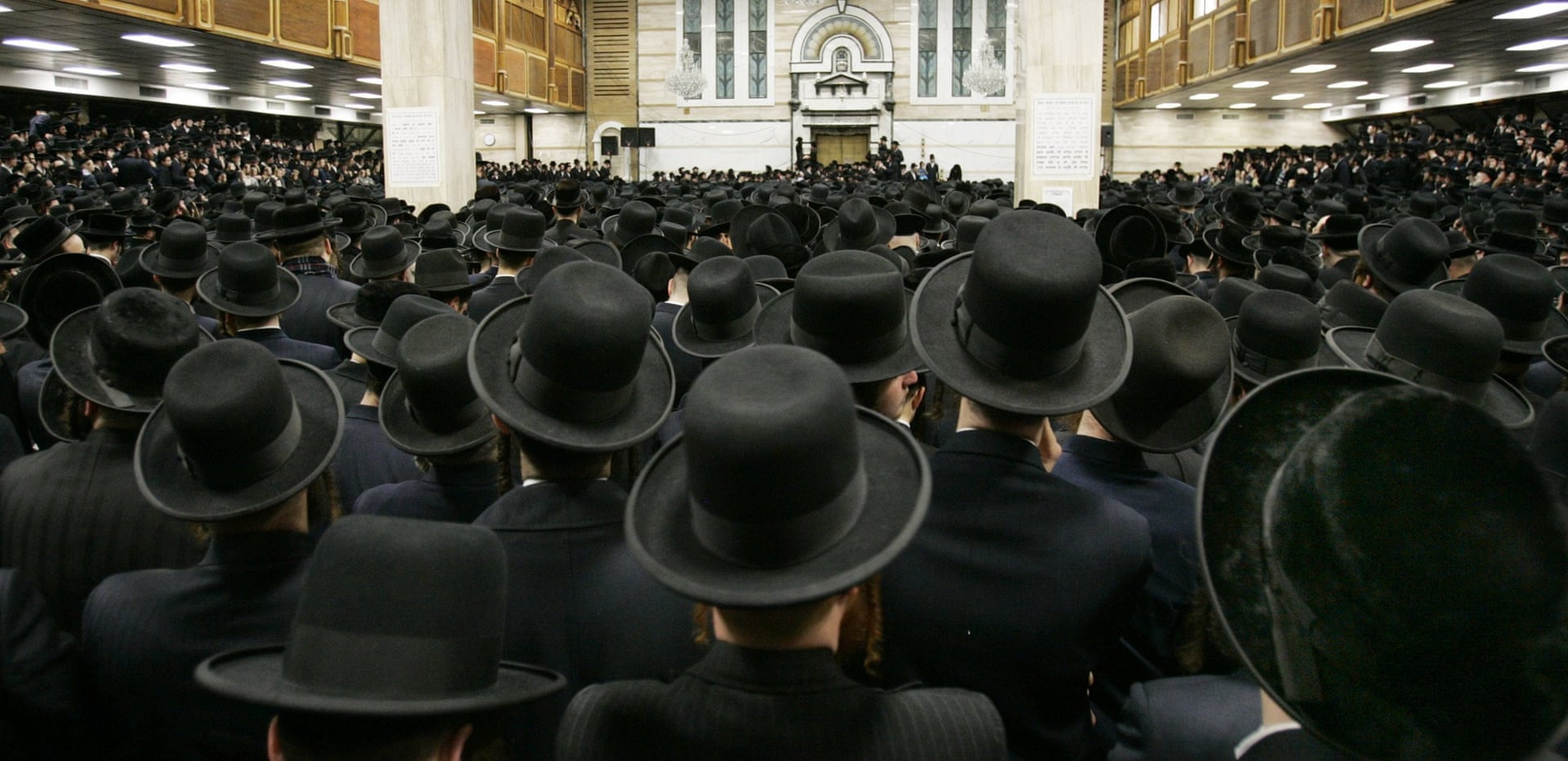
Followers of ultra-Orthodox Jewish Rabbi Moses Teitelbaum of the Satmar Hassidim pack the Congregation Yetev Lev D’Satmar. Photograph: Mike Segar/Reuters
Shulem Deen swipes through photos of his eldest daughter’s wedding with a look of pride on his face. He points to a modestly-dressed bride sitting stiffly next to her husband. “I know how nervous they felt,” he says.

Deen is only guessing; he wasn’t invited to his daughter’s wedding. These are not official photos – they were taken clandestinely by people he asked to infiltrate the ceremony.

Deen, 40, left the cloistered ultra-Orthodox Jewish enclave of New Square, a village in Rockland County, New York, seven years ago. He is one of a minority that has stepped off the derech, the devout and religious path.

Like others who have turned their back on the Hasidic way of life, Deen has lost contact with his five children and has been ostracized from the community for being a heretic. At the same time, he has found it difficult to assimilate to non-Hasidic culture and worries he comes across as strange to New Yorkers.

“It was an incredibly bad night for me,” Deen says in a tired voice, sitting in the modest apartment he shares with roommates. “I was weeping.” He hadn’t seen his daughter for four years, so the photos taken by four friends at the ceremony came as a shock. His eyes lingered on the image of his 20-year-old daughter wearing a high-collared, long-sleeved white dress.

It’s a feeling that is familiar for the defectors who decide to leave the ultra-Orthodox way of life. A growing number of men and women are breaking away from their insular lives because of a frustration with their gender-defined roles, the lack of access to wider education or out of unhappiness with how serious issues, such as abuse or divorce, are handled by their leaders.

Yet in the last two decades, the number of Orthodox Jews dotted across towns in America has boomed unexpectedly, particularly within the Hasidic sects, who have the highest birthrate of all. In fact, more than one-quarter of American Jews younger than 18 live in Orthodox households, a 2013 study by the Pew Research Center found, with this number expected to grow.

Many Hasidim, in the face of pressure from the rise of communism in the Soviet Union and the tragedies of the Holocaust, were intent on preserving their original way of life in the US. Yiddish is the common language in schools and at home, while the dress, modest and simple for both men and women, is strict. Women wear wigs, unless they are of the highly insular Satmar congregation, in which women shave their heads and cover them with scarves. Men wear beards, broad-brimmed felt or round fur hats, and long side curls called payos that are sometimes gelled with a popular wax called Dippity-Do.

For many, the Hasidic way of life and its all-encompassing support net are a source of comfort. Not only do Hasidim have their own volunteer ambulance service, called a Hatzalah, but they run their own police and control insurance brokers, real estate companies and retail stores that run the length of the main streets in the Brooklyn neighbourhood of Williamsburg, a central home for the Satmar sect.

Yet stories of poverty-stricken homes, where incomes barely touch $30,000 for a family of eight, as well as circles of abuse shine a light on the fractures within these cloistered communities and those who are not welcome.

The rabbis made it clear there was no room for 32-year-old Leah, whose name has been changed to protect her identity. “At first it was just this thing that didn’t have a name, ‘I don’t like my husband’. Then I learned the name of it: I was a lesbian,” she tells me.

In the hopes of a sympathetic ear, she met a rabbi “who seemed cool and liberal”, believing he would be more accepting than someone from the right wing of Orthodoxy – but it made no difference. “He told me I can identify as a lesbian but not actually act on it. He wanted me to be celibate for the rest of my life,” she said. Leah now has trouble trusting people after experiencing what she described as “rape by the community” after her husband forced himself on her because his rabbis told him “that was the right thing to do”.

The Torah does not forbid homosexuality, but it bans any homosexual acts. Although the role of sex is emphasized to strengthen marital bonds and growing families, many young Hasidic Jews are not well educated when it comes to sexuality.

Leah is now in the middle of a bruising two-year battle against her husband to get the custody of her three children. Her husband is fighting on religious grounds, claiming she is an unfit mother because of her sexual orientation. These cases are often difficult to litigate because the ultra-Orthodox community has access to financial resources, money for attorney fees and witnesses who are willing to testify.

Footsteps, an organization whose name is uttered only in whispers, is at the heart of the former ultra-Orthodox community and has partnered with the New York Legal Assistance Group to take on family cases like Leah’s. Founded by Malkie Schwartz, who left the Chabad Lubavitch sect in 2000, Footsteps has grown from holding impromptu meetings with 20 people huddled round a bare room to more than 1,000 members today.

The location, which is secret to protect its members and has recently moved to larger premises, is not signposted and is bare, aside from Footsteps members’ artwork. “Freedom to Selfie”, announces one collage, while a pair of knitted baby socks hang on the opposite wall with a caption that reads: “Baby footsteps are for freedom one step at a time.”

It takes time for defectors to find their feet on the other side. Children from divorced families are often in limbo, confused by the mixed messages of a sudden exposure to the secular world.

Frieda Vizel’s son, Seth, has forgotten all his Yiddish since leaving the upstate New York town of Kiryas Joel with his mother five years ago. He struggles to fit in between his father’s conservative household and his mother’s secular life, often filled with the toys and technology children have no access to in traditional Orthodoxy.

Vizel, 30, who anglicized her name from the Yiddish Freidy, still considers herself very much Jewish. She wears a silver Star of David necklace and sends her son to a religious school; she gives tours of Hasidic Williamsburg to tourists every week. She also struggles with living a secular life, where the emphasis is on material gain. “I would love to preserve some of the innocence and the reverence found in the Hasidic community,” she said. “You don’t live through this hunger for everything. It’s insatiable.” In place of flashy cars or technology, an ultra-Orthodox Jew may prize family silver or an illustrated religious text, carried in a child’s pram wherever the family goes.

On Lee Avenue, the main thoroughfare for Williamsburg’s Satmar community, preparations for the Jewish festival of Passover are underway, and the road is buzzing with activity. Special temporary food courts have been set up in metal containers to avoid unwanted crumbs dirtying the homes that are being cleaned from top to bottom in observance of the holiday.

But there are also stark reminders of a place that doesn’t allow much room for individuality outside of the confines of religion. Posters written in Yiddish denounce the occurrence of theatrical plays put on by locals that are a “place of mockery” and are forbidden.

The Satmar is considered one of the most insular of the approximately 30 sects, but generally, Orthodoxy is “not a clash of east versus west”, says Rabbi Levi Shmotkin, a Chabad Jew. “It’s about how to harness religion and the relationship with God and reconcile it with the world.” People often decide to leave because of a “negative personal interaction of experience, and not due to a theological conflict”, he said.

On this day in Williamsburg, Vizel, who is giving a tour, is also being surreptitiously followed by a Hasidic man, who pretends to be on the phone, except he doesn’t speak into the phone at any time. “He follows me around sometimes,” she said. “He emails me after, saying it sounded interesting.” She first met him many years ago, before she left. He had been thinking of leaving as well, she says, but he has a family, and once you’re married with children, it is a huge responsibility to abandon this life.

It is one that Deen, who has just released a memoir about his life, All Who Go Do Not Return, knows too well. He holds an unopened, undelivered letter he tried to send to one of his children three times. “The mailman needed a signature, so they [his family] couldn’t trash it.”

He says he will try to send it again, but he looks defeated after years of trying to make contact with his estranged children. “If I knew I was going to lose them, I would not have left. It’s like saying you would be prepared to take a step to cause a death in the family; there’s no way you’d do that.”
http://www.theguardian.com/world/2015/mar/27/ultra-orthodox-judaism-defectors-new-york

Review: HBO's 'Going Clear' a remarkable glimpse into Scientology

Robert Lloyd
March 28, 2015
LA Times

Although it is not the case in most places on Earth, it is hard to live in Los Angeles, especially in Hollywood, and not be aware of the Church of Scientology. It has stamped its name, hugely, on some of the city's most visible classic buildings, including the former Christie Hotel, the former Cedars of Lebanon Hospital, the former Chateau Elysee and the former Hollywood Guaranty Building.

There was a time you'd see members of the church out on Hollywood Boulevard, offering free personality tests to passersby; television ads were frequent. If Scientologists are in some ways more visible now, they are in other ways less. In "Going Clear: Scientology and the Prison of Belief," premiering Sunday on HBO, the roots and progress of the organization — its deterioration, some older adherents say in the film — are the stuff of the documentary by Alex Gibney.

The HBO work does not contain much that isn't already in Lawrence Wright's similarly titled book on which the documentary is based. What is new is the medium on which the information is delivered.

To rebut the Gibney film, which first played at the Sundance Film Festival in January, Scientology created a website, http://www.freedommag.org/hbo. The church characterizes the documentary as "one-sided, bigoted propaganda built on falsehoods."

Apart from some blurry dramatic re-creation and a few fanciful images to illustrate the church's less advertised beliefs — its science fiction-style creation myth involving a galactic tyrant, a 75-million-year-old-world resembling 1950s America, overpopulation, tax audits, volcanoes, hydrogen bombs and the attachment of disembodied aliens to w human newborns — Gibney's presentation is, given his hot topic, sensibly low-key.

 'Going Clear' trailer
Watch the first trailer for Alex Gibney's Scientology documentary "Going Clear."
There is order and selection, of course — to say that this is storytelling is not to impugn its parts — but much of what he has to show you is remarkable in or out of this context. Gibney lays out the more earthly origins of the church and its creator, L. Ron Hubbard — "LRH" to his followers — which are in their way as curious as any of Hubbard's inventions. (Discoveries, the faithful would say.)

Much of what might be called the practical business of Scientology was carried over from Dianetics, whose tenets Hubbard laid out in what became a huge bestseller. The practice was to face bad memories (or "engrams") to be rid of them, similar enough to other forms of self-help programs and, indeed, to psychiatry (Hubbard's objections to the contrary).

At its conclusion, Hubbard says here, "an individual has erased his reactive mind, his unconscious mind is gone and he is totally alert and totally capable."

Scientology, which Hubbard created after Dianetics had run its course, added a many-step program that would bring a seeker to the state called "clear" — and, in the bargain, reveal to her or him the church's intergalactic back story.

It's well-known that Hubbard started out as a writer of pulp fiction, including science fiction; but, notwithstanding his oft-repeated assertion that (as given here in the words of his unacknowledged second wife Sara Northrup) "the only way to make any real money was to have a religion, a religion where he could have an income and the government wouldn't take it away from him in the form of taxes," he seems to have truly believed that he had discovered a force for world-changing good.

Some of what Gibney has to show — most notably films of Scientology meetings led by the church's leader, David Miscavige, horribly kitschy and aesthetically pompous — can just seem, to an outsider, ridiculously hilarious, but not particularly unsettling. (Tom Cruise, ladies and gentlemen.) Indeed, from the outside, the rites and rituals of the church can seem a little absurd, including the "e-meter" that supposedly measures "the mass of thoughts"; the "billion-year" contract signed by members of the inner-circle Sea Organization; the unquestioning reverence for Hubbard as the sole source of these revelations.

More troubling, and the bulk of his case, is the testimony of former Scientologists, some of them high-ranked, some of them claiming inside knowledge. Defenders of the faith will say that they are lying now when they say they were lying then, but they seem quite credible and composed to me — amazed at the people they'd been, astonished by what they couldn't see, ashamed at their actions or inaction.

http://www.latimes.com/entertainment/tv/la-et-st-going-clear-review-20150328-column.html

Mar 27, 2015

Cults101: News, Intervention, Recovery

News, Intervention, Recovery

  • Cults101.org resources about cults, cultic groups, abusive relationships, movements, religions, political organizations and related topics.
  • Intervention101.com to help families and friends understand and effectively respond to the complexity of a loved one's cult involvement.
  • CultRecovery101.com assists group members and their families make the sometimes difficult transition from coercion to renewed individual choice.
  • CultNews101.com news, links, resources.

It's Not Easy Being Scientology

March 26, 2015
Sophie Gilbert
The Atlantic

Last year, the BBC reported that a building owned by the Church of Scientology in northeast England was drawing the ire of local residents. The property in Gateshead—purchased in 2007 for £1.5 million—is depicted on a U.K. Scientology website as an immaculately tended estate with a wide, sloping lawn. In the center of the image, an Arthurian sword, lodged in a stone, catches the rays of the sun. “Northumbria is the area where an entire revival of the United Kingdom's spiritual and cultural fabric emanated from in the 7th Century,” reads the accompanying text, “and now, from where it will shine once again.”

The Scientology site fails to mention that the building has never been occupied since it was purchased, or that it was damaged by a 2011 fire and never repaired. But the BBC article—the first Google search result for the words “Scientology” and “Gateshead”—describes it as a derelict building filled with squatters, its empty parking lot littered with “old sofas, rubbish, and used needles.” Nearby business owners and council members describe it as an eyesore.
View photo
.

Scientology, the movement established by L. Ron Hubbard in the ’50s, has long been known for its efforts to manipulate information about it in the public sphere. The group carefully crafts its image through widespread publicity campaigns (including a native advertisement published on this site in 2013) while suing and attacking those who portray it unfavorably. Over the past 25 years, the Church has filed lawsuits against high-profile publications such as Time and The Washington Post,as well as ex-employees who criticize the Church publicly. Hubbard himself encouraged aggressive legal action toward people who revealed secret information about the Church. According to a 1997New York Times article, Hubbard once told his followers, “The purpose of the suit is to harass and discourage rather than win … If possible, of course, ruin [the opponent] utterly.”

But the Church is losing control of its public image—in large part because the flow of information in the digital age is irrepressible. “It’s the Internet that has changed everything,” says Tony Ortega, the former editor of The Village Voice and founder of a website, The Underground Bunker, that’s dedicated to criticizing Scientology.
For example, in 2013, a Scientology spokesperson told the BBC that 27,000 people had attended its services in northeast England during the past decade. But those curious about the true number of members in the region can easily find the results of a 2011 census, which found only 2,418 self-identified Scientologists in England and Wales. (In contrast, 176,632 respondents identified as Jedi Knights.) The same census also found that in Northumbria, the number of Scientologists was 62.
Worldwide, too, the group’s membership claims appear to be dramatically inflated. The Church’sofficial media center states that Scientology has “more than 11,000 Churches, Missions, and affiliated groups across 167 nations." Karin Pouw, the group's spokesperson, says there are millions of Scientologists worldwide and that the Church has grown more in the past 10 years than in the previous 50 years combined.
But according to the new documentary Going Clear: Scientology and the Prison of Belief, directed by Alex Gibney and based on the Pulitzer-winning journalist Lawrence Wright’s book of the same name, the Church has fewer than 50,000 members. The movie, which airs on HBO March 29 and 30, is a portrait of an institution in flux, bewildered by the ubiquity of information.
“The genie’s out of the bottle,” Gibney says. “They can’t keep information bottled up, and their attempts to do so show them in the worst possible light. It’s like that moment in The Wizard of Ozwhere Toto pulls back the curtain and you see the wizened old man say, ‘Pay no attention!’ It’s too late. The curtain’s been pulled back."
* * *
Journalists have been reporting on the Church's practices for decades, from The St. Petersburg Times' Pulitzer-winning report in 1980 to Janet Reitman's 2006 feature for Rolling Stone, “Inside Scientology.” Historically, Scientology's default crisis-management mode has involved a combination of aggressive legal action and powerful counter-narrative. In 1991, when Time published a cover story titled “Scientology: The Cult of Greed,” the Church critiqued the story in a 48-page advertising supplement in USA Today. At the same time, it sued the magazine for $416 million. By the time the suit was dismissed in 1996, Time Warner had spent an estimated $3.7 million on legal fees.
In the early days of the Internet, the organization made efforts to restrict online information about its activities and core tenets. During the mid-1990s, it went after users for posting unauthorized information on newsgroups, tracking them down through their Internet service providers and even sending police to seize their hard drives. “They had a guy prosecuted for simply joking on the Internet about sending a ‘Tom Cruise missile’ to the secret headquarters compound,” Ortega says.
But censoring content online is a different proposition now that media can reach millions of people within seconds. The 2011 census reported that 71.7 percent of American households access the Internet at home, compared with 18 percent in 1997, while the Internet services company Netcraft estimated that there were 644 million active websites online in 2012, compared with 1.1 million in 1997. Policing information on the web is increasingly difficult, to the point of being nearly impossible: By the time content is taken down, screenshots of it have frequently been shared all over the Internet.
While the Church doesn’t sue news organizations with the same enthusiasm it once did, it still tries to counter criticism as loudly as possible. In 2011, after The New Yorker published “The Apostate”—a story by Wright detailing the director Paul Haggis’ disillusionment with Scientology—the organization printed a 51-page publication titled “The New Yorker: What a Load of Balderdash,” and distributed it outside the Conde Nast headquarters. In January, the Church placed an ad in The New York Times attacking the sources in Gibney's film. But these efforts reached just a tiny fraction of the people who read Wright’s story online, or saw any of the numerous articles discussing Going Clear.
Despite its shrinking size, Scientology is undeniably powerful, with holdings estimated at several billion dollars. Wright’s book was never published in the U.K. due to strict libel laws, and HBO reportedly hired 160 lawyers during the making of the documentary.
But some of the group's most outspoken online critics are former leaders, including Mike Rinder, who was the group’s international spokesperson before he left in 2007. Rinder still maintains that Scientology “can help guide one to fundamental truths about existence, happiness and one’s true nature and identity.” But he criticizes what he calls a “culture of violence and abuse” encouraged by the organization’s current leader, David Miscavige. Rinder recently posted a threatening email he’d received through his personal blog:
what DOES LRH think? Would he side with you if he was here? Reinstate you? No, Rinder. He’d cut your fuckin balls off and hang them from a tree. Something I would LOVE to do. And I mean, actually do. Unfortunately, its illegal in this country. Shut the fuck up Rinder. Shut up you fucking SP. Just shut your fucking mouth. You are being watched, 24-7. TWENTY FOUR SEVEN RINDER. TWENTY FOUR SEVEN.
When asked to respond to Rinder's accusation, Pouw, the Church's spokesperson, wrote in an email, "Mike Rinder has been making false, over-the-top claims about the Church since he left in disgrace eight years ago. We are confident he made this claim up from whole cloth, as he has countless others. And to be clear, the Church had nothing to do with any threatening message."
Pouw was equally dismissive of the claims of another high-profile former leader, Marty Rathbun—a lieutenant of Miscavige’s who has been credited with getting the group its tax-exempt IRS status in 1993. Like Rinder, Rathbun runs a website devoted to criticizing Scientology. Last year, his wife, Monique Rathbun, sued Miscavige and other Church leaders for harassment. The suit cited “numerous aggressive attempts to intimidate” Monique and stated that she had been “harassed, insulted, surveilled, photographed, videotaped, defamed, and humiliated.”
Tactics like these are heavily featured in Going Clear, which alleges that the Church exploits and abuses its members. Among other things, the film claims that one member was punished by being forced to clean a bathroom floor with his tongue, and that another, the actress Nazanin Boniadi, was made to clean toilets with a toothbrush after she displeased her former boyfriend Tom Cruise.
The organization denies the movie's allegations. During recent weeks, Scientology representatives have emailed critics who’ve written positive reviews of the film to state that it’s filled with “bald-faced lies,” and to chastise them for not reaching out to the Church for comment. The Church has also paid for sponsored tweets alleging that Gibney is “HBO’s resident propagandist,” that Rathbun "beat 'best buddy' Rinder to pulp," and that Rinder (who, like Rathbun, appears onscreen) “‘vice-gripped’ his wife of 36 years during assault” and “tore chunks of flesh” from her arm. The tweets link to the website for Freedom magazine, a Scientology publication—specifically, a special report about Going Clear that alleges the film glorifies “bitter, vengeful apostates expelled as long as thirty years ago from the Church.”
These claims—that two of its formerly high-ranking members are severely flawed individuals, and even psychopathic spousal abusers—might seem to reflect poorly on the organization itself. When Pouw was asked to comment on this, she gave an intriguing answer. "Unlike other churches, ours cleans ranks," she wrote in an email. "These individuals are a small few like the pedophile priests and we got rid of them. Our ecclesiastical justice system located their crimes and they were removed from their positions with authority." Pouw also appeared to acknowledge that Scientology expresses its displeasure with members by forcing them to do menial labor, adding, "Rathbun’s position for his final year in the Church was as a janitor in a woodworking mill."
* * *
For all its efforts to manage the media, Scientology’s leaders are strikingly reticent about speaking to the press. Leader David Miscavige, whose official title is Chairman of the Board of the Religious Technology Center (known informally as COB), almost never speaks to the non-Scientology press, and Going Clear alleges that he’s deliberately curtailed Church higher-ups whose public profiles threatened to eclipse his. The organization’s longtime spokesman and public face, Tommy Davis (the son of the actress Anne Archer), has left that role to work for a private equity firm in Austin, Texas.
Instead, the group has overwhelmingly entrusted its public-relations work to celebrities. Wright’s book focuses in large part on the close relationship between Miscavige and Cruise, the Church’s last remaining superstar congregant. Wright quotes Marty Rathbun as saying, “Miscavige convinced Cruise that he and Tom were two of only a handful of truly ‘big beings’ on the planet. He instructed Cruise that [L. Ron Hubbard] was relying upon them to unite with the few others of their ilk on Earth to make it onto ‘Target Two’—some unspecified galactic locale where they would meet up with Hubbard in the afterlife.” Rathbun also alleges in Going Clear that he carried out orders to wiretap Cruise's then-wife Nicole Kidman’s phone in an effort to drive the couple apart. (Pouw calls this accusation "false and defamatory.")
But Cruise’s association with the Church hasn’t always been advantageous to either the actor or Scientology. In 2004, Cruise spurred widespread rebuke when he stated that he thought psychiatry should be made illegal. (Scientology is vehemently opposed to psychiatry and teaches that mental illnesses do not exist). In 2008, a widely mocked video surfaced showing Cruise praising Scientologists as “the authorities on getting people off drugs, the authorities on the mind,” with the ability to "bring peace and unite cultures.” Then, in 2013, Cruise admitted in a deposition that his wife Katie Holmes had divorced him to prevent their child from being raised as a Scientologist.
Cruise’s career has arguably survived these controversies (his most recent film, Edge of Tomorrow, grossed over $350 million worldwide), but it’s hard to imagine that he’ll be able to avoid addressing Going Clear’s allegations. The film accuses the actor of benefiting personally from the labor of Sea Org employees—the Church’s most committed members, who live in communal housing on Scientology bases and work full-time for the organization. Gibney alleges that Sea Org Scientologists, who are paid less than $50 a week and punished for infractions by being confined to a set of bug-infested, double-wide trailers (sometimes for years at a time), have worked on Cruise’s cars and motorcycles and outfitted his aircraft hangar, because of his significance to the Church and his friendship with Miscavige. Wright’s book calls Cruise the second highest-ranking person in Scientology and states that Miscavige has entrusted him with special tasks—for instance, lobbying President Bill Clinton to ask former British Prime Minister Tony Blair to reconsider the Church’s tax status in the U.K.
Fellow actor and Scientologist John Travolta has already been damaged by his association with the Church, particularly following the box-office catastrophe Battlefield Earth, which was based on a 1982 novel by Hubbard. And Gibney’s movie makes the case that Travolta has known about abuses in the organization for many years. Travolta’s former Scientology liaison, Yvonne “Spanky” Taylor, describes on-camera how, after she fell out of favor with the Church, she was forced to do physical labor while pregnant, and her child was taken from her before she managed to escape with the baby. The movie alleges that Travolta knew about the way his friend was being treated. “He had the opportunity to affect the behavior of the Church, and he decided not to,” says Wright in the film. (When asked about Taylor's claims, Pouw responded, "The child was well taken care of. In addition, it should be noted ... that Taylor remained an active Scientologist for six years after her alleged 'escape.'")
In recent years, Cruise and Travolta have been less outspoken about their affiliation with Scientology. “You haven’t heard a lot from Tom Cruise or John Travolta extolling the virtues of the Church,” says Gibney. But he believes the actors should be publicly addressing the allegations against the group. “People are entitled to believe what they want to believe,” he says, “but when they’re the poster children for an organization that has a documented history of abuse, people should be asking them questions.”
Beyond Cruise and Travolta, Scientology’s celebrity advocates are mostly limited to Kirstie Alley, who had a high-profile feud with the actress Leah Remini after Remini left the Church in 2013; the Fox News host Greta van Susteren; the actress Laura Prepon (Orange is the New Black); and the musician Beck, who, like the Mad Men actress Elisabeth Moss, was raised as a Scientologist from childhood. According to Wright, Miscavige has pushed Cruise to “recruit famous people,” including David and Victoria Beckham, Will and Jada Pinkett Smith, and Steven Spielberg, but these attempts failed, and other efforts to enlist new celebrity advocates for the Church have largely been unsuccessful.
Without credible high-profile spokespeople, Scientology has mostly been limited to doing damage control. Its efforts to wrestle back control of the narrative remain strong, but its ability to fight on a million different fronts—responding to accusations of everything from extortion to human trafficking—is clearly limited, while the voices making the accusations are growing louder. Whether or not the Church’s members demand institutional reform will depend largely on how much longer the Church can prevent them from being influenced by negative publicity, and to what extent Cruise and Travolta can continue to decline to answer questions about the more egregious allegations leveled at the organization.
Many of Scientology’s critics believe the Church is inevitably doomed on both counts. “They can’t stop the flow of information, and it’s destroying them,” says Ortega. “Scientology only worked when it could use secrecy to keep people controlled. That doesn’t work anymore.”
Pouw denies that Scientology is struggling to maintain control in the information age. "Like everyone else, Scientologists use the Internet," said Pouw. "We don’t advise Scientologists on what to read and what not to read online because we believe in free speech and expression. That said, we believe it is more than obvious to anyone reviewing the stale rants and lies churned out by Marty Rathbun, Mike Rinder and their tiny failed Texas cult that they are all obsessed zealots with no credibility."
The group's takedowns of people involved with the film don’t seem likely to sway curious moviegoers. But that might not be the point. “Those attacks really aren’t meant for people in the outside world,” says Gibney. “They’re meant for the current adherents of the Church.” As Gibney sees it, “Scientology is trying to put a kind of mask over its membership so they don’t ever see the real stuff. But what they’re finding, and one of the reasons for the declining membership of the church, is the Internet. The Internet has made information so available, and while it’s the vehicle for a lot of hate speech and viciousness, it’s also the vehicle for a tremendous amount of information that’s so easy to get. If you want to find critical stories about Scientology, it’s one click away.”
http://finance.yahoo.com/news/not-easy-being-scientology-110000720.html

Movie Review: Scientology doc Going Clear eviscerates the faithful, famous, and greedy

March 27, 2015
A.V. Club
Joshua Alston

LA Scientology Blue Building
In the early 1970s, ranking officers within the church of Scientology initiated a plan to neutralize Paulette Cooper, the journalist behind a withering book criticizing the church’s practices and beliefs. The plan included schemes to defame Cooper by spreading rumors of her purported sexual promiscuity, and another to get her jailed or institutionalized by framing her for sending threatening letters to world leaders. The plot was discovered when federal authorities raided Scientology offices while investigating another active church operation to steal government records, which resulted in criminal convictions for 11 highly-placed church members. By that time, Cooper had already been indicted for mailing bomb threats to the church, the successful result of the frame-up dubbed “Operation Dynamite.”

For those planning to watch HBO’s bruising documentary Going Clear: Scientology And The Prison Of Belief, fear not: The preceding paragraph contains not a single spoiler. Going Clear doesn’t mention Cooper’s years of harassment at the hands of the church of Scientology, which also included the vexatious litigation so integral to Scientology’s institutional brand. The omission hints at just how many horror stories director Alex Gibney had to choose from when constructing the film. Going Clear is densely packed with exhaustive and exhausting research about the church of Scientology and crushing personal testimony from church defectors, and it’s the volume of damning allegations that makes the film so unsettling. Worse than the tales of the church’s unconscionable financial, psychological, and physical abuse is the pervasive sense that the scope of human suffering is wider than a two-hour documentary can comfortably accommodate.

Gibney, who directed Taxi To The Dark Side and We Steal Secrets: The Story Of WikiLeaks, was already shortlisted in the unofficial race for most important documentarian of the past decade. With Going Clear, he solidifies his reputation for fearless filmmaking by targeting the church of Scientology, which if not for Tom Cruise’s high-profile membership, would be best known for its scorched-earth policy toward detractors and apostates. The risk feels more palpable as Gibney interviews the ballsy cadre of former Scientologists who left the church and speak publicly about its alleged widespread abuses, thereby invoking its wrath. The subjects tell harrowing stories of victimization at the hands of omnipotent church officials, mostly suffered through their memberships in the Sea Org, the church’s elite, marine sect which bears resemblance to the fictional organization in Paul Thomas Anderson’s The Master.

Documentaries about reformed cult members tend to portray them as unmoored souls primarily driven by a yearning to belong and a willingness to invest in any cause that comes with a surrogate family. The subjects of Going Clear don’t sound like longing drifters. Sylvia “Spanky” Taylor talks like a woman with a genuine interest in leaving the planet in better shape than she came into it. A former political social worker, Taylor eventually became John Travolta’s publicist and spent 17 years as a Scientologist, devoutly adhering to the teachings of church founder L. Ron Hubbard. She was drawn to the church’s promise of an approach to curing societal dysfunction based on humanistic principles rather than the broad ideologies that underpinned her social work. The six- or seven-figure financial commitment, the abuse, and the looming threat of being ostracized by loved ones are missing from the sales pitch.

Hubbard’s teachings appealed to people who, like Taylor, were high achievers motivated to change the world around them and searching for the means to do it. Gibney uses archival footage to trace the path of Hubbard’s life, beginning with Hubbard as a young fabulist who went from embellishing tales from his brief, inauspicious military career to cranking out sci-fi potboilers at a furious pace. According to one of Hubbard’s wives, he was frustrated by the Internal Revenue Service and concluded he should start a religion, allowing him to collect tax-exempt income. Hubbard moved from science fiction to science self-help with Dianetics, a heady spiritual tome from which Hubbard designed the framework for Scientology after the Dianetics sales boom cratered.

It sounds like a long con, but in Going Clear, actual malice is a moving target. Hubbard is portrayed as an unrepentant huckster, but also as a self-declared visionary who suffered from severe psychological disturbances and at least partially believed in what he was peddling. The film is undoubtedly a case against Hubbard and Scientology, but it doesn’t shy away from the contradictions of either. Hubbard put real stock in the efficacy of the E-meter, a tool he helped develop to rid the body of negative emotions in so-called “auditing sessions.” Some disillusioned members still speak fondly of the relief they experienced after auditing sessions, including Academy Award-winning writer-director Paul Haggis, who says the church’s tenets saved his most valued relationships. Gibney paints Scientology as a racket, but one fueled by its followers’ positive results. The doctrine became realer to Hubbard as it gained evangelists, validating Hubbard’s ideas, which were then codified into the religion even when they were bigoted, unethical, or vindictive.

Though the film’s thesis is about faith, Going Clear is a more effective treatise on the evils of corporate culture than on the perils of spiritual certainty. The church of Scientology is depicted as being greedy above all else, hoarding an estimated $3 billion in assets for the financial enrichment of a select few, including chairman David Miscavige. Heading the church of Scientology is a job for which Miscavige seems exclusively qualified. In addition to being the quintessential soulless capitalist, the film depicts Miscavige as megalomaniacal, paranoid, and physically abusive, as if he were literally Hubbard’s reincarnation. He also advances Hubbard’s strategy to glamorize the church with celebrity endorsements. The film depicts a disturbing relationship between Miscavige and Cruise, whose every whim is satisfied in exchange for serving as the church’s public face. It’s an abjectly unflattering portrayal of Cruise. While Miscavige is the tyrant, Gibney argues, Cruise is the person in the best position to expose and reform the church’s abusive practices but would rather enjoy the spoils of Scientology’s war against its own members.

Going Clear is a shocking exposé that’s most shocking because it wasn’t conceived as an exposé. Lawrence Wright, the author of the similarly-titled book from which the film culls its research, says he began his exploration with an open mind. “My goal wasn’t to write an exposé, it was simply to understand Scientology, trying to understand what people get out of it,” says Wright. And yet Going Clear is the most scorching, disturbing documentary in recent memory, not because Wright and Gibney smuggled agendas, but because the institutionalized cruelty and avarice alleged against the church of Scientology precludes pure objectivity.

http://www.avclub.com/review/scientology-doc-going-clear-eviscerates-faithful-f-216896

What Happens When Your Guru Disappears?

March 27, 2015
Eliezer Sobel
The Daily Beast


Andrew Cohen
Followers expected the swift return of spiritual teacher Andrew Cohen after he stepped down in the wake of scandal. That was two years ago, and there’s been no sign of him since.

What happens when the guru up and quits?

The controversial American spiritual teacher Andrew Cohen did just that about two years ago, and his disappearing act became an enduring mystery in the New Age world. 

In June 2013, amid increasing allegations of abuse and cultish behavior, Cohen formally apologized in an open letter to his worldwide community of followers and voluntarily relinquished his 27-year reign as their “Perfectly Liberated Spiritual Master.” Perhaps this is not earth-shaking news to observers accustomed to tales of cult leaders gone bad, but within the spiritual subculture, Andrew Cohen quitting his job and vanishing was a very big deal. 

Despite all “the blood and tears he left in his trail,” as he sometimes boasted, he had consistently weathered all attempts to expose and depose him, and actually seemed to be at the top of his game. He was the author of 11 provocative books about the spiritual path; he served as editor of What Is Enlightenment?, a once-popular, thoughtful and respected magazine; he was the founder of EnlightenNext, a nonprofit global organization. He lectured internationally, often appearing in public dialogue with leading theologians, philosophers, and scientists. He led retreats around the world; and in 2012 he was #28 on Mind Body Spirit magazine’s list of the top 100 most spiritually influential people alive.

Before his ascent to spiritual stardom, Andrew Cohen was an ardent seeker and committed meditator, but it wasn’t until a fortuitous meeting in 1986 that he was quite suddenly propelled into the guru profession. That cataclysmic “awakening” event occurred in Lucknow, India, only 20 minutes into his first encounter with H.W.L. Poonja—“Poonja-ji”—a guru who declared Andrew to be “finished” with his spiritual path and destined to be the successor Poonja-ji had waited for his entire life.

Cohen took that ball and ran with it, and before long had followers and communities all over the world. He also denounced Poonja-ji along the way, leaving him standing alone at the head of the spiritual class, without a lineage, or at the very least, some qualified supervision, which is required even to become a licensed social worker, though clearly unnecessary for an Enlightened Master.

Disagreeing with or challenging Andrew about anything was simply not permitted, and would be met with public humiliation and scorn from him, accompanied by his particularly annoying, cackling laughter.
I first went to see Cohen in Cambridge, Massachusetts, in 1989, and was unimpressed. He was presiding over a room of perhaps 200 acolytes who appeared to have surrendered their personal decision-making power over to this conservatively dressed Jewish guy who resembled many of the kids I grew up with in the New Jersey suburbs. He fielded questions like, “Should I eat meat?” or “Should I break up with my girlfriend?” or “Where should I live?” He responded to all of them with authoritative instructions.

I stood in the back, dead center, and at one point he looked up and picked me out of the crowd: “Do I know you?” he asked. I immediately answered, “B’nai Israel Hebrew School? Fair Lawn, New Jersey? Little League?” And that was the end of our interaction. For eight years, anyway.

Then in 1997 I found myself in Rishikesh, India, on my own spiritual pilgrimage, and discovered that Andrew’s photograph was plastered all over town, announcing his upcoming two-week retreat. The local bookstores were carrying all his published works. I quickly read them all, and decided to attend.

Unlike our first encounter, on the retreat I did notice something very interesting. I had always been a restless meditator, never able to last longer than 15 minutes before needing to adjust my position. Sitting with Andrew, however, I found to my amazement that I was able to sit effortlessly for 90 minutes in perfect stillness. So there was definitely an “energy” in that room with which I was previously unfamiliar.

But as a seasoned Buddhist practitioner later pointed out to me, “Energy is not inherently a good thing.”


As the two weeks of the retreat unfolded, my “cult antennae” became increasingly aroused. Disagreeing with or challenging Andrew about anything was simply not permitted, and would be met with public humiliation and scorn from him, accompanied by his particularly annoying, cackling laughter. Cohen likened his “Perfect Teachings” to a glittering diamond, shining and flawless no matter through which facet it is viewed.

When the retreat was over, Andrew’s written works went on display and I picked up an early copy of his newsletter and discovered that his followers addressed their letters to him with the salutation “Dear Lord.”

That very same newsletter grew and expanded over the years into the aforementioned What is Enlightenment?, in which Cohen managed to attract and interview respected luminaries not only from the spiritual world, but esteemed social activists, eco-pioneers and other visionaries on the cutting-edge of contemporary, paradigm-shifting work. Although it often seemed as if he was actively cultivating “respect-by-association.”

While Andrew consistently presented a public face as the very model of integrity, often denouncing other teachers for their imperfections and bad behaviors, he was engaging in them himself. He had a community of devotees living with him on a property in Lenox, Massachusetts, adhering to a strict regime of rules and regulations, with him comfortably ensconced as King of the Castle.

It gradually came to light that anyone deviating in the slightest from their leader’s ideas or instructions were subject to bizarre punishments, humiliation, and community shunning, and anyone who wanted to leave often had to literally escape in the dead of night.  Scores of people reported suffering emotional, physical, financial, and spiritual trauma at his hands.

Notably, however, sexual misconduct was not part of these allegations. According to his critics, Cohen was manipulative, dictatorial, demanding, and mean. But not a sexual predator.

Gradually, disaffected members of his community revealed horrific tales of Andrew’s misdeeds online, and his attempt to hide behind a cultish veil of secrecy became more and more untenable as the Internet grew. A website was established to serve as a sounding board for those who finally escaped the clutches of Cohen’s charismatic hold on them, and—not unlike the meltdown underway at the Church of Scientology—it included people formerly in his inner circle.

Even Cohen’s own mother, Luna Tarlo, publicly turned against him. In an astonishing memoir entitled The Mother of God, she characterized her son as a living Buddha or Christ, and like any good Jewish mother, was his most loyal devotee. But later she had a disagreement with Andrew’s methods and he kicked her out of his community. She then altered her assessment, calling him “a dangerous tyrant” and compared him to Jim Jones and Hitler. Freud would have had a field day with that one.

Unaware of any of that, I unwittingly incurred Andrew’s public scorn on the retreat when I made the innocent comment that “One measure of enlightenment is the quality of one’s relationship with one’s parents.” Oops. 

Although Cohen was able to fend off all the allegations for quite some time, and had many loyal, staunch defenders counterattacking his attackers, eventually his reputation moved beyond “damage control,” and his global empire crumbled in a single day, just as he had originally become an Enlightened Master overnight.

That was two years ago. Since then, his disappearance has turned into a spiritual version of Where’s Waldo. All Google hits terminate abruptly in 2013, and there hasn’t been a peep out of him since.

Initially it was unclear whether his seeming contrition was for real or merely a political necessity. Many to whom he apologized said that he seemed robotic, as if begrudgingly doing what was required of him to salvage his reputation.  Even more telling, an email from his P.R. team was leaked at the time of his demise, letting his inner circle know how they intended to “spin” his humble retreat from public life and possibly pave the way for his return in the spring of 2014.

But that never happened, and I’ve since learned that the P.R. team itself abandoned ship soon after that first email circulated.

What is known is that Cohen embarked on a soul-searching pilgrimage to India. Several former devotees (who requested anonymity) have confirmed spotting him there, and some have said he appeared to be suffering a great deal, and growing more authentic in his brokenness and more sincere in expressing his regrets. He was even engaged for a time in voluntary service work with the poor, the sick, and the homeless.

Even his mother has come around.  The current website for her book says that the two “have reconciled and see one another when Andrew is not traveling.”

If Cohen’s path of repentance is genuine, it is a significant departure from the usual pattern of disgraced gurus. I have witnessed other fallen spiritual leaders be publicly exposed, subsequently disappear, and invariably pop up in a new location several years later only to repeat the same pathological patterns that led to their downfall the first time around. The taste of power often seems to be so inebriating and irresistible that offenders are doomed to repeat their history again and again.

Time will tell. And, truth be told, I wish Andrew well. His penetrating “energy” could be put to good use here at home, if he is truly doing the personal healing work he needs to do. May the noblest aspects of his character prevail.

http://www.thedailybeast.com/articles/2015/03/27/what-happens-when-your-guru-disappears.html

Mar 26, 2015

Ancient India: age of freedom and synthesis

Ancient India: age of freedom and synthesis
This is the second part of the IndiaFacts’ series on “Distortions in Indian History,” excerpted from Dr. N.S. Rajaram’s book, “Nationalism and Distortions in Indian History. Read the first part here.

History books today begin with the Aryan invasion of India, which is said to have taken place in 1500 BC. Students are told that the ancient civilization of the Indus Valley or the Harappan Civilization was Dravidian, which was destroyed by the invading Aryans. According to this theory, the language of the Harappan seals, which contain a good deal of writing, is some form of Dravidian language, unrelated to Sanskrit. However, recent researches have revealed that there is every possibility that the Harappan Civilization was Vedic.

This also means there was no Aryan invasion and no Aryan-Dravidian conflicts either. In Sanskrit, ‘Aryan’ simply means cultured and not any race or language. I am myself a so-called Dravidian who speaks Kannada. Kannada, like all South Indian languages, is heavily influenced by Sanskrit. South Indian dynasties going back time immemorial called themselves ‘Aryas’ because they were followers of the Vedic culture. The South has always been a stronghold of Vedic culture and learning. Sayana, probably the greatest Vedic scholar of the last thousand years was a South Indian. He was the brother of Vidyaranya, who helped Harihara and Bukka found the great Vijayanagara Empire.

The idea of Aryans and Dravidians as mutually hostile people was created during the colonial period, in which Christian missionaries played an active role. It was part of the British policy of divide and rule. Bishop Robert Caldwell was probably the most influential Dravidian scholar. When criticized for his theories, he defended them “as not only of considerable moment from a philological [linguistic] point of view but of vast moral and political importance.” By ‘moral and political’, he meant Christian missionary and British colonial interests.

The unity of India, rooted in her ancient culture, is of untold antiquity.

This shows that one of the main forces behind the Aryan invasion theory, and of education policy in general, was the conversion of Hindus to Christianity to make them accept British rule. According to the Aryan invasion theory, the Vedas and Sanskrit language were brought by these Indo-European invaders and not native to India. This is now demolished by science, technological advances, and archeology.

Using this fabricated theory, the British could claim that India had always been ruled by foreign invaders — first the Vedic Aryans, and later the Muslims. The British claimed to be Aryans (as Indo-Europeans) and therefore only the latest rulers of India, but related to their own ancient Aryans who also were foreign invaders! Christian missionaries took advantage of this by enjoying the patronage of colonial rulers. The presented the Bible as ‘Yesurveda’ — or the Veda of Yesu (Jesus).

Many influential British officials felt that the conversion of Hindus to Christianity would make them readily accept British rule. The most influential of these was Thomas Babbington Macaulay who introduced the English education system in India. He made no secret of his goal of conversion of India to Christianity. In 1836, while serving as chairman of the Education Board in India, he enthusiastically wrote his father:

Our English schools are flourishing wonderfully. The effect of this education on the Hindus is prodigious. …… It is my belief that if our plans of education are followed up, there will not be a single idolator [Hindu] among the respectable classes in Bengal thirty years hence. And this will be effected without any efforts to proselytise, without the smallest interference with religious liberty, by natural operation of knowledge and reflection. I heartily rejoice in the project.

So religious conversion and colonialism were to go hand in hand. Christian missions always supported the colonial government, with missionaries working hand in glove with the British government. Christian missionaries supported the Jallianwallah Bagh Massacre too, even though many Englishmen were ashamed of it. In a real sense, Christian missions were not religious organizations at all but an unofficial arm of the British Administration. The same is true of many Catholic missions in Central American countries. Many of them are in the pay of the American CIA. This was admitted by a CIA director, testifying before the Congress. It is pertinent to read the detailed investigationsby Arvind Kumar into the CIA’s long record of funding missionaries in his article titled The Religious Crusades of the CIA.

It was part of the Macaulayite education program to distort Indian history to serve British colonial and Christian missionary interest. To do this, he employed a German Vedic scholar now famous as Friedrich Max Müller.

Max MüllerMacaulay used his influence with the East India Company to find funds for Max Müller’s translation of the Rigveda. There can be no doubt at all regarding Max Müller’s commitment to the conversion of Indians to Christianity. Writing to his wife in 1866 Max Müller himself explained his purpose:

It [the Rigveda] is the root of their religion [Hinduism] and to show them what the root is, I feel sure, is the only way of uprooting all that has sprung from it during the last three thousand years.

Two years later, he also wrote to the Duke of Argyle, then the acting Secretary of State for India:

“The ancient religion of India is doomed. And if Christianity does not take its place, whose fault will it be?”

His job was to uproot Hinduism by giving a negative version of the Vedas! Unfortunately, the version of history being taught to children in Indian schools and colleges, including the Aryan invasion, is the version created by Macaulay and Max Müller. It is a tragedy. It is not only anti-national but also totally false.

Unity of India is of untold antiquity

It was claimed by the British, and faithfully repeated by the Leftist intellectuals, that the British unified India. This is completely false. The unity of India, rooted in her ancient culture, is of untold antiquity. It may have been divided at various times into smaller kingdoms, but the goal was always to be united under a ‘Chakravartin’ or a ‘Samrat’. This unity was cultural though not always political. This cultural unity was seriously damaged during the medieval period, when India was engaged in a struggle for survival — like what is happening in Kashmir today. Going back thousands of years, India had been united under a single ruler many times. The earliest recorded emperor of India was Bharata, the son of Shakuntala and Dushyanta, but there were several others. I give below some examples from the Aitareya Brahmana.

“With this great anointing of Indra, Dirghatamas Mamateya anointed Bharata Daushanti. Therefore, Bharata Daushanti went round the earth completely, conquering on every side and offered the horse in sacrifice.

“With this great anointing of Indra, Tura Kavasheya anointed Janamejaya Parikshita. Therefore Janamejaya Parikshita went round the earth completely, conquering on every side and offered the horse in sacrifice.”

There are similar statements about Sudasa Paijavana anointed by Vasistha, Anga anointed by Udamaya Atreya, Durmukha Pancala anointed by Brihadukta and Atyarati Janampati anointed by Vasistha Satyahavya.

Atyarati, though not born a king, became an emperor and went on conquer even the Uttara Kuru or the modern Sinkiang and Turkestan that lie north of Kashmir. There are others also mentioned in the Shathapatha Brahmana and also the Mahabharata. This shows that the unity of India is ancient.

There was no Aryan invasion and no Aryan-Dravidian conflicts either.

Also, the British did not rule over a unified India. They had treaties with the rulers of hereditary kingdoms like Mysore, Kashmir, Hyderabad and others that were more or less independent. The person who united all these was Sardar Patel, not the British. But this unification was possible only because India is culturally one. Pakistan, with no such identity or cultural unity, is falling apart.

Continued in the next part
http://indiafacts.co.in/ancient-india-age-of-freedom-and-synthesis/

Mar 25, 2015

Why Scientology ' s cone of silence shattered

Jacob Siegel
March 25, 2015
The Daily Beast


Scientology
For decades, the controversial church was able to bat down unflattering media attention. But now the klieg lights are everywhere.

For most of its existence the Church of Scientology grew and prospered by protecting its secrets. But it’s been tough holding on to that model in the 21st century, a notoriously bad era for powerful institutions in the secret-keeping business. That point has been amply made in recent years by top church officials turned whistleblowers, a high-profile book by Lawrence Wright of The New Yorker, and now a lacerating new HBO documentary based on Wright’s exposé. The new voices in the Scientology debate have both testified to the church’s efforts to silence its critics and, by speaking out, shown the limits of that approach. Their accounts seem to show the church losing its grip on the public narrative it once aggressively controlled.

“The history of Scientology’s attempts to scuttle critical stories goes back decades,” said Stephen Kent, a sociology professor at the University of Alberta who has studied and written about the church.

In 1970, Paulette Cooper, a Harvard graduate in comparative religion with a master’s degree in psychology, began publishing work about Scientology. When’s her book The Scandal of Scientology came out in 1971, it drew the church’s attention.

Internal Scientology documents (revealed in later court documents) described the church’s plan for Cooper, a child of parents killed in Auschwitz during the Holocaust, which was to have her “incarcerated in a mental institution or jail, or at least to hit her so hard she drops her attacks.”

Less extreme examples of Scientology’s reported pressure tactics abound. Former high-ranking Scientologists and experts on the group describe an approach that relies on the threat of legal action and implied negative consequences to dissuade reporters and entertainers from using the church as a subject.

“I know for a fact that some media individuals, media organizations and even academics were scared off from doing stories about Scientology for fear of being sued or otherwise harassed,” Kent said. The professor related a story about being interviewed for a Canadian television production exploring Scientology when, he said, “one of the shows announcers got cold feet” and it never aired.

“Even The Daily Beast knows we do not ‘harass’ the media,” Scientology spokeswoman Karin Pouw wrote in response to a list of questions submitted by The Daily Beast. “This is a myth spread by those who produce one-sided hatchet jobs like Alex Gibney [Academy Award-winning director of the HBO documentary Going Clear] and Lawrence Wright did, but whine when we exercise free speech by pointing out their bias and shoddy methods.”

Mike Rinder knows about Scientology’s approach to dealing with media criticism from experience. Rinder, who’s featured in Going Clear, was a senior executive in the church who spent time in its public affairs division before leaving Scientology.

In 2007 the BBC’s Panorama program began producing a feature, “Scientology and Me.” “The church sent private investigators to follow the BBC’s reporter, John Sweeney,” said Rinder. “The people involved in the production, from Sweeney and his producer all the way up to the top of the BBC, were investigated.”

Pouw, the Scientology spokeswoman, did not address specific claims about the BBC show but wrote in her statement: “The Church does not hire private investigators to follow journalists.”

Rinder, a top official in the church at the time of the BBC program, said he was involved in the operation and saw it firsthand. “I know the church hired [private investigators] to follow Sweeney, as I was there,” he said. “I also saw the reports from them. And John Sweeney video’d them and showed them in his Panorama documentary!”

“That’s basically the tactic the church uses,” Rinder said. Scientology’s approach with its critics, he said, is to “silence them by finding out something that they’re seeking to protect that will either cost them their job or the threat of exposure will cause them to back away.” And “of course, there were also legal threats,” Rinder said.

“Basically that’s the playbook,” Rinder said of the BBC show, “that gets used for every perceived media piece on Scientology.”

At some point, though, that alleged tactic, which left a trail of gaps in the public’s understanding of Scientology where stories were left on the cutting-room floor or never written at all out of fear, apparently began losing its effectiveness.

Ex-Scientologists and experts differ on when exactly they believe the church’s hold on the story of Scientology first started to slip, but they agree on the cause. “The simple answer is the Internet,” said Kent, the University of Alberta sociology professor.

“The ’Net changed everything and from all accounts has had a major impact on membership,” said Mark Bunker, a TV journalist and longtime anti-Scientology activist.

The Internet, of course.

Still, it’s a bit more complicated than that, Kent said. “It’s not just the Internet,” he said. Much of the momentum in the anti-Scientology movement that has culminated in the new HBO documentary comes from ex-members of the church, he said. The Internet gave them a chance to meet each other and trade stories, creating an echo effect that amplified their voices. “Former members became emboldened enough to start speaking on the Internet” about abuses they had allegedly witnessed and, Kent said, that in turn led to more defections and more ex-members speaking out.

“The big change came around 2005, when South Park did their episode on Scientology and ended it with ‘Sue Me,’ and they didn’t get sued,” said Bunker. That lessened the fear among commentators of being sued and, in a dangerous turn for any official piety, opened the group to wider ridicule. Said Kent, “The gravitas of Scientology diminishes rapidly as comedians start picking it apart.”

“The fallout from the first airing of that South Park episode was pretty stunning,” said Bunker. According to Rinder, it led Scientology to scramble to use Tom Cruise’s weight in Hollywood to get the episode quashed.

“When South Park did their program, I went to CAA,” said Rinder, using the abbreviation for Creative Artists Agency, a top Hollywood talent agency that represented Cruise.

Rinder said this is what happened next:

“The Tom Cruise card was played with CAA to get them to put pressure on Comedy Central and Viacom. Ultimately, it really backfired.

After the South Park dustup came other public bruises for Scientology. In 2008, the church found itself in a war with the Internet collective Anonymous. The dispute began over Scientology’s attempts to remove a video from the web that showed Tom Cruise praising the group at an internal church event. That roused an impassioned defense of free speech in a growing online culture that considered the Internet inviolable ground. The back-and-forth ended up generating publicity for Anonymous, which seemed to relish the audience, and exposing Scientology to added and sometimes harsh media attention.

At the same time, Scientology experienced a number of defections by high-level members. Some said they were leaving the church over disputes with its current leader, David Miscavige. And some of those former Scientologists then went public with sharp criticisms of the church and detailed allegations of abuses they claim were carried out by Miscavige or under his authority. In turn those defections supplied some of the critical source material for Wright’s book, which became the basis for Gibney’s new film. And now, coming out on the heels of all the developments that preceded it, the film is generating a wave of press attention that has made it easier to cover Scientology without fear of standing out.

Rinder has another reason he believes the church’s old tactics aren’t as useful as they once were. Litigation as a default response is no longer as effective. That’s because “the first notice of deposition is going to be to [Scientology leader] David Miscavige,” according to Rinder, “and the second note is going to be to Tom Cruise. And that is something that they can’t deal with.”

“They’ve got too many skeletons in their closet and too much they can’t answer to, so their response is to just say everyone’s a liar,” he said.

The church has run an ad campaign attacking the new HBO film that does call nearly everyone involved a liar, criminal, violent psychopath, or some combination of the three.

Scientology’s secrets fill a space both in and outside the organization.

Former Scientologists say that even loyal followers don’t learn about key tenets of church doctrine until they’ve spent years in the church and spent considerable sums for the privilege.

It’s only gotten harder to control the narrative now that HBO’s new documentary, Going Clear: Scientology and the Prison of Belief, has been touring film festivals before its premiere on March 29. The film illustrates the church’s heavy-handed approach to outsiders, but its most harrowing scenes are the ones that purport to show what happens to church insiders who run afoul of Scientology’s leaders.