Showing posts with label propaganda. Show all posts

Aug 9, 2021

CultNEWS101 Articles: 8/9/2021 (Legal, Love has Won, Clergy Sexual Abuse, Cult Recovery, Propaganda)

Legal, Love has Won, Clergy Sexual Abuse, Cult Recovery, Propaganda
"Autopsy report delayed as Saguache County coroner tries to find lab to test Amy Carlson's body.

The Saguache County coroner has identified a woman found dead inside a home used by the Love Has Won cult as Amy Carlson, the group's leader, but he's not yet been able to determine her cause of death because of the need for complicated lab testing.

Carlson's identity recently was confirmed through a DNA test, Coroner Tom Perrin said. However, he does not know when the autopsy report will be finished because he cannot find a laboratory to test her body for heavy metals.

The cult used electrolysis to break down metals into various solutions that its members sold online as health aids, he said. Authorities want to know if Carlson had been ingesting those substances."
"Former Cardinal Theodore McCarrick, who was defrocked by The Vatican in 2019 over sex abuse allegations, is now facing criminal charges in Massachusetts for alleged sex abuse of a minor nearly 50 years ago, according to a court filing.

According to a criminal complaint filed Wednesday, McCarrick is charged with three counts of indecent assault and battery on a person over 14. The complaint was filed by Wellesley Police in Dedham District Court."
CultRECOVERY101: Coping with Triggers
" ... Dissociation is a normal mental response to anxiety. A momentary anxiety arises when internal or external cues (triggers) set off a memory, a related idea, or a state of feeling that has anxiety attached to it."

Dr. Singer emphasizes the primary need for education, specifically psycho education. She advises ex-members to learn about trance states, how they are induced, the results of trance states and, specifically how your group used them. Also, learn the vocabulary used to identify and label the normal human processes that describe triggers:

  • Dissociation – a sudden, temporary alteration m the normally integrative functions of consciousness, identity or motor behavior
  • Depersonalization – one's sense of one's own identity and reality is temporarily lost — "who am l?"
  •  Derealization – a sense of the reality of the external world is lost–"where am I?" "Is this real?"

Secondly, learn how to protect yourself. After leaving a highly controlled environment, you need your own space and personal time. Learning to establish healthy personal boundaries after a cult experience takes time and patience. You may want to purchase an answering machine and even monitor your calls. Remember, you don't have to answer all calls, especially calls from the group.

Ex-members benefit tremendously from ex-member support groups. However, not all of us are fortunate enough to live in a location where a support group meets. So you need to establish your own support system. Even one person you can talk to who understands can be very helpful. Some ex-members have set up a support system over the telephone or the internet.

For your own protection, resist the urge to rescue people you left behind in the cult. Remember, they know the guilt buttons to push and all the phobia indoctrination to use. These could cause triggers for you, even as well prepared as you think you are.

Third, Dr. Singer recommends that you get exit counseling. This is part of the psycho educational process. This does not have to be a formal exit counseling.

Fourth, Dr. Singer warns ex-members about going to a "normal" therapist, meaning one not knowledgeable about the effects of a thought reform environment. Therapists tend to blame
it on the ex-member, on their masochism, their dependency issues, or their parents . . ."blame the victim."

And let's take the negative connotation out of the word "victim." Yes, we were the victims of a very sophisticated system of thought reform, of deception, of guilt and fear manipulation. Perhaps we were in a transitional stage where we were looking for more answers for our life than usual, or were looking for new friends, looking for spirituality, looking for somewhere to belong. A group took our best qualities and used them for their own benefit while taking our vulnerabilities and using them to exploit and manipulate us. The other side of it is that we survived! It took a lot of courage to leave the group and it takes a lot of courage to get our lives back together."

"Our guest this week is Olga Yurkova from Ukraine. Olga edits the Context and Opinions sections of StopFake.org. She teaches different audiences how propaganda works and how to identify fake news, consulting with a range of organizations and collaborating with mainstream media as a journalist.

Yurkova explores propaganda methods and finds out new ways to overcome these challenges. In June 2017, she and her colleagues Maarten Schenk and Jordy Nijenhuis launched a project called Forbidden Facts, which explains how fake news spreads online through clickbait headlines on Facebook that reach out to skeptical audiences.

Yurkova has 15 years of experience in journalism. She headed the local multimedia newsroom in Ternopil city for six years. She then ran the Donbas and Crimea department at the national multimedia newsroom Nova Informacia for three years. She has been working as a new media trainer since 2012, and for fighting propaganda, Yurkova was included in the list of New Europe 100 and was named a TED Fellow in 2018.

Olga describes the disinformation campaign launched by Russia to influence Ukrainian popular opinion and the blatant and shocking false narratives that she set out to expose with her projects Forbidden Facts and StopFake.org .Throughout the conversation, Olga shares with Rachel her perspective on disinformation in the media landscape and talks about her work combating propaganda.
Before You Go: Rachel expands on the importance of Olga's ideas around building information resilience and media literacy, explaining the manipulation of emotion that mass media often utilizes to influence large populations into believing certain narratives."

News, Education, Intervention, Recovery


CultEducationEvents.com

CultMediation.com   

Intervention101.com to help families and friends understand and effectively respond to the complexity of a loved one's cult involvement.

CultRecovery101.com assists group members and their families make the sometimes difficult transition from coercion to renewed individual choice.

CultNEWS101.com news, links, resources.

Facebook

Flipboard

Twitter

Instagram

Cults101.org resources about cults, cultic groups, abusive relationships, movements, religions, political organizations and related topics.


Selection of articles for CultNEWS101 does not mean that Patrick Ryan or Joseph Kelly agree with the content. We provide information from many points of view in order to promote dialogue.


Please forward articles that you think we should add to cultintervention@gmail.com.


May 9, 2021

'Belonging Is Stronger Than Facts': The Age of Misinformation

Social and psychological forces are combining to make the sharing and believing of misinformation an endemic problem with no easy solution.

Max Fisher
New York Times
May 7, 2021

There’s a decent chance you’ve had at least one of these rumors, all false, relayed to you as fact recently: that President Biden plans to force Americans to eat less meat; that Virginia is eliminating advanced math in schools to advance racial equality; and that border officials are mass-purchasing copies of Vice President Kamala Harris’s book to hand out to refugee children.

All were amplified by partisan actors. But you’re just as likely, if not more so, to have heard it relayed from someone you know. And you may have noticed that these cycles of falsehood-fueled outrage keep recurring.

We are in an era of endemic misinformation — and outright disinformation. Plenty of bad actors are helping the trend along. But the real drivers, some experts believe, are social and psychological forces that make people prone to sharing and believing misinformation in the first place. And those forces are on the rise.

“Why are misperceptions about contentious issues in politics and science seemingly so persistent and difficult to correct?” Brendan Nyhan, a Dartmouth College political scientist, posed in a new paper in Proceedings of the National Academy of Sciences.

It’s not for want of good information, which is ubiquitous. Exposure to good information does not reliably instill accurate beliefs anyway. Rather, Dr. Nyhan writes, a growing body of evidence suggests that the ultimate culprits are “cognitive and memory limitations, directional motivations to defend or support some group identity or existing belief, and messages from other people and political elites.”

Put more simply, people become more prone to misinformation when three things happen. First, and perhaps most important, is when conditions in society make people feel a greater need for what social scientists call ingrouping — a belief that their social identity is a source of strength and superiority, and that other groups can be blamed for their problems.

As much as we like to think of ourselves as rational beings who put truth-seeking above all else, we are social animals wired for survival. In times of perceived conflict or social change, we seek security in groups. And that makes us eager to consume information, true or not, that lets us see the world as a conflict putting our righteous ingroup against a nefarious outgroup.

This need can emerge especially out of a sense of social destabilization. As a result, misinformation is often prevalent among communities that feel destabilized by unwanted change or, in the case of some minorities, powerless in the face of dominant forces.

Framing everything as a grand conflict against scheming enemies can feel enormously reassuring. And that’s why perhaps the greatest culprit of our era of misinformation may be, more than any one particular misinformer, the era-defining rise in social polarization.

“At the mass level, greater partisan divisions in social identity are generating intense hostility toward opposition partisans,” which has “seemingly increased the political system’s vulnerability to partisan misinformation,” Dr. Nyhan wrote in an earlier paper.

Growing hostility between the two halves of America feeds social distrust, which makes people more prone to rumor and falsehood. It also makes people cling much more tightly to their partisan identities. And once our brains switch into “identity-based conflict” mode, we become desperately hungry for information that will affirm that sense of us versus them, and much less concerned about things like truth or accuracy.

In an email, Dr. Nyhan said it could be methodologically difficult to nail down the precise relationship between overall polarization in society and overall misinformation, but there is abundant evidence that an individual with more polarized views becomes more prone to believing falsehoods.

The second driver of the misinformation era is the emergence of high-profile political figures who encourage their followers to indulge their desire for identity-affirming misinformation. After all, an atmosphere of all-out political conflict often benefits those leaders, at least in the short term, by rallying people behind them.

Then there is the third factor — a shift to social media, which is a powerful outlet for composers of disinformation, a pervasive vector for misinformation itself and a multiplier of the other risk factors.

“Media has changed, the environment has changed, and that has a potentially big impact on our natural behavior,” said William J. Brady, a Yale University social psychologist.

“When you post things, you’re highly aware of the feedback that you get, the social feedback in terms of likes and shares,” Dr. Brady said. So when misinformation appeals to social impulses more than the truth does, it gets more attention online, which means people feel rewarded and encouraged for spreading it.

“Depending on the platform, especially, humans are very sensitive to social reward,” he said. Research demonstrates that people who get positive feedback for posting inflammatory or false statements become much more likely to do so again in the future. “You are affected by that.”

In 2016, the media scholars Jieun Shin and Kjerstin Thorson analyzed a data set of 300 million tweets from the 2012 election. Twitter users, they found, “selectively share fact-checking messages that cheerlead their own candidate and denigrate the opposing party’s candidate.” And when users encountered a fact-check that revealed their candidate had gotten something wrong, their response wasn’t to get mad at the politician for lying. It was to attack the fact checkers.

“We have found that Twitter users tend to retweet to show approval, argue, gain attention and entertain,” researcher Jon-Patrick Allem wrote last year, summarizing a study he had co-authored. “Truthfulness of a post or accuracy of a claim was not an identified motivation for retweeting.”

In another study, published last month in Nature, a team of psychologists tracked thousands of users interacting with false information. Republican test subjects who were shown a false headline about migrants trying to enter the United States (“Over 500 ‘Migrant Caravaners’ Arrested With Suicide Vests”) mostly identified it as false; only 16 percent called it accurate. But if the experimenters instead asked the subjects to decide whether to share the headline, 51 percent said they would.

“Most people do not want to spread misinformation,” the study’s authors wrote. “But the social media context focuses their attention on factors other than truth and accuracy.”

In a highly polarized society like today’s United States — or, for that matter, India or parts of Europe — those incentives pull heavily toward ingroup solidarity and outgroup derogation. They do not much favor consensus reality or abstract ideals of accuracy.

As people become more prone to misinformation, opportunists and charlatans are also getting better at exploiting this. That can mean tear-it-all-down populists who rise on promises to smash the establishment and control minorities. It can also mean government agencies or freelance hacker groups stirring up social divisions abroad for their benefit. But the roots of the crisis go deeper.

“The problem is that when we encounter opposing views in the age and context of social media, it’s not like reading them in a newspaper while sitting alone,” the sociologist Zeynep Tufekci wrote in a much-circulated MIT Technology Review article. “It’s like hearing them from the opposing team while sitting with our fellow fans in a football stadium. Online, we’re connected with our communities, and we seek approval from our like-minded peers. We bond with our team by yelling at the fans of the other one.”

In an ecosystem where that sense of identity conflict is all-consuming, she wrote, “belonging is stronger than facts.”


https://www.nytimes.com/2021/05/07/world/asia/misinformation-disinformation-fake-news.html

Mar 18, 2021

7 ways to avoid becoming a misinformation superspreader

Identify and stop the lies. NLshop/iStock via Getty Images Plus
H. Colleen Sinclair
Associate Professor of Social Psychology, Mississippi State University
The Conversation
March 18, 2021

Disclosure statement
H. Colleen Sinclair receives funding from the Department of Defense.

Partners
Mississippi State University

Mississippi State University provides funding as a member of The Conversation US.

We believe in the free flow of information

Republish our articles for free, online or in print, under a Creative Commons license.

The problem of misinformation isn’t going away. Internet platforms like Facebook and Twitter have taken some steps to curb its spread and say they are working on doing more. But no method yet introduced has been completely successful at removing all misleading content from social media. The best defense, then, is self-defense.

Misleading or outright false information – broadly called “misinformation” – can come from websites pretending to be news outlets, political propaganda or “pseudo-profound” reports that seem meaningful but are not. Disinformation is a type of misinformation that is deliberately generated to maliciously mislead people. Disinformation is intentionally shared, knowing it is false, but misinformation can be shared by people who don’t know it’s not true, especially because people often share links online without thinking.

Emerging psychology research has revealed some tactics that can help protect our society from misinformation. Here are seven strategies you can use to avoid being misled, and to prevent yourself – and others – from spreading inaccuracies.

1. Educate yourself

The best inoculation against what the World Health Organization is calling the “infodemic” is to understand the tricks that agents of disinformation are using to try to manipulate you.

One strategy is called “prebunking” – a type of debunking that happens before you hear myths and lies. Research has shown that familiarizing yourself with the tricks of the disinformation trade can help you recognize false stories when you encounter them, making you less susceptible to those tricks.

Researchers at the University of Cambridge have developed an online game called “Bad News,” which their studies have shown can improve players’ identification of falsehoods.

In addition to the game, you can also learn more about how internet and social media platforms work, so you better understand the tools available to people seeking to manipulate you. You can also learn more about scientific research and standards of evidence, which can help you be less susceptible to lies and misleading statements about health-related and scientific topics.

 
Badges identify ways misinformation exploits people's minds

Playing the ‘Bad News’ online game illustrates different ways information warriors can prey on people’s psychological vulnerabilities. Screenshot of Get Bad News


2. Recognize your vulnerabilities

The prebunking approach works for people across the political spectrum, but it turns out that people who underestimate their biases are actually more vulnerable to being misled than people who acknowledge their biases.

Research has found people are more susceptible to misinformation that aligns with their preexisting views. This is called “confirmation bias,” because a person is biased toward believing information that confirms what they already believe.

The lesson is to be particularly critical of information from groups or people with whom you agree or find yourself aligned – whether politically, religiously, or by ethnicity or nationality. Remind yourself to look for other points of view, and other sources with information on the same topic.

It is especially important to be honest with yourself about what your biases are. Many people assume others are biased, but believe they themselves are not – and imagine that others are more likely to share misinformation than they themselves are.

3. Consider the source

Media outlets have a range of biases. The Media Bias Chart describes which outlets are most and least partisan as well as how reliable they are at reporting facts.

You can play an online game called “Fakey” to see how susceptible you are to different ways news is presented online.

When consuming news, make sure you know how trustworthy the source is – or whether it’s not trustworthy at all. Double-check stories from other sources with low biases and high fact ratings to find out who – and what – you can actually trust, rather than just what your gut tells you.

Also, be aware that some disinformation agents make fake sites that look like real news sources – so make sure you’re conscious of which site you are actually visiting. Engaging in this level of thinking about your own thinking has been shown to improve your ability to tell fact from fiction.

4. Take a pause

When most people go online, especially on social media, they’re there for entertainment, connection or even distraction. Accuracy isn’t always high on the priority list. Yet few want to be a liar, and the costs of sharing misinformation can be high – to individuals, their relationships and society as a whole. Before you decide to share something, take a moment to remind yourself of the value you place on truth and accuracy.

Thinking “is what I am sharing true?” can help you stop the spread of misinformation and will encourage you to look beyond the headline and potentially fact-check before sharing.

Even if you don’t think specifically about accuracy, just taking a pause before sharing can give you a chance for your mind to catch up with your emotions. Ask yourself whether you really want to share it, and if so, why. Think about what the potential consequences of sharing it might be.

Research shows that most misinformation is shared quickly and without much thought. The impulse to share without thinking can even be more powerful than partisan sharing tendencies. Take your time. There is no hurry. You are not a breaking-news organization upon whom thousands depend for immediate information.

5. Be aware of your emotions

People often share things because of their gut reactions, rather than the conclusions of critical thinking. In a recent study, researchers found that people who viewed their social media feed while in an emotional mindset were significantly more likely to share misinformation than those who went in with a more rational state of mind.

Anger and anxiety, in particular, make people more vulnerable to falling for misinformation.

6. If you see something, say something

Stand up to misinformation publicly. It may feel uncomfortable to challenge your friends online, especially if you fear conflict. The person to whom you respond with a link to a Snopes post or other fact-checking site may not appreciate being called out.

But evidence shows that explicitly critiquing the specific reasoning in the post and providing counterevidence like a link about how it is fake is an effective technique.

Even short-format refutations – like “this isn’t true” – are more effective than saying nothing. Humor – though not ridicule of the person – can work, too. When actual people correct misinformation online, it can be as effective, if not more so, as when a social media company labels something as questionable.

People trust other humans more than algorithms and bots, especially those in our own social circles. That’s particularly true if you have expertise in the subject or are a close connection with the person who shared it.

An additional benefit is that public debunking notifies other viewers that they may want to look more closely before choosing to share it themselves. So even if you don’t discourage the original poster, you are discouraging others.

7. If you see someone else stand up, stand with them

If you see someone else has posted that a story is false, don’t say “well, they beat me to it so I don’t need to.” When more people chime in on a post as being false, it signals that sharing misinformation is frowned upon by the group more generally.

Stand with those who stand up. If you don’t and something gets shared over and over, that reinforces people’s beliefs that it is OK to share misinformation – because everyone else is doing it, and only a few, if any, are objecting.

Allowing misinformation to spread also makes it more likely that even more people will start to believe it – because people come to believe things they hear repeatedly, even if they know at first they’re not true.

There is no perfect solution. Some misinformation is harder to counter than others, and some countering tactics are more effective at different times or for different people. But you can go a long way toward protecting yourself and those in your social networks from confusion, deception and falsehood.

Dec 9, 2016

CultNEWS101 Articles: 12/10/2016

cult news


"More than 80 Catholic and Anglican Church priests and other representatives – including women - are alleged to have committed child sex crimes against Hunter children over decades, newly released data analysis and evidence to the Royal Commission into Institutional Responses to Child Sexual Abuse."


"The Swiss Bishops Conference (SBK) said it had created a reparations fund worth 500,000 Swiss francs ($495,000, 462,000 euros) to be used to pay sex abuse victims who no longer have the right to seek redress in court"


"A new compensation process set up by the Archdiocese of New York, potentially the most extensive effort of its kind to date. Some 46 people have filed claims in under two months, and the total could at least triple.

The program lets people take claims, often too old for court, to a noted outside mediator while keeping painful details private."


"You get penalized for asking questions and for looking." In fact, it was a rudely rebuffed question at Tom Cruise's wedding to Katie Holmes that started her exit from Scientology, she explained."


"The program, which is expected to begin in early 2017, aims to assuage government concerns — and derail proposed new federal legislation — over social media content that is seen as increasingly driving terrorist recruitment and radicalization, while also balancing free-speech issues."


"ISIS has resorted to recruiting toothless, gray-bearded geriatrics to carry out their sick jihadist executions, according to a new report.

Over the weekend, the Islamic State released an online video showing the bizarre group of grandpas blowing away a line of prisoners with their rifles."


"FOR the sixth week in a row, hundreds of thousands of protesters have taken to the streets of Seoul.

The angry citizens chanted “Step down! Step down! You must step down!” while marching towards the presidential Blue House in massive numbers.

They’re angry over a political scandal that threatens to end the rule of South Korea’s president Park Geun-hye."


"Former white nationalist and author of “My Life After Hate” Arno Michaelis discusses with Sheinelle Jones if the KKK and alt-right is encouraged by Trump’s campaign rhetoric and if it is possible to be a “former” white supremacist."


"Brandon and Gail Blackmore, who are separated as "celestial" husband and wife, each face a charge related to a 13-year-old girl who church records show in 2004 married Warren Jeffs, the now-imprisoned prophet of the Fundamentalist Church of Jesus Christ of Latter-Day Saints."


​​News, Intervention, Recovery

Cults101.org resources about cults, cultic groups, abusive relationships, movements, religions, political organizations and related topics.
Intervention101.com to help families and friends understand and effectively respond to the complexity of a loved one's cult involvement.
CultRecovery101.com assists group members and their families make the sometimes difficult transition from coercion to renewed individual choice.
CultNews101.com news, links, resources.
Flipboard
Twitter
Cults101 Bookstore (500 books/videos)

Selection of articles for CultNEWS101 does not mean that Patrick Ryan or Joseph Kelly agree with the content. We provide information from many points of view in order to promote dialogue.

Please forward articles that you think we should add to CultNEWS101.com.

Thanks

Oct 8, 2015

Tourism or propaganda: how ethical is your North Korean holiday?

Will Coldwell
The Guardian
October 8, 2015


North Korean children finish a performance for foreign tourists to celebrate the 60th anniversary of Korean War. Photograph: Wu Hong/EPA
North Korean children finish a performance for foreign tourists
 to celebrate the 60th anniversary of Korean War.
Photograph: Wu Hong/EPA
Asking a person who risked their life to escape from North Korea why foreigners would pay to go on holiday there has a touch of the surreal.


Ji Min-kang, who fled the country after his grandfather, a government minister, was imprisoned and his family placed under surveillance, struggles to understand it.

“Outsiders can’t communicate with the citizens and the guides control all that they see,” says Ji. “You cannot see the real North Korea as a tourist.”

Yet despite tight restrictions and widespread human rights abuses, the number of people visiting North Korea is booming.

In 2005 – around the time Ji defected with his sister and mother – the number of western tourists was in the hundreds. Now 5,000 visit every year, say Koryo Tours, the biggest operator taking tourists to the isolated communist dictatorship. That number is still dwarfed by Chinese tourists, estimated to be 100,000 annually.

And the North Korean government wants more. In recent years it has opened new attractions such as the five-star Masikryong ski resort, the “tourist city” of Wonsan, and is training future tour guides at Pyongyang tourism college.

In June, they said by 2020 they want two million foreigners to be visiting annually.

A force for good?


The tour companies taking visitors in encourage the view that tourism is a positive thing, but the extent to which it helps remains difficult to unpick, with many remaining sceptical.

“If tourism were opening North Korea [up], over the 15-year span of this industry we ought to have seen some evolution in the restrictions and permissible exposure of foreigners to North Korean society,” says Joshua Stanton, founder of the OneFreeKorea blog. “[But] we haven’t.”

“Kim Jong-un has redoubled his efforts to isolate the majority of his people ... cracking down on cross-border cell phones, smuggling, and refugee flows,” he adds.

This is also the attitude held by the European Alliance for Human Rights in North Korea – who have supported defectors such as Ji. They argue that the tourism industry serves only “to fund and legitimise the regime”.

As destinations go, North Korea is unique. State guides will accompany you throughout and there is no deviation from the government-approved itinerary.

Trips aren’t cheap either – four nights can cost around £1,000 excluding flights – and it is a profitable enterprise for all involved.

But those working in the industry argue that the money trickling through to the government is small – and if they were to cease operations tomorrow the impact on the regime would be negligible.

‘Tourism helped the citizens of the USSR’


Andrei Lankov, a specialist in Korean studies who attended Pyongyang’s Kim Il-sung University in the 1980s but has since been blacklisted, supports the view that tourism can subtly undermine the authoritarian government.

He draws from his own experience growing up in a working class family in the Soviet Union and recalls seeing tourists from Finland, who would visit the USSR for the cheap alcohol. “We didn’t talk to them, but everybody saw how they dressed and how they behaved and nobody could view them as poor victims of capitalist exploitation,” he says.

A view of the Pyongyang skyline, taken by Danish photographer Ulrik Pedersen, who spent two weeks last year documenting a more colourful side to life in North Korea. Facebook Twitter Pinterest
A view of the Pyongyang skyline, taken by Danish photographer Ulrik Pedersen, who spent two weeks last year documenting a more colourful side to life in North Korea. Photograph: UkrikPedersenTransterra/Barcroft
“They showed a very high level of living and individual freedom. Not a single person had any doubt that people in western countries lived [a] better [life] than us.”

Lankov believes that a revolution in North Korea cannot be forced. He’s a proponent of slow evolution, in which tourism can play a “minor and marginal” role.

But Ji places less emphasis on the tourist connection. It’s easier than ever, he says, for North Koreans to get information from the outside from other means – radio transmissions from China and South Korea are the prime example.

Hyeonseo Lee, a North Korean activist and author of The Girl With Seven Names, the story of her escape in 1997, is equally cynical.

North Koreans can get in serious trouble for trying to talk to a foreigner about any substantive issues, so this is “hardly constructive engagement”, she says. Besides, most North Koreans who tourists meet in Pyongyang are part of the elite, with little incentive to resist.

“Tourists are used as propaganda,” says Hyeonseo. “They are required to bow to the large statue of our first dictator, Kim Il-sung”,and these images are used by “propagandists to show North Koreans that foreigners come from all over the world to pay homage to the Dear Leader.”

She adds: “This is an effective brainwashing technique for the North Korean people, who think that if foreigners are making a pilgrimage to respect the leader ... North Korea’s supremacy must be true.”

Hyeonseo is also critical of the tour companies. They have full access to information about the injustices of the regime yet still take people there, she says, “and profit in the process.”

Tour companies have full access to information about the injustices of the regime yet still take people there
Hyeonseo Lee
One of the first travel companies to specialise in trips to North Korea is Koryo Tours, founded in 1993, who take around 40% of the western visitors to the country.

Vicky Mohieddeen, creative projects manager for Koryo Tours, says that many more North Koreans are now employed as guides, coach drivers, restaurant workers and other jobs catering to the influx of tourists.

“They enjoy certain benefits because they work in the tourism industry,” she says. “They are healthy and enjoy the wages and benefits of working as a tour guide; they get to meet foreign people, practice foreign languages and they get a glimpse of the outside world.”

Gareth Johnson, founder of Young Pioneer Tours, believes the gentle requests from travel companies to take visitors to new locations has played a “huge role” in encouraging the North Korean government to relax.

“If you go back eight years ago to when I started, Americans weren’t allowed in the country at all,” he says. “If something opened – like the swimming pools, or the aquarium – you wouldn’t be allowed to go or you’d have to seek permission. Now, generally speaking if something opens you can.”

Visitors are also left with conflicted feelings. Ludovica Picone travelled to North Korea with Young Pioneer Tours in 2012. She describes the trip as a “propaganda tour de force”, but believes tourism can be educational. It’s not just about the North Koreans, but western tourists also “getting a better understanding the country and its ideology,” she says.

“It becomes very evident that the magnitude of the North Korean threat has been amplified by the media.”

Guardian journalist Peter Walker visited the country in 2003, travelling with Koryo Tours. “My feelings are mixed,” he says. “On the one hand you’re giving money to a regime which the UN has said bears moral equivalence to the Nazis. Against that, you’re arguably helping keep some North Koreans a bit in touch with the outside world.”

Tourists should ask themselves if they actually want to go, he says, adding “it’s the most depressing place I’ve ever been.”

“We’d had a performance by kids from a sort of state theatre school. I assumed the ones we met were about six or seven. It turned out they were 10 or older. Even as kids of the elite they’d been stunted by the famine” – which ravaged the country in the 1990s.

In terms of helping the outside world understand North Korea better, the people working for the tour companies have played a significant role as a news source, providing insights and tip-offs from within a country that has tight restrictions on journalists.

Though it ultimately serves to promote the tour operators, some of their work has been particularly impressive. Koryo Tours helped produce award-winning documentary the Game of Their Lives, about surviving members of North Korean 1966 World Cup team, who were adopted by football fans from Middlesbrough. “Such links are arguably vital in a discourse dominated by talk of war,” says Walker.

http://www.theguardian.com/travel/2015/oct/08/north-korean-tourism-ethics

Sep 13, 2015

What Nazi Propaganda Can Teach Us about ISIS

Steven Luckert
Huffington Post
September 11, 2015

In 1924, Adolf Hitler described propaganda as "a terrible weapon in the hands of an expert." For two decades, the Nazis showed the world what a devastating weapon it could be. They won over millions of Germans to their extremist goals in a democracy by branding their movement with powerful symbols and images of their leader, engaging in niche marketing, and crafting messages that appealed to a public disheartened by the economic dislocation of the Great Depression. Nazi propagandists employed the most modern communications technology of the time--radio, film, and even television-- to spread their radical ideas.

Today, ISIS draws upon many of these same sophisticated techniques to win adherents around the world. And, like the Nazi regime, it understands that terror too can be an effective form of propaganda. Hitler and his Minister of Public Enlightenment and Propaganda, Joseph Goebbels, realized that targeted violence could shape public opinion and behavior in support of the movement if it was portrayed as necessary and justifiable and the objects of the terror deemed deserving of punishment. In its provocative social media propaganda, ISIS does the same.

Take one recent example of an ISIS video that shows boys (the "lion cubs of the Caliphate") executing captured Syrian troops in a perverse rite of passage on stage in the Roman theater in Palmyra. While much of the western media focus on the jihadist group's brutality towards its victims, which, in turn, fuels our outrage, we miss something by focusing only on the video's murder sequence. By isolating this footage from the rest of the film, our feelings of empathy rightly go out to the victim and our animosity is directed at the killers. We must remember that this was not the intended goal of the video or the ISIS terrorists. There is method to the seeming madness of their films: they seek to justify these killings to recruits and sympathizers and spread fear to opponents or would-be opponents.

Many of the ISIS videos follow a particular pattern; they essentially convey a twisted morality story to its audience by highlighting the commission of a crime, identification of the perpetrators, and punishment of the "guilty." In the Palmyra video, to cite just one case, the ISIS propaganda piece opens with a verse from the Koran enjoining its members to carry out divine retribution with their own hands against Allah's enemies, (in this instance, Assad's troops and their allies.) The footage then visually identifies the alleged perpetrators by showing captured troops being taken to the notorious Tadmor prison in Palmyra, where political opponents of the Syrian regime were imprisoned and tortured. These "Alawites," the narrator tells us, are "guilty of torturing Sunni citizens." Now, we are promised, they will get a taste of their own medicine. The "lion cubs of the Caliphate" then punish the guilty in God's name, and the prison is blown up, symbolizing the end of the Assad regime. In this narrative, the ISIS terrorists appear as liberators of oppressed Muslims everywhere.

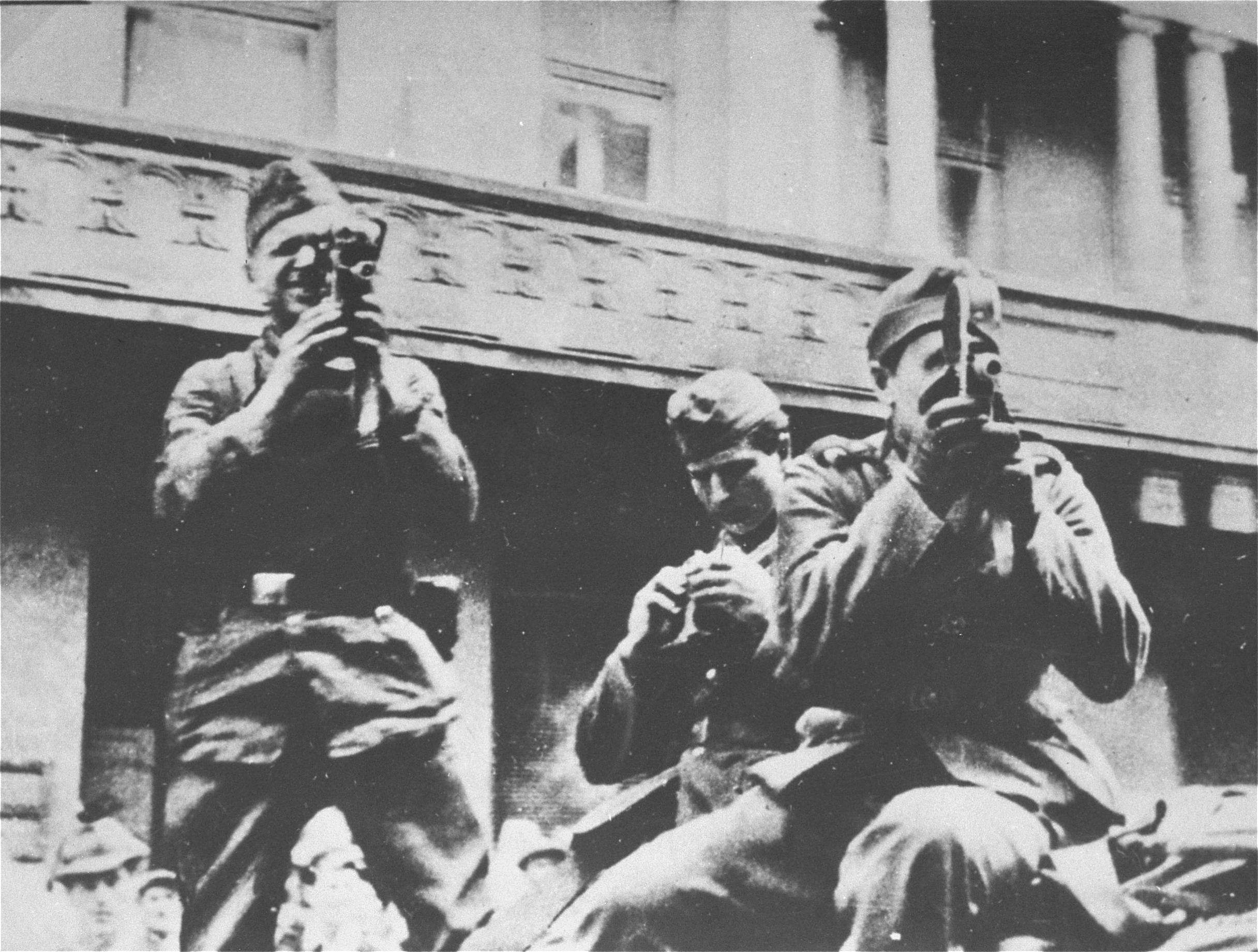
This ISIS film uses a tried and true propaganda technique that has been employed, with varying degrees of success, by various perpetrators of mass violence. In the summer of 1941, following the German invasion of the Union of Soviet Socialist Republics, Goebbels sent teams of cameramen to film the discovery of the corpses of Ukrainians, Latvians, and others who had been tortured, mutilated, and finally murdered in prisons by the Soviet secret police prior to the arrival of the German army. In Berlin, he then used the footage to create emotionally potent newsreels for the German public and for use abroad. Goebbels, like Hitler and the other leaders, viewed the campaign against the Soviet Union as a war to destroy "Judeo-Bolshevism." Nazi propaganda thus had to incite hatred of the Jews and emphasize a "real" Soviet threat to European society.

Members of a German military propaganda unit in Lviv, Ukraine, summer 1941
Above: Members of a German military propaganda unit in Lviv, Ukraine, summer 1941. (U.S. Holocaust Memorial Museum, courtesy of Yad Vashem Photo Archives)

The cinematic narrative of these German newsreels took the form of a morality tale. The bodies were hauled out of the prisons, accompanied by the painful crying of the local populace; the perpetrators of the crimes were identified; and retribution dispensed. The Nazis falsely attributed the atrocities to Jews in order to whip up public support for their radical antisemitic policies. Nazi propagandists understood that psychologically, audiences, whether on the ground or in theaters, would demand immediate and swift justice for such crimes. And they were not mistaken.

After seeing these newsreels, moviegoers in Germany and Hungary demanded harsher measures against the Jews. Within weeks of this propaganda campaign, the German government ordered all Jews in the Reich to wear a yellow Star of David on their clothes and began deportations to the ghettos in occupied Poland and the Soviet Union. What audiences didn't see were the mass shootings of Jews carried out by the SS and local collaborators in "reprisal" for Soviet atrocities.

German officials recognized that photographs and footage of Nazi-sponsored murder could be used with great effect by Allied propagandists as evidence of German war crimes. As a result, the German Army and the SS repeatedly prohibited troops from taking pictures of mass killings and executions. Existing prints and negatives were to be confiscated. German soldiers, however, continued to photograph these horrific scenes in spite of the bans and some of these images did fall into Allied hands.

ISIS propagandists have no such fears. Killings are stage-managed in front of the cameras and often shown in grisly detail to dramatize the deaths. The propaganda message is crystal clear: those being put to death are guilty of killing innocent Muslims and must be punished.

While it is difficult to gauge public opinion in the ISIS-occupied areas of Syria and Iraq, at least some of the population under its rule respond positively to that message. The cinematic brutality of these films has not dissuaded young men and women from leaving Europe and even the United States to join the terrorists.

To hard core supporters of ISIS, the video will continue to resonate since it reinforces all the themes that have garnered the terrorist organization recruits and sympathy outside of Iraq and Syria: Islam is under attack by crusaders and Jews, assisted by Muslim traitors, and that violence against Islam's internal and external enemies is necessary and justifiable.

While the Islamic State is not Nazi Germany, there are some lessons that can be drawn from the past. Long before the United States entered the Second World War, American lawmakers, government officials, religious leaders, and journalists recognized the dangers that Nazi propaganda represented to a free society. They publicly exposed Nazi machinations in this country and elsewhere, which reduced the appeal of Berlin's messages. But, just as importantly, the Allies created effective counter-propaganda, using radio--the Internet of its time--to broadcast around the world, including into the heart of the Reich. Counter-propaganda alone did not defeat Nazi Germany, it took the combined military and industrial might of the Allies to destroy the Third Reich.

Defeating ISIS too will require not just a military solution, but a similar multi-faceted approach that degrades its communications by diminishing the power and appeal of its propaganda to its targeted audiences.

http://flip.it/oK7fL